

- Home
- Blog
- Event Host Blog
- Christmas games for family: games the whole family can play together
Christmas games for family: games the whole family can play together
 By Kevin Durham, event host and MC
25 October 2026 · updated 10 November 2026
8 min read

In short
- The best Christmas games for family are the ones a seven-year-old and a seventy-year-old can both win: short rounds, mixed-age teams and nothing that needs fast reading.
- The games below work in a living room on Christmas Day, from charades and a homemade survey game to a parade of presents to memorise.
- Mix the generations in every team. The BBC built a whole Saturday-night show on that idea.
- For a bigger family Christmas party, split the room into two sides and rotate who plays each round, so nobody spends the afternoon watching.
- Plan the order: something active before lunch, something seated after it, charades once everyone has had a sit down.
Christmas games for family have a harder job than any other party game. They have to work for a child who can’t read yet, a teenager who would rather be on their phone, and a grandparent who remembers playing the same game in 1975. When it works, the day has a centre. When it doesn’t, three people play while everyone else finds a reason to do the washing up.
The appetite is there. In a December 2019 poll, half of Britons expected to play a board game on Christmas Day. Only 21% expected charades. I’d read that as a verdict on how charades usually gets run, not on the game itself.

What makes good Christmas games for family?
Good Christmas games for family give every age a real chance of winning. That means short rounds, teams that mix the generations, and rules you can explain while someone is still carving.
Mixing ages is not a new idea. When the BBC launched The Generation Game in October 1971, each team was two relatives from different generations, usually a parent and a son or daughter. Family Fortunes, which reached ITV in January 1980, used teams of five from the same family. Both knew what I’d tell any family at Christmas: you are better as a team than as rivals.
My rules for keeping it fair:
- Put the youngest and the oldest on the same side. Nobody can sulk about losing to Grandma.
- Avoid anything that rewards reading speed. Read questions aloud, or pair a young child with an adult who reads for them.
- Keep rounds under five minutes, so a bad round is over before anyone minds.
- Let people sit a round out without comment.
Simple games do more than fill the afternoon. In one randomised trial, preschoolers who played a numbered board game did measurably better on number tasks than children who played the same game with colours. Snakes and ladders after lunch counts as homework.
Christmas Day games for family in the living room
These need paper, pens, a tray and whatever is under the tree. Nothing else.
- What’s missing from the tree. Put ten small decorations on a tray, give everyone 30 seconds to look, then cover it. The NSPCC suggests a memory game like this for ages four and up: write down what you remember, or take one object away and guess which. It is Kim’s Game, named after Kipling’s 1901 novel, with tinsel.
- Carol dice. Also from the NSPCC: give each number on a die a rule (whisper, jog on the spot, adults only) and whoever rolls sings a carol under that rule.
- Yes and No. One person thinks of something, everyone else asks questions that can only be answered yes or no. Dickens has Scrooge’s nephew play it at his party in A Christmas Carol, and the answer turns out to be Uncle Scrooge. I’d allow a relative in the room as the answer.
- The survey game. Before lunch, hand everyone the same five questions on slips: name something Grandad says every Christmas, name a food nobody actually eats. Tally the answers, then play two teams guessing the top answers, three wrong guesses and the other side can steal.
- The present parade. One person walks a tray of ten to fifteen objects slowly past the team, then takes it away. The team has 45 seconds to name as many as they can, as the conveyor belt contestants did on television. Always include a cuddly toy.
- Cracker joke-off. In November 2025, 64% of Britons said pulling crackers is part of their Christmas. The London confectioner Tom Smith patented his first cracker in 1847 with a love motto inside; the jokes came later. Read each joke’s set-up and let the other team guess the punchline. A point for a right answer, two for a better one.
- Higher or lower. Deal a row of playing cards face down. Turn the first, and the team calls higher or lower for each card along the line.
- Pass the parcel. Wrap a small prize in layers, with a forfeit or a question between each one. Stop the music for every player in turn so the youngest are not left out.
How do you play Christmas charades?
You play Christmas charades by acting out a festive film, song, book or phrase without speaking while your team guesses against the clock. Teams of mixed ages, a one-minute timer and a hat of folded slips make it work.
The game began as a written riddle in 18th-century France and became an acted parlour game in Britain in the 19th century. Thackeray’s Vanity Fair and Brontë’s Jane Eyre both feature it. The signals are still the same:
- Fingers up for the number of words, and fingers on the forearm for syllables.
- Crank an old film camera for a film, open your hands like a book for a book, mime singing for a song.
- Tug your ear for “sounds like”.
For prompts, mix the easy with the silly. Try films like Elf, Home Alone and The Snowman, carols like Jingle Bells and Silent Night, and actions like wrapping a present badly or pulling a cracker with someone who won’t let go. Let small children act with an older partner, and give them pictures instead of words.
Which Christmas family games work for adults too?
The Christmas family games that work for adults are the ones where general knowledge and family memory count for more than speed. That way the adults have something to do and the children can still score.
The survey game is the best of these, because the answers come from the people in the room. Yes and No works better with adults playing, because their choices get stranger. A family quiz works well if each generation writes one round for another: the children set a round on their favourite things, the grandparents set one on 1970s television.
If the adults want their own games later in the evening, there are more adult party games that suit a grown-up crowd.
How do you run Christmas games for family at a bigger party?
To run Christmas games for family at a bigger party, split the room into two big sides and rotate different people up to play each round.
Fixed teams mean the same five people play all afternoon, and the rest become an audience. Rotating means most of the room gets a turn. It is my signature move with Family Fortunes, and it works just as well with a tea tray and a room full of cousins.
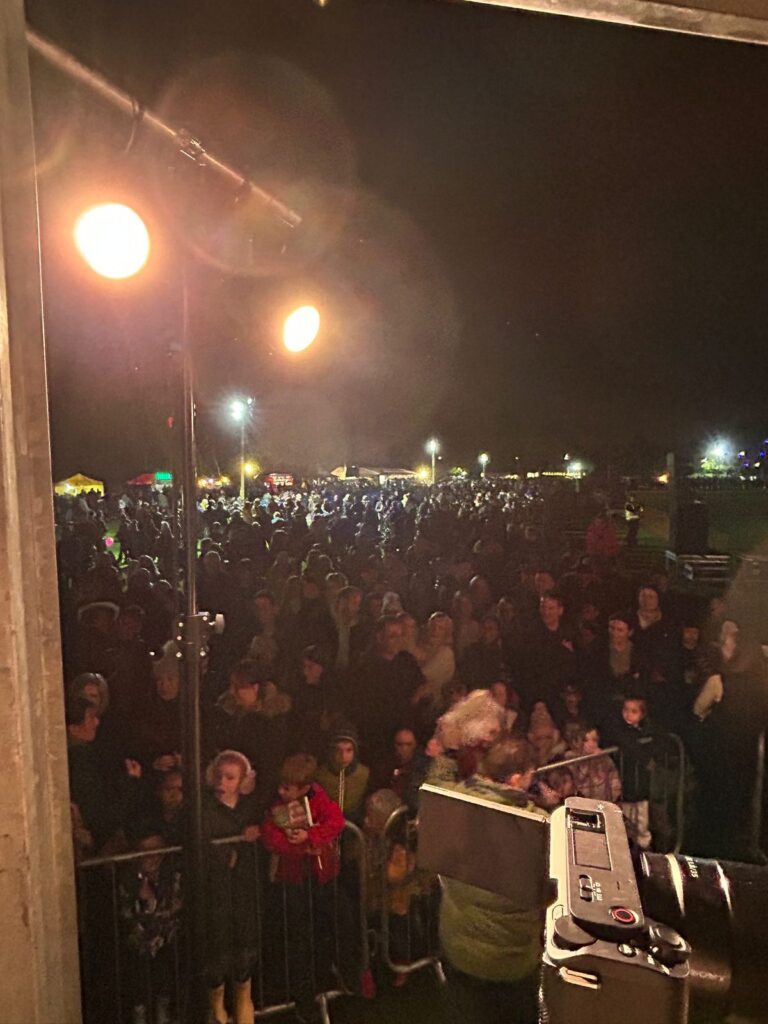
That matters at a big family get-together, a company family Christmas party or a community event, where the age range is wider and the room is noisier. A few things change once you get past twenty people:
- Run games in short bursts between the food, the presents and the visit from Father Christmas, rather than as one long block.
- Use table teams for anything written, so nobody has to stand up to take part.
- Keep one game for the end that the whole room plays at once, so the last thing everyone remembers is joining in.
- If the event is being photographed, follow the organiser’s photo policy. The NSPCC says children should never be excluded from an activity because consent wasn’t given. A sticker telling the photographer works better.
How do you keep every age playing?
You keep every age playing by giving everyone a job, not just a turn. A child who keeps the timer, a grandparent who keeps the score and a teenager who reads the questions are all in the game even when they are not answering.
Handicaps help too. Give the under-tens an extra clue, or let them answer first. Rotate the teams after each game so the same side doesn’t win all day. And end every round on applause, whoever won it.
A running order for Christmas Day games
This is the order I’d use, because most Christmas Days have the same shape and the games work best when they fit it.
- Morning, after presents: the present parade and what’s missing from the tree, while the children are still awake.
- Before lunch: hand out the survey questions, so the answers are ready later.
- After lunch: sit-down games. The survey game, Yes and No, a board game or higher or lower.
- Early evening: charades, once everyone has had a rest and some confidence has come back.
- Last thing: carol dice or a cracker joke-off, quick and loud, to finish on a laugh.
How I run family Christmas games as a hosted show
At a family event the room holds every age at once, which is exactly what game shows were built for. I run them on my own software, with every game written for the people in front of me, so a children’s Christmas party, a company family day and a community event each get a different show.
Two of them are made for families:
- Family Fortunes. I write the survey questions for that audience, then split the whole room into two sides and rotate the players every round, so as many people as possible get to the front and nobody stands there long enough to get nervous.
- The Generation Game. I pick the games to suit the crowd before the conveyor belt finale. At one family event we ran an egg-and-spoon race judged on the silliness of the walk, not who finished first.

More party game ideas
- Family quiz questions that work for all ages.
- Family Fortunes questions and answers for a party or work night.
- Minute to win it games for work parties.
For a company family party in December, the Christmas party entertainment page shows how the games run. One host, the whole afternoon. Call me on 07596 851647 and tell me who is coming.