
- Home
- Blog
- Event Host Blog
- Christmas lights switch on: how to plan and host a town switch-on event
Christmas lights switch on: how to plan and host a town switch-on event
 By Kevin Durham, event host and MC
25 October 2026 · updated 10 November 2026
8 min read
In short
- A Christmas lights switch on is a big outdoor event squeezed into a dark winter evening, so plan it like one: road closure, safety advisory group, licensing and fireworks, months ahead.
- The running order builds to one moment. Put acts before the countdown and after it, so people arrive and leave in waves.
- The countdown needs a rehearsed cue between the stage and whoever actually turns the lights on, plus a plan for when they don’t come on.
- Crowd safety is the biggest job of the night: people arrive in daylight, leave in the dark and all want the same view of the same tree.
- Whoever holds the microphone is running the evening, so brief them like a member of the safety team.
A Christmas lights switch on looks simple from the crowd: a stage, a few acts, a countdown, and the town goes bright. For the organiser it is a road closure, licensing, fireworks and a few thousand people in a square in the dark, all building to about ten seconds.
I’ve hosted family festival events with crowds past 80,000, with multiple stages, changing weather and running orders that changed at the last minute. A town switch-on is the same job in a smaller, colder space. Here’s how I’d plan one, and how I’d host it.
How do you organise a Christmas lights switch on?
You organise a Christmas lights switch on by working backwards from the date: book the lights, tell the council early, sort the permissions, then build the stage programme around the countdown. Most of the hard work is done by early autumn.
A rough timeline:
| When | What to sort |
|---|---|
| Spring or early summer | Date, budget, lighting contractor, who leads (council, BID, shopping centre) |
| At least three months out | Notify the council events team and safety advisory group |
| Two to three months out | Road closure, licensing, fireworks operator, stage and sound |
| Six weeks out | Acts confirmed, running order drafted, stewards briefed |
| Final week | Lighting test, site walk, host briefing, wet-weather call agreed |
Get one person to own the running order. Committees are good at choosing acts and bad at deciding at 5.40pm whether the fireworks go before or after the thank-yous.
What permissions does a switch-on need?
A town switch-on usually needs a road closure, a conversation with the council’s safety advisory group, and a check on licensing, music and fireworks. The detail depends on your council, the crowd and what’s on the stage.
Road closure. The government’s Can do guide says most councils want four to six weeks’ notice to close a quiet street, and several months for a busy or main road. A town centre is nearly always the second kind.
The safety advisory group. Most councils run one. East Devon’s SAG guidance is typical: it asks for at least three months’ notice for events expecting 500 or more people, or involving pyrotechnics, road closures or alcohol. A SAG can’t approve or ban your event, and the organiser keeps prime responsibility for safety.
Alcohol and licensed areas. A Temporary Event Notice costs £21 in England and Wales (October 2026), covers fewer than 500 people at any time, staff included, and has to be in at least 10 clear working days ahead. That suits a fenced mulled-wine bar, not the whole square.
Entertainment and music. Plays and dance need no licence between 8am and 11pm for audiences of up to 500, but larger street and open-air festivals may need one. Ask the licensing team early, as music on local authority premises has its own exemptions. Separately, playing music in public usually needs TheMusicLicence from PPL PRS.
Fireworks. HSE says category 4 fireworks are for professional operators only, and that major displays need marked-out spectator and firing areas, a safety zone and a clear fall zone. Wind direction gets rechecked on the day.
Martyn’s Law. The Terrorism (Protection of Premises) Act 2025 got Royal Assent on 3 April 2025, with an implementation period of at least 24 months, and there’s no legal duty until it comes into force. An event only qualifies if 800 or more people are expected and there are access checks such as tickets or payment, so a free open street usually falls outside it and a ticketed enclosure may not.
What does a Christmas lights switch-on running order look like?
A Christmas lights switch-on running order builds steadily to the countdown, with a strong act before it and something worth staying for after it. HSE suggests entertainment before and after the main event as a way to stagger arrivals and departures, which matters when the whole town wants the same minute.
Here’s the shape I’d use for a three-hour evening:
| Time | On stage | Around the square |
|---|---|---|
| 15:30 | Music playing | Stalls open, road closed, stewards in place |
| 16:00 | Welcome: what’s on, first aid, the meeting point | Families arriving |
| 16:15 | School choir | |
| 16:40 | Dance school | |
| 17:00 | Crowd game | Square filling up |
| 17:15 | Headline act | Crowd at its densest |
| 17:40 | Switch-on guest, short sponsor thanks | Fireworks zone clear |
| 17:50 | The countdown, lights on, fireworks | |
| 17:55 | After-show act, Father Christmas arrives | First families leave |
| 18:45 | Goodnight and the way home | Stewards on exits |
The thank-yous go before the countdown, not after. Once the lights are on, nobody is listening to a list of sponsors.
Christmas lights switch-on ideas and entertainment
The best Christmas lights switch-on entertainment is local. People come to watch someone they know: their child in the choir, their neighbour’s dance school, the panto cast from the theatre down the road.
What I’d put on a switch-on stage:
- School and community choirs. Two or three songs, and every parent in the square is watching.
- A dance school: bright costumes, one big track, done in five minutes.
- The panto cast, with a song and a plug for the show.
- A lantern parade that arrives in the square just before the countdown, so the crowd builds behind it.
- Crowd games. Something the whole square can play at once, like Heads or Tails, or a Family Fortunes round with the square split in two.
- The switch-on guest. A local hero often lands better than a celebrity: the lollipop lady who’s retiring, the fundraiser everyone knows, the oldest resident.
- Father Christmas arriving after the countdown, which gives families a reason to stay and spreads the departures out.
My guide to family fun days covers stage games for daytime crowds.
How do you run the countdown?
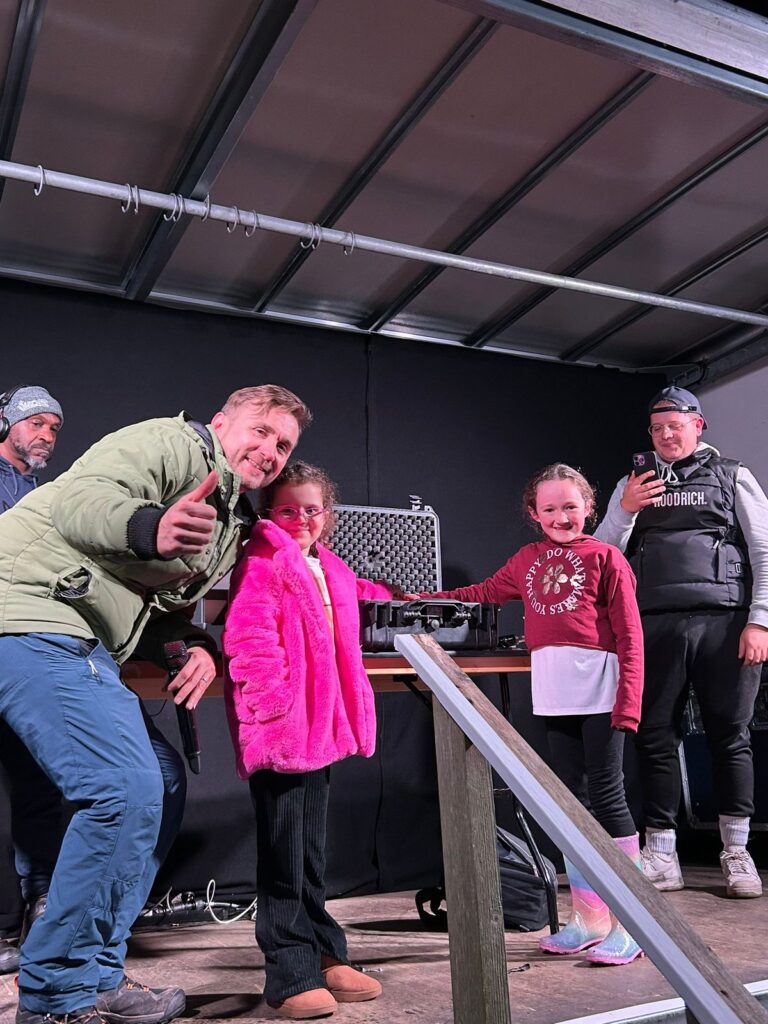
You run the countdown by rehearsing one agreed cue between the stage and whoever is actually switching the lights on, then filling the seconds after with something big. The plunger on stage is theatre. The real switch is with the lighting contractor.
What to agree before the night:
- The cue. The host counts down from ten and the lights go on at “one”, not on “lights” or a beat later. Everyone on the radio knows which word it is.
- One channel. Host, stage manager, lighting contractor and fireworks operator on the same radio channel for the last five minutes.
- A test. Run the lights the evening before, and walk through the countdown in daylight on the day.
- The guest’s job. Where to stand, when to press, and to look at the crowd, not the button.
- Plan B. If the lights don’t come on, the host keeps talking, the contractor fixes it, and the crowd does the count again. A second countdown can get a bigger cheer than the first, if nobody on stage panics.
- What happens next. Fireworks, music or snow within seconds of the lights. A ten-second count followed by silence is the worst moment of the night.
How do you keep a switch-on crowd safe?
You keep a switch-on crowd safe by planning for the dark, the density in front of the stage and the rush to leave once the lights are on. HSE flags that people who arrive in daylight and leave in darkness can get disorientated, so lighting matters along the exit routes as well as on the tree.
The same guidance suggests splitting an outdoor site into zones: arrival and exit points, viewing areas, and the areas around bars and the stage. A town square is all of those at once.
Practical checks:
- Estimate the crowd from last year’s numbers, the publicity and the forecast.
- Keep the grotto and food queues off emergency routes.
- Agree with the police what happens if the square fills.
- Lost children need their own plan. Council guidance says the child’s name must never go out over the PA. Use a neutrally named control point, staffed by two DBS-checked people.
- Decide in advance who makes the weather call if the wind gets up, and what the crowd hears.
The Purple Guide is the industry’s own event safety guide, with a Lite version for smaller community events.
Why a stage host holds the evening together
Everything that changes on the night goes through the microphone. The headline act is late, the rain starts, the fireworks are held for wind, the square is too full. Someone has to tell a few thousand people without the mood dropping.
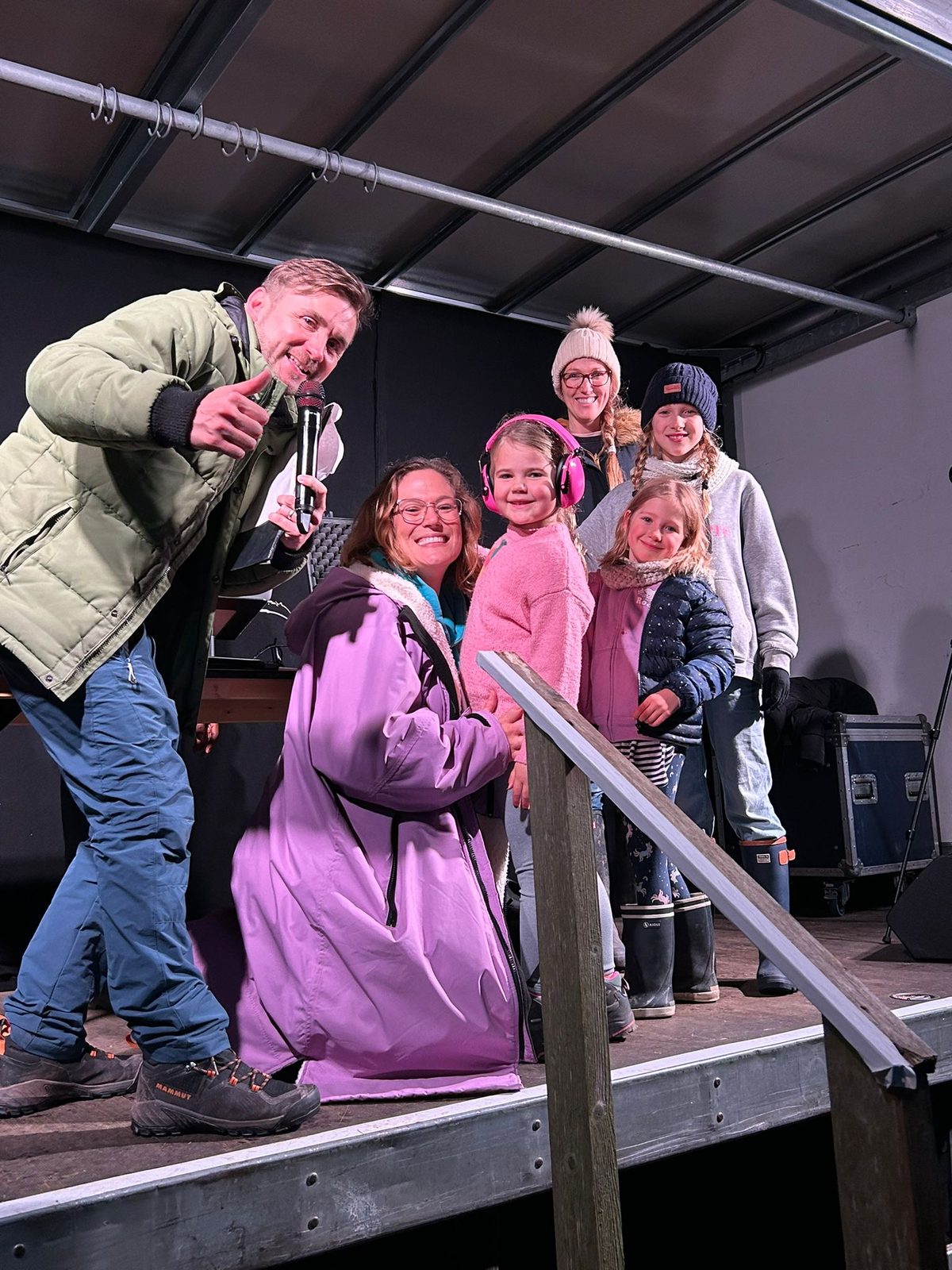
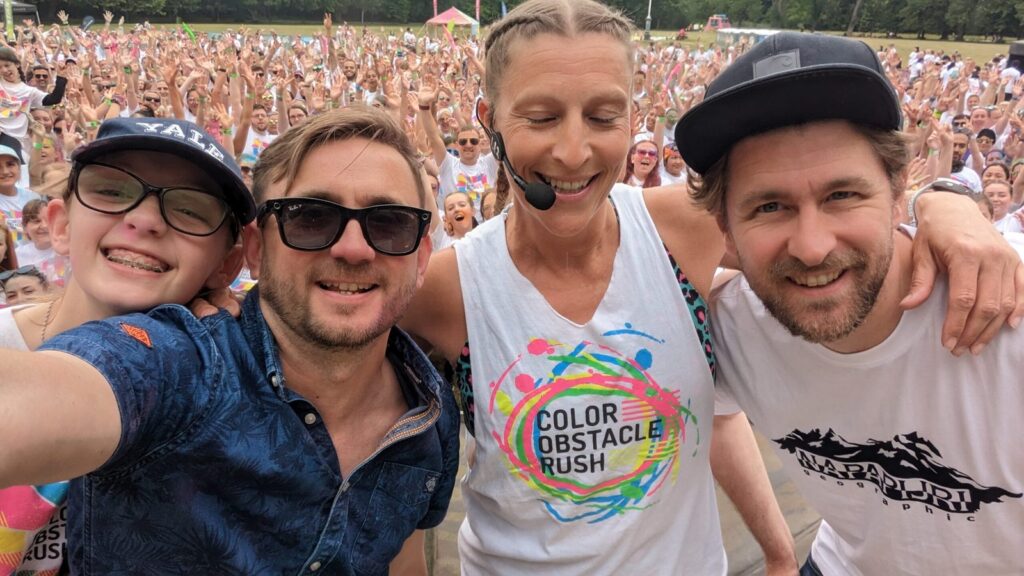
At festivals with crowds past 80,000, the skill I’ve relied on is adapting live without it showing. You can’t let the microphone do the work, and you can’t afford a dead minute, because a crowd is always one dull moment from drifting off. At a switch-on, a dead minute in the cold sends families home before the countdown.
How I’d host your Christmas lights switch-on
I’d treat your Christmas lights switch-on as one show that builds to the countdown, not a list of acts read out in order. Most of the work happens before the night, so I’d want the running order, the safety plan, the lost-child procedure, the cue words for the lights and the wet-weather call before I’m anywhere near the stage.
On the night I’d open the square, bring on the acts, run the crowd games and count the town down. The games are my own, built on my own software, and I write them for the crowd that turns up. A square full of families gets a different show from a corporate room, and it should.
More guides
- Christmas family games the whole family can play together.
One host. The whole evening. You can see more on my festival presenter page, and if you’re planning a switch-on, call me on 07596 851647 and tell me about the square, the crowd and what went wrong last year.