
- Home
- Blog
- Event Host Blog
- General knowledge quiz for adults: 42 questions graded easy to hard
General knowledge quiz for adults: 42 questions graded easy to hard
 By Kevin Durham, event host and MC
29 October 2026 · updated 10 November 2026
7 min read
In short
- A general knowledge quiz for adults works best graded: an opening round nearly everyone scores in, a middle round that decides it, a hard round at the end.
- Below are 42 questions and answers in three tiers, plus a tie-breaker with a number for an answer.
- I checked every answer against a source and dropped four as disputed or liable to date.
- Balance the subjects. Four sport questions in a row ends the night for the table with no sports fan on it.
- Six to eight rounds of ten fills about two hours. Around a dinner, two or three sharp rounds is plenty.
Most question lists online are written for anyone. A general knowledge quiz for adults has a harder brief: grown-ups who have all seen a quiz before, who spot a question with two right answers, and who stop playing the moment they feel out of their depth.
So this set is graded by difficulty, not subject, because difficulty decides whether a table stays in. For themed rounds there are quiz round ideas, and a longer subject-by-subject set of pub quiz questions.
What makes a good general knowledge quiz for adults?
A good general knowledge quiz for adults has one checkable answer per question, a visible climb in difficulty, and no subject hogging the round.
The climb matters. If the first five questions are hard, the room decides early that this quiz is not for them, and you spend the night winning them back.
- One answer, checkable. If two people can argue two answers with a straight face, I bin it.
- Grade it honestly. Hard means hard for the room in front of you. A graduate intake and a board of directors do not share a hard round.
- Spread the subjects so no single interest dominates.
- No questions that will age. Anything phrased “currently” or “the most” needs re-checking every year, and nobody re-checks.
How many questions should a general knowledge quiz for adults have?
For a standalone quiz night, six to eight rounds of ten questions is the usual shape. Parentkind’s quiz night checklist puts ten per round across six to eight rounds at about two hours, and Marie Curie’s fundraising guide suggests 50 to 80 questions split over five to ten rounds.
A quiz inside a corporate evening is a different animal. Nobody came for the quiz, dinner is still arriving, and the room gives you twenty minutes of attention at a time. Two or three rounds of ten between courses beats eight that outlast the coffee.
The 42 below are three rounds of fourteen: run them as they are, or take ten from each tier and keep the rest.
How do you balance the subjects so no table is locked out?
Balance them by giving each subject a fixed share of every round rather than grouping them. The World Quizzing Championship splits its 240 questions into 30 each across eight broad categories, which is the principle in its purest form: nobody dodges a subject, nobody drowns in one.
Six categories is plenty for a work quiz: science and nature, geography, history, arts and books, sport, everyday life. Two or three per subject per round, shuffled so no subject runs twice in a row.
The test: picture the table with no sports fan, no reader and no scientist on it. Can they still score five out of ten?
Round one: the questions almost everyone gets
Fourteen openers. Most tables score eleven or twelve, and that is the point: a team that scores early stays all night.
- Which planet is known as the Red Planet? Answer: Mars.
- How many players from each team are on a netball court? Answer: seven.
- What is the currency of Japan? Answer: the yen.
- Which gas makes up most of the air we breathe? Answer: nitrogen, at just over 78%.
- Which country gave the Statue of Liberty to the United States? Answer: France.
- What is the hardest naturally occurring substance? Answer: diamond.
- How many wives did Henry VIII have? Answer: six.
- What is the tallest land animal? Answer: the giraffe.
- How many strings does a standard violin have? Answer: four.
- What do the letters WWW stand for? Answer: World Wide Web.
- What colour is the circle on the flag of Japan? Answer: red.
- Which element is number one on the periodic table? Answer: hydrogen.
- Who wrote Pride and Prejudice? Answer: Jane Austen.
- In which sport is the Ryder Cup contested? Answer: golf.
Round two: the questions that decide the night
This is where the scores separate. Each one is gettable by six adults talking it through.
- What is the longest bone in the human body? Answer: the femur.
- Who composed The Four Seasons? Answer: Antonio Vivaldi.
- In Greek mythology, who is the god of the sea? Answer: Poseidon.
- What is the capital of Morocco? Answer: Rabat, not Marrakech or Casablanca.
- In which year did the Berlin Wall come down? Answer: 1989.
- Who painted The Starry Night? Answer: Vincent van Gogh.
- What is the chemical formula for table salt? Answer: NaCl.
- What is the highest mountain in Africa? Answer: Kilimanjaro.
- Which country has the longest coastline in the world? Answer: Canada.
- In which year did the Channel Tunnel open? Answer: 1994.
- Who discovered penicillin? Answer: Alexander Fleming, in 1928.
- What is the SI unit of electrical resistance? Answer: the ohm.
- In which Indian city does the Taj Mahal stand? Answer: Agra.
- Who was the first woman to win a Nobel Prize? Answer: Marie Curie, for physics in 1903.
Round three: the hard questions for the end
Nobody should sweep this one. Expect six or seven out of fourteen from a strong table, and say so before you start, so a low score reads as design rather than failure.
- Which element has the chemical symbol W? Answer: tungsten.
- What is the smallest bone in the human body? Answer: the stapes, in the ear.
- Who wrote the novel Things Fall Apart? Answer: Chinua Achebe.
- In which year was the Treaty of Versailles signed? Answer: 1919.
- Who composed the opera The Magic Flute? Answer: Mozart.
- What is the deepest oceanic trench on Earth? Answer: the Mariana Trench.
- What is the largest island in the world? Answer: Greenland.
- Who wrote the play A Doll’s House? Answer: Henrik Ibsen.
- How many time zones does Russia have? Answer: eleven.
- Which number does the Roman numeral D stand for? Answer: 500.
- Rosencrantz and Guildenstern appear in which Shakespeare play? Answer: Hamlet.
- In which year was the first Tour de France held? Answer: 1903.
- In which year did the Chernobyl disaster happen? Answer: 1986.
- In which year was the NHS founded? Answer: 1948, on 5 July.
What makes a good tie-breaker?
A good tie-breaker has a number for an answer, so the nearest guess wins outright and nobody shares the trophy. Ask: how tall is the Shard in London, in metres?
The answer is 309.6 metres. Write it on the answer sheet beforehand: the only thing worse than a draw is a host doing mental arithmetic in front of 200 people.
Which questions should you leave out?
Leave out any question whose answer is disputed, moves with the news, or depends on how you measure it. Four came out of this set.
- What is the capital of Switzerland? Bern is the seat of government, but Switzerland has no official capital in law.
- Which planet has the most moons? It changes as new moons are confirmed. Any answer you print has a shelf life.
- Which is the most expensive spice? Saffron is the stock answer, but I could not find a reliable source that settles it, so the question went.
- How many countries are there? It depends who you count and who recognises whom.
A quiz loses the room over a wrong answer on the sheet faster than over a hard round.
How do you read the questions out?
Read each question twice, name the subject first, and say what you will accept before anyone argues.
Naming the subject (“this one’s geography”) gives the table a second to work out who is answering. It is the difference between a brisk round and one where every question starts with “sorry, what?”.
Write the accept-list in advance. If “Marie Curie” and “Maria Sklodowska-Curie” both score, decide that at your kitchen table, not in front of the room.
How I run a general knowledge quiz as a show
A list like this works in a pub because the people who turned up chose a quiz. At a corporate dinner or a family day nobody chose it, and one pen per table leaves most of the room watching someone else write.
So I run general knowledge as a show instead, on software I write myself, with the questions written for the people actually in the room. Three ways to play the set above:

- On every phone. With Quiz Live, every guest answers on their own handset against a countdown, and the leaderboard comes up between rounds. Nobody leans on the one confident person at the table.
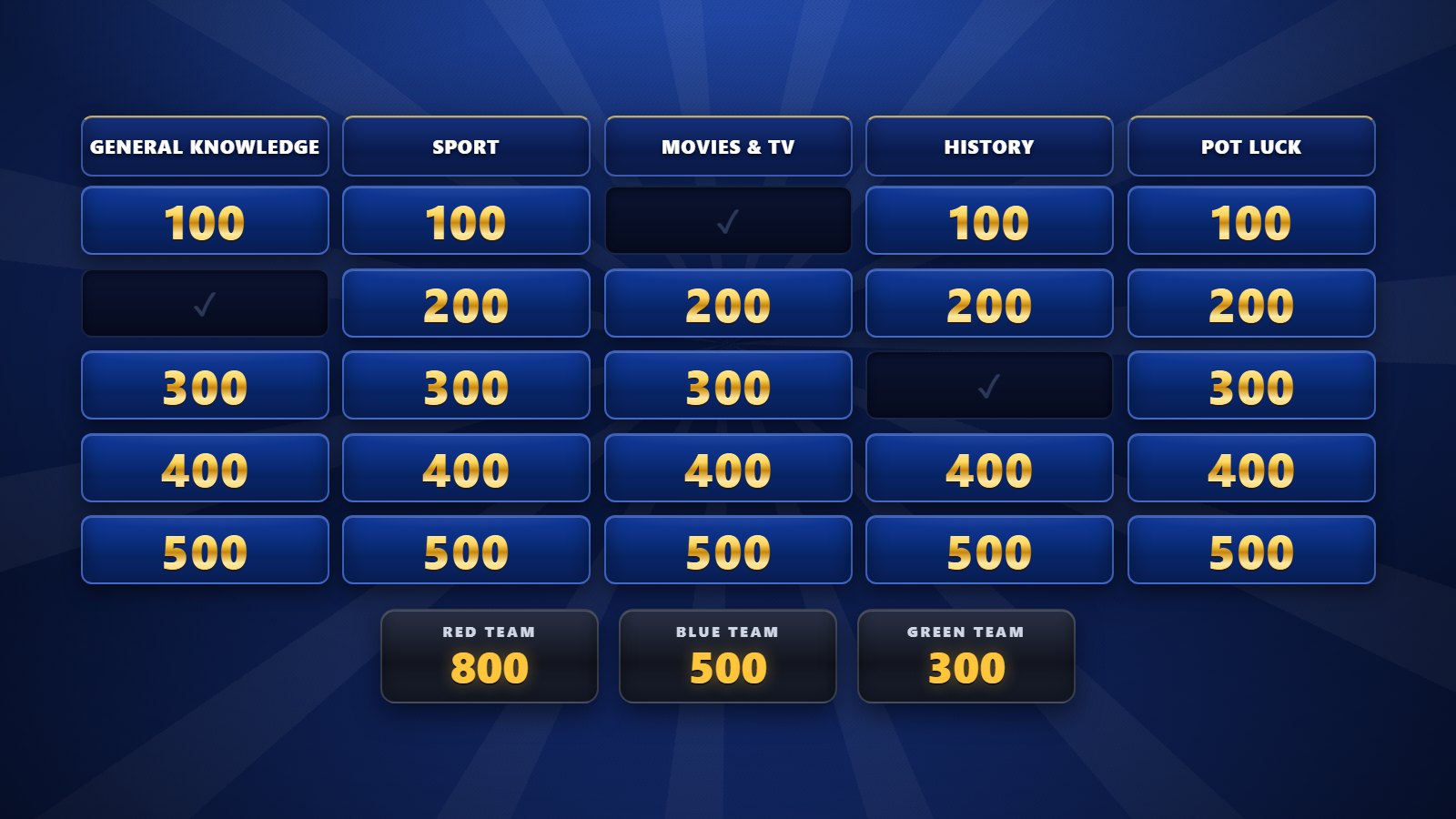
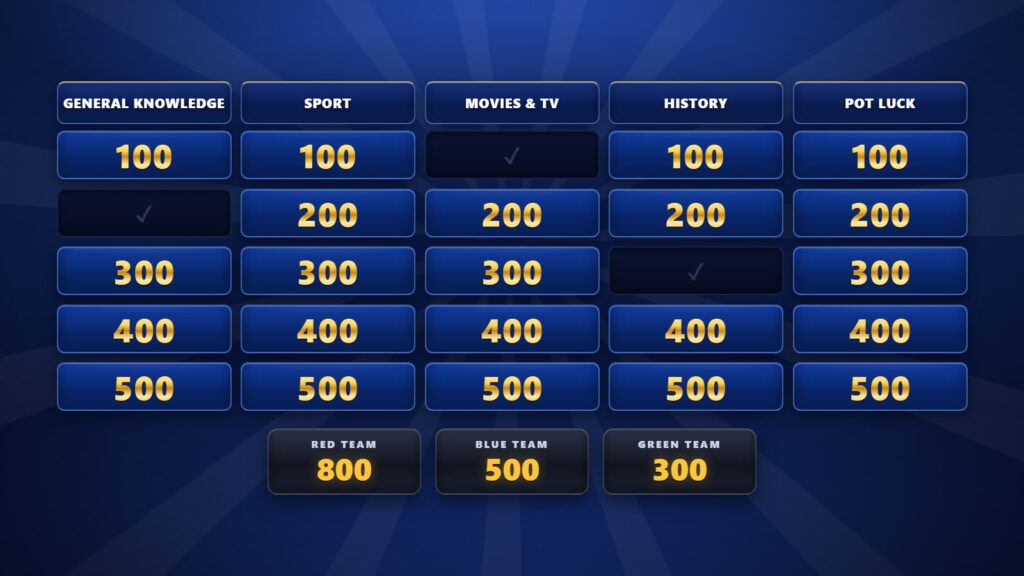
- On the big screen. The three tiers become three value bands on a Quiz Show board: easy at the bottom, the hard round at the top, teams picking and stealing.
- As a knockout. The whole room starts in and the lowest scores drop out each round until one player is left.
I also split a room into two big teams and rotate who answers each round, so as many people as possible play rather than watch. The best round is usually the one nobody could look up: fourteen questions about the company, the year it has had and the people in the room.
If you would rather hand the whole thing over, I will write the rounds, run the software and host it as your quiz master. Ring 07596 851647 with the date and a rough headcount.