
- Home
- Blog
- Event Host Blog
- Guess the song quiz: how long to play the intro, and how to run the round
Guess the song quiz: how long to play the intro, and how to run the round
 By Kevin Durham, event host and MC
28 October 2026 · updated 10 November 2026
7 min read

In short
- A guess the song quiz is an audio round: teams hear the opening seconds of a track and write down the song.
- Five seconds is a kind clip and two seconds is hard. Lab studies get recognition from under half a second, but a function room is not a lab.
- Build the running order from each decade’s biggest sellers, easiest first.
- Score the title and the artist separately, and make the audio round worth more than a written one.
- Playing recorded music to a room is a public performance in the UK, so somebody needs a music licence. Usually the venue.
There is a particular noise a room makes during a guess the song quiz when it recognises a track in two notes. Half the tables groan, one shouts the answer at the ceiling, and somebody at the back starts conducting. No written round does that.
I host quizzes for companies, charities and family events as a quiz master, and a guess the song quiz is the round I get asked for most. It is also the one most likely to go flat, because three decisions get made badly: clip length, running order, and whether anyone checked the sound. The wider menu of formats is in my music round guide. This one is only about the audio version.
How does a guess the song quiz work?
A guess the song quiz plays a short clip from the start of a track and asks teams to name it. Its strength is that the answer lands before anyone can think, so the whole room reacts at once.
The structure that works in a live room:
- Ten to twelve songs. After that the novelty has gone.
- Each clip twice. A few seconds of silence between the plays.
- A written answer sheet, or buzzers if you want a race rather than a round, which changes the whole feel of the thing.
- Answers at the end, with each chorus played underneath while people mark.
People skip that last one, and it turns the dullest part of a quiz into the bit where the room sings.
How long should the intro clip be?
Start at five seconds and work down to two. That gives the round a difficulty curve without you having to find harder songs.
The numbers here are stranger than you would expect. In one study of very short clips, listeners named both the artist and the title on more than 25% of trials from 400 milliseconds, and at 300 milliseconds identification dropped sharply while judgements of style, mood and even the decade of release held up.
A larger 2020 online study of 517 people found much lower rates: 0 to 7% identification across 48 very short pop excerpts, with longer clips recognised more often and a singing voice helping.
Both are true and both matter. People can recognise a track from a fraction of a second, but only sometimes, and those tests used headphones in quiet conditions. Your audience is listening through a function-room PA with 200 people talking and a kitchen door swinging.
So the practical ladder is five seconds for the first three songs, three for the middle four, two for the last three. Do not go below a second in a live room. You get silence instead of noise, and silence is the one thing an audio round cannot survive.
Where in the track should you cut the clip?
Cut from the first beat of the recording, not a point you pick by ear. Teams are listening for the opening they know, and a clip that starts 200 milliseconds late can sound like a different song.
Two levers change the difficulty without changing the song:
- Include the first sung word and it gets much easier. The 2020 study found a singing voice aided recognition, and the earlier research found people did better when the clip held a word or part-word from the title.
- Stop before the vocal and it gets much harder. The same track becomes a different question.
Choose songs with a hard opening: a drum fill, a riff, a synth stab, a count-in.
Slow fades are hopeless.
How do you build the running order across the decades?
Build it a decade at a time, taking one or two of the biggest sellers from each, then order the round easiest to hardest. Working from sales rather than taste stops you writing a round for yourself.
Official Charts publishes a best-seller list for each decade, a better starting point than a personal playlist. One caveat: the all-time list counts physical and download sales only, not streams, and the 1990s list is pure physical sales. Older decades are over-represented, which suits a mixed-age room. Two songs per decade from the 1970s to the 2010s gives you ten, plus a 2020s pair if the room skews young.
A ten-song guess the song quiz running order
Every song comes from the relevant Official Charts decade list. The clip column does the difficulty work.
| # | Song and artist | Decade | Clip |
|---|---|---|---|
| 1 | YMCA, Village People | 1970s | 5 sec |
| 2 | Eye of the Tiger, Survivor | 1980s | 5 sec |
| 3 | Blinding Lights, The Weeknd | 2010s | 5 sec |
| 4 | Barbie Girl, Aqua | 1990s | 3 sec |
| 5 | Don’t You Want Me, Human League | 1980s | 3 sec |
| 6 | I Gotta Feeling, Black Eyed Peas | 2000s | 3 sec |
| 7 | Shotgun, George Ezra | 2010s | 3 sec |
| 8 | Heart of Glass, Blondie | 1970s | 2 sec |
| 9 | Amarillo, Tony Christie | 2000s | 2 sec |
| 10 | Love Is All Around, Wet Wet Wet | 1990s | 2 sec |
The decades are shuffled on purpose. A round that marches from 1973 to 2019 tells the youngest table it can go to the bar for the first four questions.
How should you score a guess the song quiz?
Score the title and the artist separately, one point each, and weight the round above a written one. Twenty points over ten songs is clean to mark and gives half credit to the table that knows the tune but not the band.
Radio 2’s long-running quiz is a useful model. In PopMaster a standard question is worth three points, but the questions that involve listening to music are worth six. The audio question is priced at double, which is the right instinct.
The arguments are never about the songs. They are about the marking, so settle two things first:
- Accept the title without the brackets. Amarillo is the answer. Nobody writes a full parenthetical title on a damp answer sheet.
- Decide the half-mark rule before you start, and say it out loud. A table that writes the right artist and the wrong song gets one point, and they should hear that from you rather than find it on the leaderboard.
For a tie-break, borrow Three-in-Ten from the same programme: name an artist, and the table has ten seconds to name three of their hits.
Do you need a music licence for a guess the song quiz?
In the UK you almost certainly do, and in practice it is the venue’s, not yours. GOV.UK is direct: you need a single licence from PPL PRS, known as TheMusicLicence, and playing recorded music in public without one infringes copyright and you could be sued for damages.
Worth knowing:
- PPL PRS says music played outside a domestic environment counts as a public performance, so a quiz in an office or a hired hall is in scope, not just a pub.
- One licence covers virtually all commercially released music, and the price depends on the size of the business, the venue and how the music is used.
- For a one-off event, PPL PRS points new customers to a temporary permit, and existing licence holders can add it by amending their music usage.
- Charity and community organisations may qualify for a discount on events.
- Genuinely royalty-free music needs no licence.
- A personal streaming subscription does not solve it. Spotify’s terms grant permission to make personal, non-commercial use of the service.
I am a host, not a lawyer, so treat that as facts rather than advice. The practical move is one email to the venue asking whether they hold TheMusicLicence and whether it covers a function room. If the night arrives unlicensed, switch to a round that needs no audio.
Running the intro round on my own quiz software
I run the audio round inside my own game software. Every clip and answer screen is written for the audience in front of me: a graduate intake gets a different ten songs from a board of directors.

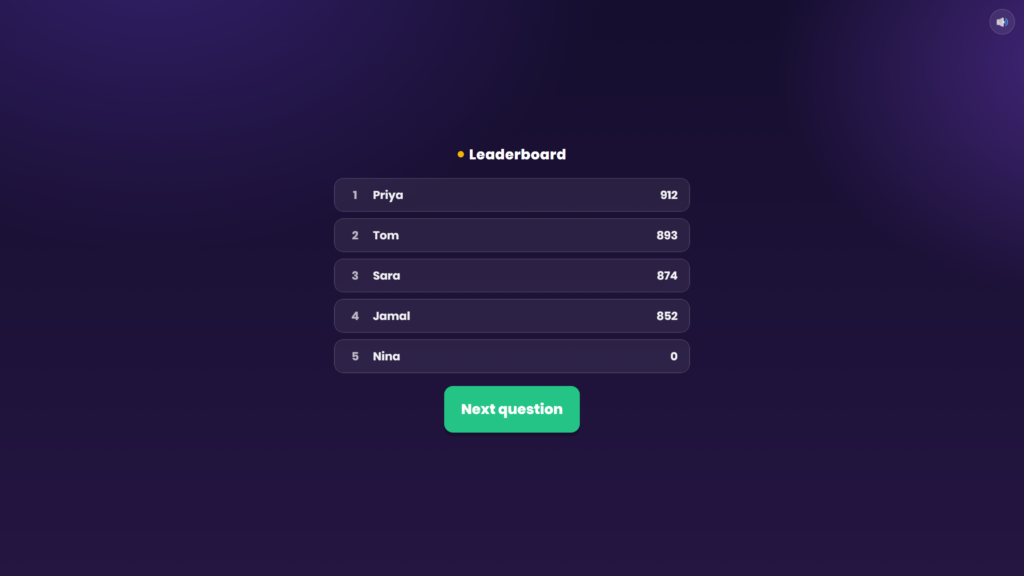
The quiz software also fixes what usually breaks an intro round: clip lengths are identical every time, the answer screens carry the artwork, and the leaderboard updates in front of the room instead of being read off a clipboard.
What actually goes wrong on the night
Sound, nearly always. Hosting is energy management as much as presenting, and an audio round nobody can hear kills a room in about forty seconds.
Test the volume from the furthest table with the air conditioning on, then again once people are in, because a full room absorbs sound in a way an empty one does not. Agree who touches the mixer.
The rest is preparation: agree the ten songs with the client, check nothing clashes with the walk-in playlist, and keep two spares for the moment a clip will not play.
If you want the round run for you, with the songs written for your audience, call 07596 851647 and tell me who is coming and what they sing along to.