

- Home
- Blog
- Event Host Blog
- Halloween party games for corporate and family events
Halloween party games for corporate and family events
 By Kevin Durham, event host and MC
28 October 2026 · updated 10 November 2026
7 min read

In short
- These Halloween party games are sorted into two rooms: a corporate party where half the guests came straight from their desks, and a family event where the youngest player is four years old.
- Most of them need a microphone, a screen and someone keeping the pace up, not a box of props.
- Four things need checking before the night: naked flames, costumes, flashing lights and food.
- There is a running order at the bottom, because the order you play them in decides whether the room stays.
- If you want questions as well as games, the Halloween quiz questions are already written and checked.
Most Halloween game lists assume a house, a craft box and a room full of people in costume. A work party or a village family day is nothing like that. Only 16% of GB adults dress up at Halloween, YouGov found in a survey of 2,069 adults in September 2025, and 51% do not mark it at all. Plan for the people in a jumper, not the cape.
What makes Halloween party games work?
A Halloween party game works when you can explain it in one sentence, play it sitting down, and stop it while people still want more. The rest is decoration.
Three things separate a game that lands from one that dies on its feet.
- No queue. If 60 people are watching four people play, you have a demonstration, not a game. Everyone should be doing something inside a minute.
- No costume required. Make dressing up worth points and you punish whoever came from a client meeting.
- A hard finish. Give every game an end condition: a score, a timer, a last player standing. Games without one trail off.
Halloween party games for a corporate event
An office Halloween party is a short window after work, with people who know each other too well. These six suit that room.
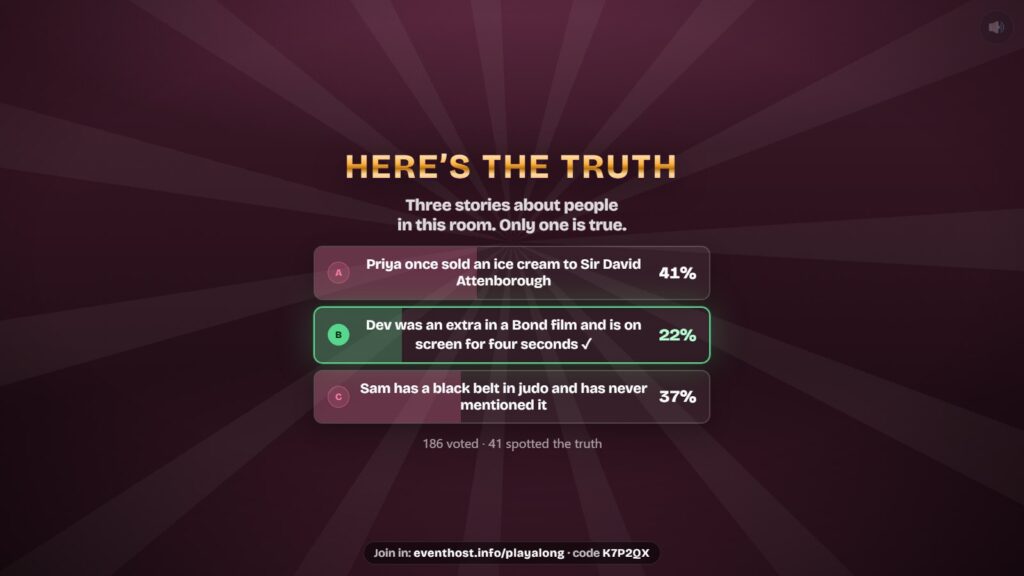
- Ghost story bluff. Three people each read out a “strange thing that happened to me” story. Only one is true, the room votes, then the truth is revealed. The best Halloween game for a work crowd, because it is about the people, not the pumpkins.
- Our survey says, haunted house edition. Run a survey-answer game with Halloween boards: name something in a haunted house, name a horror film everyone has seen, name something people are scared of but will not admit. I split the room into two teams and rotate a new pair in each round, so as many people as possible get to play.
- Describe a horror film badly. One person gets a film title and has 20 seconds to describe it without naming anything in it. Tables shout the answer. No preparation beyond a list of titles.
- The pumpkin race. Teams carve one pumpkin against a three-minute clock, judged on the face rather than the craft. The Guinness World Records mark for carving one pumpkin is 16.47 seconds, set by Stephen Clarke in 2013, so three minutes is generous. Send the flesh to the kitchen: Hubbub’s campaign exists because millions of pumpkins are bought and never eaten.
- Costume categories worth winning. Scrap “best costume”, which always goes to whoever spent the most. Award most accurate to their actual job, worst effort with the most confidence, and best use of stationery.
- The jar. Guess the number of sweets, written on a slip with a name. It runs in the background and hands you a winner when you need one.
What are the best Halloween party games for large groups?
The best Halloween party games for large groups are the ones where nobody waits for a turn: voting, guessing and knockout formats rather than anything played one person at a time.
I have hosted family festival events with crowds past 80,000, and the lesson scales down to a function room of 300. You cannot afford a dead minute, because that is when people go to the bar. Pick formats that absorb numbers:
- Knockout rounds. Everyone answers, the lowest scores drop out, repeat until one player is left. A room of 300 is down to a final two in about ten minutes.
- Room votes. Ask the question, everyone picks an answer, show the split on screen. Nobody is exposed and everybody plays.
- Two giant teams, with a new pair coming to the front each round. The people at the back still own the result.
Avoid anything that needs a circle or a queue. Apple bobbing with 300 people is a two-hour job and a wet carpet.
Halloween party games for family events
A family Halloween event has a wider age range than any other party of the year, with toddlers and grandparents in the same room. These work across all of it.
- Apples on a string. Hang them at head height and eat yours with your hands behind your back: the dry, hygienic version of apple bobbing, and much better for a public event.
- Pumpkin bowling. Small pumpkins, plastic skittles, two lanes, a running scoreboard. No handicap needed at any age.
- Torch hunt. Hide 20 paper spiders around the space, drop the lights, one torch per family. Counting beats collecting, so nobody fights over the last spider.
- Monster musical statues. The fastest way to get 200 people on their feet.
- Mummy wrap. One roll per team, one mummy, 90 seconds.
At a family event I would rather run one game that most of the room joins in with than three that split it into cliques.

Which Halloween party games need no props?
Four Halloween party games need nothing but a microphone and a room: ghost story bluff, describe a horror film badly, monster musical statues, and a last-letter round where each team names a horror film beginning with the last letter of the one before.
Add a fifth if you have a screen: a picture round of horror scenes cropped so tightly that only the shape gives it away. These are the games you start early when the food runs late.
How do you keep a Halloween party safe and inclusive?
I check four things before any Halloween night: flames, costumes, lights and food. Halloween adds risks a normal party does not have, and most are easy to design out.
- Swap the candles. London Fire Brigade advises switching candles for battery-operated lights or glow sticks. Tea lights inside pumpkins sit at the height a trailing sleeve passes.
- Costumes are not fireproof. Trading Standards advice is that the British Retail Consortium’s voluntary codes set stricter fire-safety standards than the CE mark alone, and that those codes do not cover wigs or masks.
- Go easy on the strobe. Around 3% of people with epilepsy are photosensitive, and lights flashing 16 to 25 times a second are the most likely to trigger a seizure. Announce it if you are using flashing effects.
- Label the food. A Food Standards Agency study published in May 2024 estimated that 6% of adults in the UK have a clinically confirmed food allergy. Sweets tipped into an unlabelled jar are a guess, so keep the wrappers.
- Make it optional, visibly. Acas notes that discrimination can happen at work social events as much as at a desk. Some colleagues will not mark Halloween for reasons of faith: never make dressing up the price of joining in.
- Check the music. Playing recorded music at a venue usually needs TheMusicLicence, and the venue may already hold one. Worth a call before you build a playlist round.
What does a Halloween party running order look like?
A good running order front-loads the games that need no explanation and saves the loudest for the point where energy dips, usually about 40 minutes after food.
- Arrivals: the sweet jar on a table, costume judging quietly under way.
- Fifteen minutes in: ghost story bluff, which gets people talking about each other.
- Food.
- Twenty minutes after food: the survey game, split room, rotating players.
- The dip: monster musical statues or the pumpkin race.
- Costume awards, three categories, 90 seconds each.
- Finish on the knockout, so the last thing anyone sees is a winner.
Keep each game under 12 minutes. The usual mistake is one game going on twice as long as it should.
Where do the traditional Halloween games come from?
Most Halloween party games descend from Samhain harvest customs, where the fruit and nuts gathered for the festival ended up in the games played on the night. The National Museum of Ireland records that common games included bobbing for apples and apples on a string, and describes guisers going house to house in masks for a treat.
How I run Halloween party games on my own software
Nobody remembers a normal night. I run these as a show, on game software I built myself, so the evening never depends on anyone finding the props box. Most of my games play three ways: at the front with teams at the board, at the tables, or on every guest’s phone.
- Ghost story bluff is Who’s Bluffing. Three stories about people in the room, one true, everyone votes on their phone, and the reveal shows how many were fooled.
- The survey and picture rounds sit on a Quiz Show board as Halloween categories, with teams buzzing in and stealing each other’s misses.
- The knockout finish runs on Quiz Live, where every guest plays on their own phone and the leaderboard updates after every question.
I write the questions and the survey answers for the people in front of me, so a Halloween night can carry a round about your own office or the thing that went wrong at last year’s party.
If you would rather hand the evening over, I will pick the games, write the rounds and host it as your quiz master. Ring 07596 851647, or email hello@eventhost.info, and tell me who is coming in costume.