In short
- An office Christmas quiz works best with teams of four to six, five or six short rounds, and a mix of general trivia, company-specific questions and one genuinely silly round.
- Company knowledge rounds, built around your own team’s year, consistently land better than generic Christmas movie trivia alone.
- A nominated quiz master matters more than the questions. Someone needs to keep pace, read clearly and stop any one round dragging.
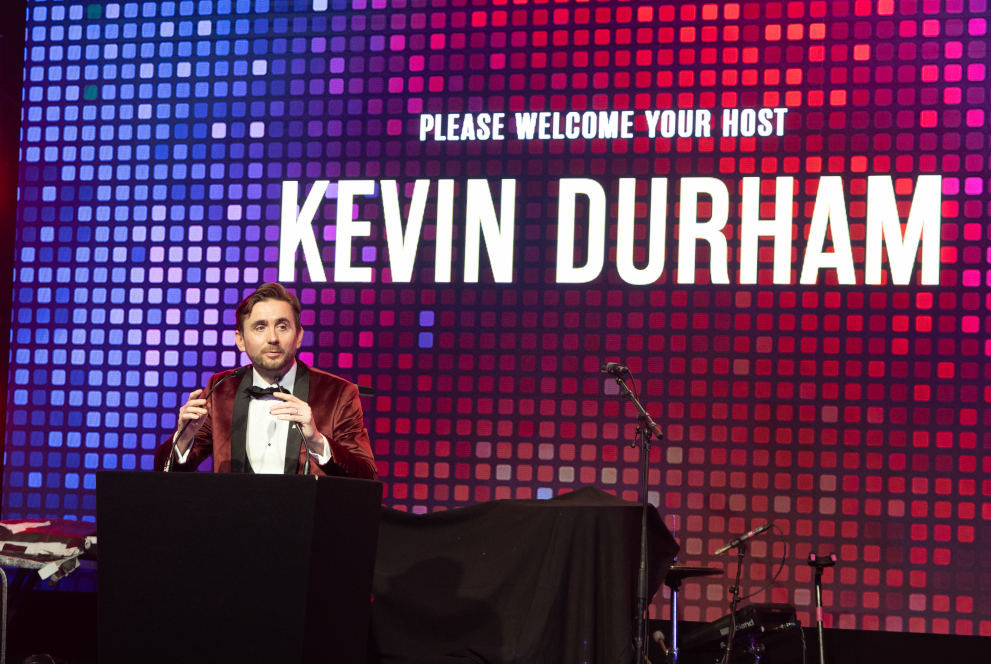
- I run mine as a hosted, Family Fortunes-style format rather than a straight read-off-a-sheet quiz, because it turns a static Q&A into something the whole room is actively playing.
- Whether you run it yourself or bring someone in to host it, the structure matters more than the trivia.
I’ve hosted enough office quizzes to know the exact moment they either take off or stall. It’s usually around round three, when the questions have been fine so far but nobody’s laughed yet. A good office Christmas quiz needs at least one moment that isn’t really about knowing the answer.
This guide covers how to actually structure an office Christmas quiz that people want to play, not just tolerate: team sizes, round formats, question mix, and where a hosted format changes the whole feel of the afternoon.
Team sizes: keep it to four or six
Teams of four to six work best for an office Christmas quiz. Any smaller and one confident person ends up carrying the round. Any bigger and quieter team members disengage because there’s no need for their input.
If your office has an awkward number, don’t force even teams. A team of five and a team of seven beats forcing someone to sit out, and six-player teams are consistently recommended across most quiz-format guidance for exactly this reason. If you’ve got a genuinely large office, split into more teams rather than stretching one team past seven or eight: past that size, the quietest people stop bothering to shout out an answer at all.
What should the round structure actually look like?
The best structure runs five or six short rounds of eight to ten questions each, rather than one long twenty-question slog. Momentum matters more than volume. A quiz that changes shape every ten minutes holds attention far better than one flat round after another.
A structure I’d recommend for an office setting:
- General Christmas trivia: films, songs, traditions, safe opening territory everyone can get a few right.
- Company knowledge: questions about your own year, built from real events, launches, or running jokes from the office.
- Picture round: logos, festive images, or “guess the colleague’s childhood Christmas photo” if anyone’s brave enough to submit one.
- A genuinely silly round: interactive formats that break from straight trivia, like guessing which colleague wrote a specific Christmas wish, work well here.
- Wildcard or tiebreaker: one closing question that decides the placings if scores are level.
Print or project the scoreboard between rounds if you can. Watching the gap close or widen between teams is a big part of what keeps the last two rounds competitive rather than a formality once one team’s clearly ahead.
What makes a company knowledge round work?
A company knowledge round works when the questions are built from real, specific moments from your team’s actual year, not generic “guess the CEO” filler. Questions like “which client did we nearly lose in March” or “what was actually in the leaving card for [name]” get a genuinely different reaction than any Christmas movie question ever will.
This is the round people remember afterward. Generic trivia is available on a hundred websites; a question about your own office isn’t available anywhere else, which is exactly why it lands.
Should the questions be multiple choice or open answer?
Multiple choice questions keep an office Christmas quiz moving faster and reduce arguments over near-enough answers, which matters more in a room that’s also trying to enjoy mince pies and mulled wine. Quiz-format guidance consistently favours multiple choice for exactly this reason: it’s faster to mark and harder to dispute.
Open-answer questions still have a place for the company knowledge round, where the specificity is the point and there’s no risk of a plausible wrong option being mistaken for correct.
The quiz master matters more than the questions
Someone needs to be nominated as quiz master, and it shouldn’t be whoever wrote the questions and also wants to compete. The quiz master’s job is pace, clarity and keeping any one round from dragging past its slot, which is a genuinely different skill from writing good questions.
Quiz-running guidance consistently comes back to the same point: a quiz with great questions and a flat delivery falls just as flat as one with mediocre questions and a confident host. Whoever takes the role needs to project to the back of the room, keep strict time on each round, and be comfortable moving the group on even when a table’s still arguing over an answer.

Why do I run mine as a hosted format instead of a straight read-through?
I run mine as a hosted, interactive format because a straight read-off-a-sheet quiz caps out at how much energy the room can generate on its own. My version borrows the structure of Family Fortunes: “our survey says” style rounds, buzzers, and a proper host keeping the pace and the banter going between questions.
The questions themselves are written specifically for your team, not pulled from a generic bank, in the same way I’d build any game show entertainment format for a corporate audience. The show is built for your room, and it drops in cleanly without turning your day into a production job.
My signature move, when the room’s big enough to need it, is splitting everyone into two large teams and rotating who’s up at the buzzers each round, so nearly the whole office actually gets a turn rather than the same five confident colleagues doing all the answering. It’s the difference between a quiz the room watches and a quiz the room plays.
I write the “our survey says” style questions from scratch for each client, built around the team in front of me rather than pulled from a stock bank, the same approach I take with any Family Fortunes or Generation Game booking. That’s what turns a Christmas quiz from a nice-enough afternoon activity into the thing people are still quoting back at each other in January.
Does a Christmas quiz actually help team morale?
A well-run Christmas quiz genuinely helps, because it’s one of the few office moments where hierarchy briefly stops mattering. The person who knows every Christmas song lyric isn’t necessarily the most senior person in the room, and that reshuffling is part of what makes it work.
The wider context makes this worth doing properly: UK employee engagement sits at roughly one in four, and a flat, forgettable end-of-year moment does nothing to shift that. A quiz people actually enjoy is a small, cheap way to give the year a proper send-off.
How does an office Christmas quiz fit alongside other party games?
A quiz works best as one segment of the afternoon rather than the entire event, especially if your office Christmas party also includes other Christmas party games or a wider mix of party games throughout the day. Twenty to thirty minutes of quiz, well-paced, beats an hour that overstays its welcome. Pair it with a shorter, more physical round afterward and you get the best of both: a seated, thinking segment followed by something that gets people out of their chairs before anyone checks their phone.
Quick answers: office Christmas quiz
How long should an office Christmas quiz run? Twenty to forty minutes for five or six rounds is the sweet spot. Past that, energy tends to drop off even with good questions.
What’s the ideal team size for a work Christmas quiz? Four to six people. Big enough that everyone isn’t forced to answer, small enough that nobody can hide entirely.
Should the quiz be multiple choice? Mostly, yes, for speed and fewer disputed answers. Save open-answer questions for the company-specific round where the detail is the whole point.
Can a Christmas quiz work for a hybrid or remote team? Yes, with video call breakout rooms or a shared screen and private chat for answers, though the split-room, buzzer-led energy of a hosted in-person format doesn’t fully translate online. If your team’s fully in person for the one Christmas gathering of the year, that’s the moment to make it count.