In short
- Emcee games for corporate events work best as a hosted show, not a printed quiz sheet: one host runs the room and pulls people in.
- The three rounds I run most are Family Fortunes, The Generation Game and Play Your Cards Right, each rewritten for the actual crowd.
- My signature move is splitting the whole room into two teams and rotating each round, so nearly everyone plays.
- Two modes suit different nights: a fixed TV format for a few people on stage, or a flexible whole-room version.
- Once numbers climb past a certain point, a hosted game holds a room that a generic quiz quietly loses.
I get asked for “something more interactive than a quiz” more than almost anything else, and emcee games for corporate events are where I answer it. The rooms that ask are usually the ones that sat through a flat night the year before: a printed round, a scoring pause, and half the tables checking their phones by question six. What I run instead is a show that happens to be a game, built around the people actually in front of me. Here is what that looks like, and how to pick the version that fits your evening.
Why do emcee games for corporate events beat a pub quiz?
Because a hosted game pulls the whole room into the action, while a pub quiz leaves most tables filling in a sheet and waiting for the answers. A quiz is a fine warm-up for twenty people in a bar. Put two hundred colleagues in a function room and the maths changes: the gaps between rounds get longer, the scoring drags, and the energy leaks out of the corners of the room where nobody can hear the question clearly.
A game show round fixes that because the host is the engine. There is always someone driving the pace, reading the room, and making the person on the buzzer feel like the star for thirty seconds. Gallup’s research on the workplace is a useful reminder here: only a minority of employees describe themselves as genuinely engaged at work, and a passive evening does nothing to change how a team feels about each other. A round that gets people up, laughing and competing does more for the room than another slide of trivia. You can read the wider case for hosted corporate entertainment as your centrepiece rather than a filler act.
Which game show rounds do I actually run?
Three formats do most of the work: Family Fortunes, The Generation Game and Play Your Cards Right, each rebuilt for the specific room. They are not off-the-shelf. I write the questions, choose the rounds and set the pace for the audience in the brief, whether that is a finance team at a black-tie awards dinner or a mixed family crowd at a summer party.
Each one does a different job. Family Fortunes is the crowd-pleaser: fast, loud, and built on guessing what everyone else said. The Generation Game is the one that gets people doing something daft with their hands and laughing at themselves. Play Your Cards Right is the closer, a higher-or-lower gamble that turns a whole table into a chorus of “lower” in about ten seconds. Between them they cover corporate event games for almost any age range and any level of after-dinner reserve. This sits inside my broader game show entertainment, which flexes from a fifteen-minute segment to a full evening.
How does the split-room Family Fortunes work?
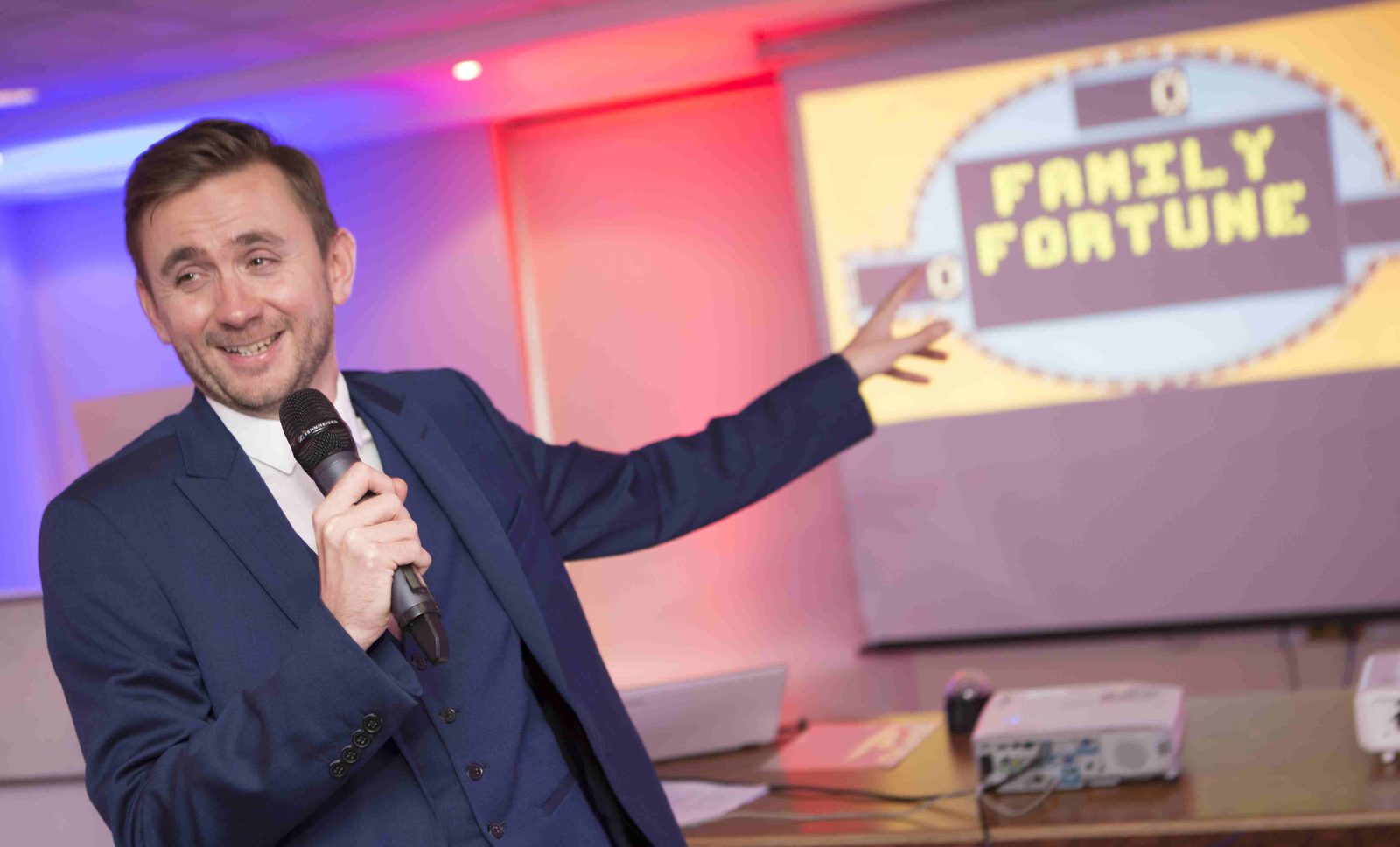
I split the whole room into two teams and rotate the players each round, so nearly everyone gets a turn on the buzzer rather than five people playing while the rest watch. That rotation is the part other hosts tend to skip, and it is what turns a stage game into a room game. Instead of the same faces up front all night, a new pair steps up each round, the tables cheer their own, and the competition belongs to everyone.
The other half of the work is the writing. I build the “our survey says” questions for that specific audience, so the answers land as in-jokes: the department everyone blames for slow emails, the meeting that always over-runs, the biscuit that vanishes first from the kitchen. That is what makes family fortunes corporate rather than generic. A survey question about your own office gets a bigger laugh than any bought-in question ever could, because the room recognises itself in the answers.
The Generation Game, adapted for the room
The Generation Game is where I lean into the silliness, carefully judged for the crowd. The original Generation Game was built on teams having a go at something unfamiliar and getting it gloriously wrong on stage, and that spirit adapts beautifully to a corporate room that has loosened up after dinner.
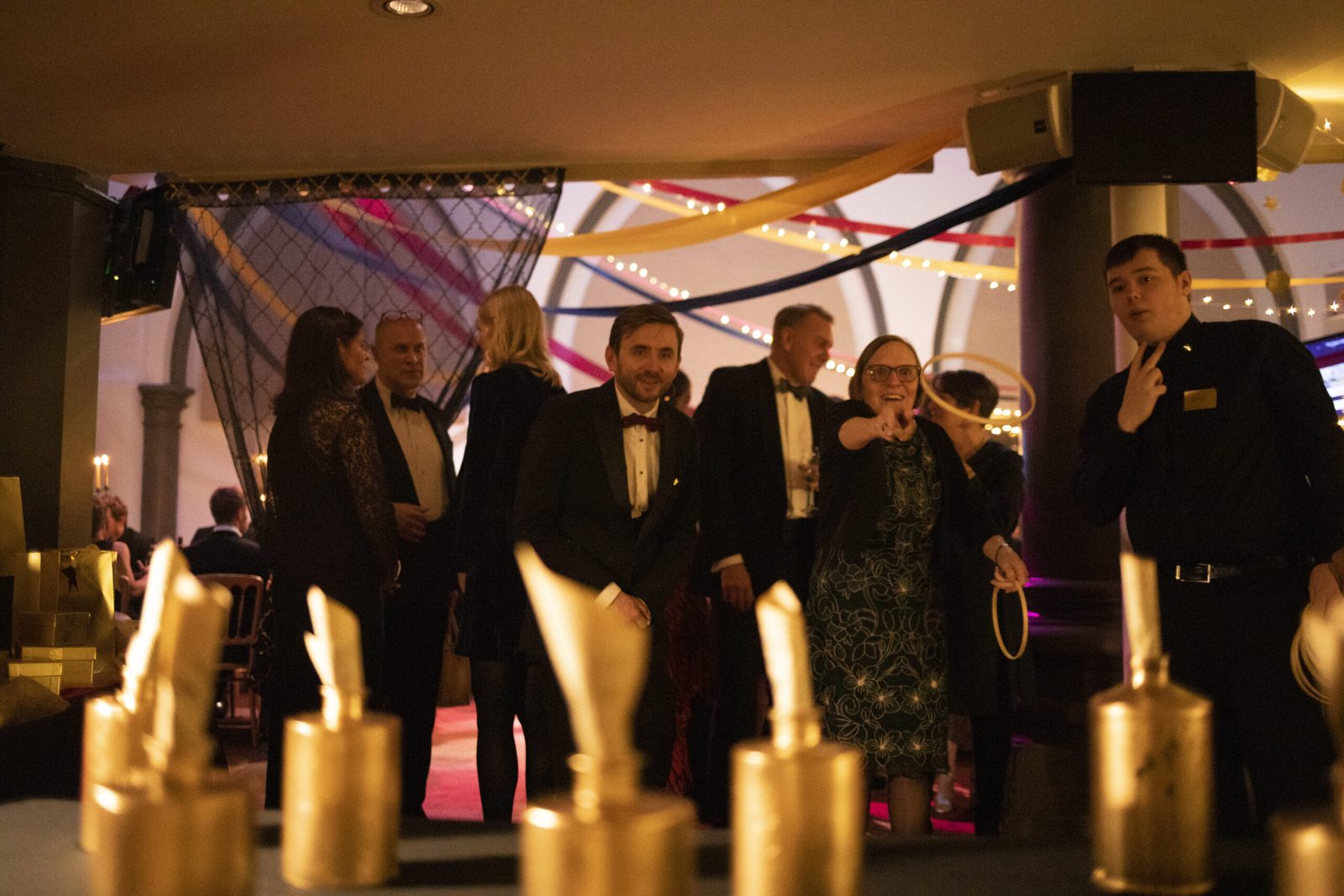
I pick the rounds to suit the people in front of me. At one family event I ran a modified egg-and-spoon race that was judged not on who crossed the line first, but on the sheer silliness of the walk, and the room decided the winner by cheer. Nobody minded losing because the point was the performance, not the result. That is the trick with interactive games for corporate events: give people permission to be daft in a way that feels earned, and the confident and the shy both find a way in.

Should you choose fixed format or whole-room?
Choose fixed format when you want a tight, TV-style show that a few people play on stage; choose whole-room when you want as many guests as possible on their feet and involved. Both are proper shows. The difference is how much of the room is playing versus watching, and the right answer depends on your night.
The fixed format keeps a small group on stage throughout, the rest of the room enjoying it like a live broadcast, which suits a slicker, more formal evening. The whole-room version is the one built for participation: split teams, rotating players, Play Your Cards Right run table-by-table so nearly every table gets a hand to gamble on. For a boisterous crowd that wants to be in it, whole-room wins every time. For a room that would rather watch great telly with a drink, fixed format is the smarter call. If you are still weighing options, my rundown of corporate entertainment ideas sets the games alongside the alternatives.
Here is a short clip from one of my events, a room mid-round, so you can see what the whole-room version does to the energy.
Are emcee games for corporate events right for every event?
Not for every event, but for more than you would expect. Anywhere you have a room that needs to bond, relax or simply stay in their seats to the end, a game show round earns its place: summer parties, Christmas dinners, conference wind-downs, staff away-days and team celebrations.
The most interesting use I have found is inside an awards night. Standard ceremonies drag for everyone who is not winning, so for one client I built the evening as a hybrid: award presentations interleaved with game show rounds, so the room stayed alive between the trophies. Everyone stayed to the final award, and the client’s feedback said as much. You can see how that came together in my awards hybrid case study. The judgement call is always the same: read the audience, match the format to their mood, and never force a game on a room that wants a speech.
Quick answers: emcee games for corporate events
How many people do you need for a game show round? Anything from a small dinner of thirty to a hall of several hundred works; the whole-room format is built to scale, and the rotation keeps large groups involved.
Do guests have to get up and play? No. In every format some people play and the rest enjoy the show, so nobody is dragged into anything, and the reluctant ones usually join in by the second round anyway.
Can you tailor the questions to our company? Yes, that is the point. I write the survey answers and rounds around your team, your in-jokes and your industry, which is what separates this from a hired-in quiz.
Is this suitable for a formal, senior audience? Yes, with the fixed TV format and the right tone. A board-level room enjoys a well-run show as much as anyone, provided the host reads them correctly.
Getting the show into your event
The honest answer to “which game should we do” is that it depends on your room, and that is a conversation worth having before anything is booked. Tell me the audience, the occasion and the mood you are after, and I will tell you which rounds will land and whether fixed or whole-room fits. To talk it through, get in touch or call 07596 851647, and we will build the night around the people who will actually be in the room.