
In short
- An after dinner speaker is the person who takes the floor once the plates are cleared, and choosing the right one depends far more on the room than on the name.
- A big-name keynote and an entertaining host are two different jobs: one wants you to sit and listen, the other wants the room involved.
- Many corporate dinners land better with an interactive host than with a talking head, especially late in a long evening.
- Length matters more than most organisers expect: attention drops fast after a meal, so shorter and livelier usually wins.
- My game-show hosting is built for exactly that after-dinner slot, because it pulls the whole room in rather than asking it to stay quiet.
I’ve watched a lot of good dinners go slightly flat at the same moment: the food is done, the wine is flowing, and someone stands up to deliver twenty-five earnest minutes to a room that has just eaten a three-course meal. Booking an after dinner speaker is one of those decisions that looks simple and quietly decides how your whole evening is remembered. So before you sign anyone, it helps to be honest about what the slot actually needs.
What is an after dinner speaker, really?
An after dinner speaker is whoever holds the room once the meal is over, using talk, humour or interaction to give the evening a centrepiece. The traditional version is a single person at a lectern telling stories, and communication scholars describe the after-dinner speech as one whose purpose is to entertain while still saying something worth hearing. It is a speech, not a stand-up set, and the good ones read the mood of the room rather than reciting a fixed routine.
That definition is broader than most people assume. It covers the retired sportsperson doing anecdotes, the specialist making a dry subject funny, and the host who turns the back half of the night into something the whole table plays. All three are, technically, your after-dinner entertainment. They are not remotely the same experience.
Is a big-name keynote after dinner speaker always the right call?
No, and this is where a lot of budgets get spent in the wrong place. A big-name keynote after dinner speaker can be superb when your audience genuinely wants to hear that particular person, and when the evening is built around listening. The problem is that a name on a poster does not guarantee a night that feels alive in the room.
I’ve seen well-known speakers arrive with no briefing, deliver the same set they do everywhere, and leave a dinner respectful but slightly cold. What clients tell me afterwards is nearly always the same: the night felt flat, and nobody was actively holding it together between courses. If your real goal is a room that talks about the evening the next morning, a famous talking head is not automatically the answer.
What makes a good after-dinner slot?
A good after-dinner slot fits the mood of a fed, relaxed, sociable room rather than fighting it. People have eaten, they have been sitting a while, and they are in a social frame of mind, not a lecture-theatre one. The job is to work with that energy, not to demand they switch back into conference concentration.
In practice that means a few things. It means genuine warmth over polished distance. It means content pitched at the actual people in the room, their industry, their in-jokes, the reason they are all together. And it means someone who can handle the moment a table gets loud or a running order slips, without it showing. That last skill is unglamorous and it is the one that quietly saves evenings.
How do you match the choice to the audience and the night?
Match the choice by starting with who is in the room and what the evening is for, then working backwards to the format. A boardroom-heavy awards dinner wants something different from a sales team blowing off steam after a hard quarter. The same booking can be right for one and wrong for the other.
Ask a few plain questions. Do these people mostly know each other, or is half the room strangers? Is this a reward, a celebration, a thank-you, or a networking night with dinner attached? How late does the speaker slot fall, and how much drink will have been taken by then? A reflective keynote can work at nine o’clock in a sober, senior room. Put the same speaker on at eleven after a raucous table quiz and you have miscast the night.
I always ask for this in the briefing, because the quality of an evening is decided there, not on the night. Clients who have used in-house hosts or celebrity name-drops often tell me those bookings came with almost no preparation conversation, and it showed.

How long should an after dinner speaker actually talk?
Shorter than most people plan for, because attention falls off a cliff after a meal. Attention research on live audiences suggests people can genuinely focus on a single speaker for roughly seven to ten minutes before they need a change of pace, and a heavy dinner only shortens that. I run full-day conferences, and managing the after-lunch dip is one of the hardest parts of the job, so I know how quickly a fed room drifts.
For a straight after-dinner speech, fifteen to twenty tight minutes usually beats thirty loose ones. If you want the room engaged for longer than that, the honest answer is that you probably do not want a single person talking at all. You want something the room takes part in, so the energy comes from them rather than from one voice trying to carry the lot.
Where one host fits across the whole evening
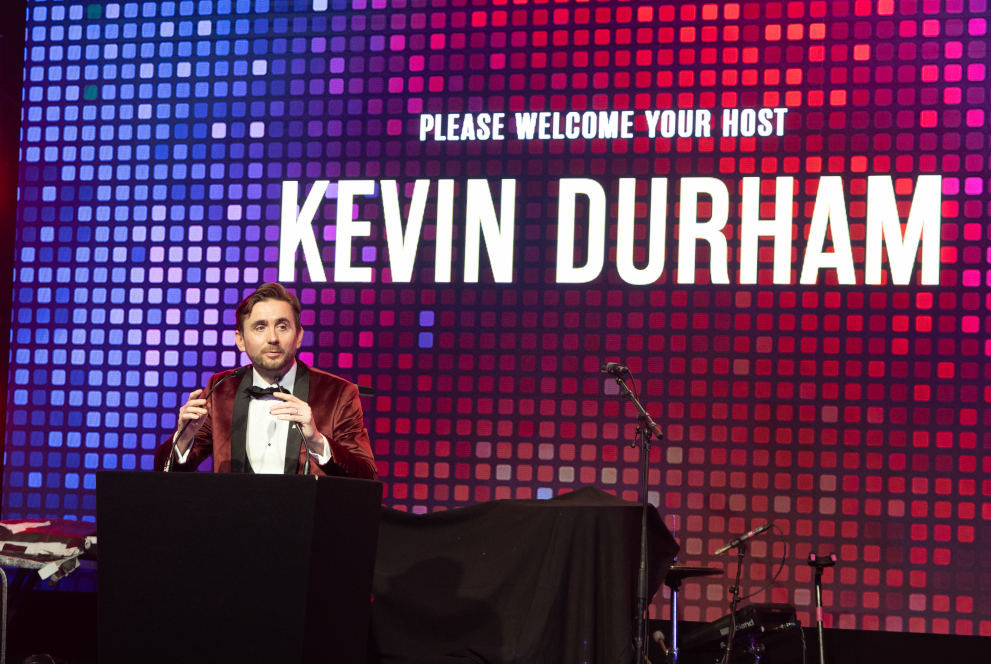
This is the part I care about most, because it is what I actually do. Instead of a talking head, I host the after-dinner slot as an interactive show built around the people at the tables. I write Family Fortunes style questions for that specific audience, split the whole room into two teams and rotate each round so nearly everyone gets to play, and run rounds table by table so no one is just watching.
The reason it works after dinner is simple: a well-fed, sociable room wants to do something, not sit still. My biggest booking of last year was an awards night built as a hybrid, where I interleaved the presentations with game-show rounds, because standard ceremonies drag for everyone who is not winning. Everyone stayed to the end, which at an awards dinner is not a given. You can see the range of this in my corporate entertainment work and the specific emcee games I run for corporate rooms.
One reason I can move between a formal awards dinner and a rowdy sales night is years of live television, working to a camera and a timed rundown while reading an audience fast. Here is a clip from one of my events that shows how one host covers very different rooms.
After dinner entertainment ideas that beat a talking head
The best corporate after dinner entertainment gives the room something to do together, and the ideas that consistently land are the participatory ones. If you are gathering after dinner speaker ideas and the brief is really “make the second half of the night fun”, here is where I would look before booking a keynote.
- A whole-room game show, teams drawn from the tables, questions written about the company and the crowd.
- A quick, silly physical round judged on style rather than skill, so the confident and the shy both get a laugh.
- Table-by-table competition that runs alongside coffee, so nothing has to stop for it.
- A short, sharp speaker followed by an interactive segment, if you genuinely want both a message and a lift.
The common thread is that the entertainment includes the audience rather than performing at it. That is the difference between a room that politely claps and a room that is still talking about round three at the bar.
Quick answers: after dinner speaker
What does an after dinner speaker do? They hold the room once the meal is finished, giving the evening a centrepiece through talk, humour or interaction. The format ranges from a lectern speech to a fully interactive show.
Is an after dinner speaker the same as an event host? Not quite. A speaker delivers to a seated audience, while a host runs the whole evening and keeps energy up between segments. Booking one person to do both means nobody has to coordinate a speaker and a separate act.
How much does an after dinner speaker cost? Fees vary widely by format, length and profile, so there is no standard rate. I quote each event individually once I understand the room and the running order.
What is better after dinner, a speaker or a game show? It depends on the room, but a fed, sociable crowd usually engages more with something interactive than with a single voice. If the goal is a night people remember, participation tends to win.
If you are weighing up an after dinner speaker for your event and you want the room involved rather than just spoken at, tell me about the night and I will be straight with you about what suits it. You can read what past clients have said on my reviews page, see the awards hybrid in detail, or get in touch and we will talk it through. Or call 07596 851647.