In short
- The best work social ideas get people taking part in something together, not just given a room and free drinks and left to mingle.
- Low-key, regular socials (a coffee morning, a shared lunch) do more for team cohesion than one big annual bash.
- Close work friendships are strongly linked to engagement: Gallup and KPMG both find socially connected employees are far more likely to say they are engaged at work.
- Fun things to do with coworkers work best when they mix low-effort options (quizzes, games at the desk) with the occasional bigger night out.
- An interactive host running a game-show format gets a whole room playing at once, rather than three volunteers while everyone else watches.
Most advice on work social ideas reads like a shopping list: bowling, escape rooms, a pub crawl, repeat. The list is not really the problem. The problem is that a work social gets treated as a box to tick once a year, rather than something worth doing little and often. Here is what the research says about why work socials matter, and a set of ideas that actually get people involved rather than standing at the edge of the room checking their phone.
This matters more than it sounds. A team that only socialises when HR schedules it tends to default back to the same small cliques the moment the event ends, because nothing about the format asked them to mix. The ideas below are chosen because they force some kind of interaction, whether that is a shared task, a team, or a simple rule that mixes people who do not normally sit near each other.
What makes a work social actually work?
A work social works when people are doing something together, not simply occupying the same room. Free drinks and background music invite people to cluster with whoever they already know, which is the opposite of what a social event is meant to achieve.
The case for bothering at all is stronger than most managers assume. Gallup has found that having a close friend at work is strongly linked to better business outcomes, including profitability and safety, not just to how people feel about Mondays. KPMG’s more recent research puts a number on it: employees with close friends at work are far more likely to describe themselves as always engaged than colleagues who do not socialise. The British Psychological Society’s review of the same evidence base explains the mechanism: workplace friendships act as a buffer against stress and give people a reason to show up fully, not just show up.
None of that happens automatically. It happens because someone designed a moment for it, then did it again.
What are the best low-key work social ideas for small teams?
The best low-key work social ideas for small teams lower the bar for who joins in. A team of eight does not need a marquee and a live band. It needs a reason to eat lunch together without a laptop open, repeated often enough that it becomes a habit rather than an event.
Some options that need almost no organising:
- A rotating lunch, where a different person each month picks the food or the place.
- A Friday half-hour wind-down, five minutes to share one good thing from the week and then just talk.
- A coffee-and-cake morning once a month, no agenda, no forced icebreakers.
- A short walk together at lunchtime, particularly useful for teams that are mostly on video calls.
- A show-and-tell slot at the end of a Friday meeting, where anyone can share something unrelated to work.
Knight Frank’s research on hybrid teams found that a large share of colleagues now rely on instant messaging and “anything but work” calls to stay connected socially. That is a reasonable substitute for a team spread across locations, but it is not a replacement for time spent in the same room. Small, regular, low-effort socials do more of that work than people expect, and they are far easier to keep going than a big annual event that depends on one person organising it every time.
What are fun things to do with coworkers outside the office?
Fun things to do with coworkers outside the office work best when the activity gives people something to do together, rather than something to watch. A meal is fine. A meal plus an activity is memorable, mainly because it gives colleagues who do not normally speak a reason to end up on the same team.
A few formats that reliably work for UK teams:
- Crazy golf or a bowling alley, both cheap and naturally sociable.
- A quiz night, ideally one built around your team rather than a generic pub quiz.
- An escape room, good for teams of six to ten who already get on reasonably well.
- A cookery class, which forces small groups to work together on something with no work content at all.
- A pub garden afternoon in summer, low pressure and easy to make optional.
Research from Green Recruitment Company found that most professionals credit workplace friendships with making them feel more engaged, more satisfied, and more connected to their organisation. Getting people out of the building, even for two hours, is one of the more reliable ways to build that, and it costs far less than most managers assume once the activity itself is kept simple.
Office social event ideas that need a bit more planning
Some office social event ideas are worth the extra planning because they cover a bigger group and mark something specific: the end of a quarter, a summer party, a milestone the whole company hit together.
For events at this scale, structure matters more than the venue. A room of sixty people left to mingle over canapes will naturally split into the same small groups who already sit near each other. A room of sixty people split into teams for a shared activity behaves completely differently. The Escape Recruitment Services research on hybrid working found that the share of employees who say they have a close friend at work has been falling, which makes the case for a well-run larger event stronger, not weaker: it is one of the few remaining moments the whole team is in a room together on purpose.
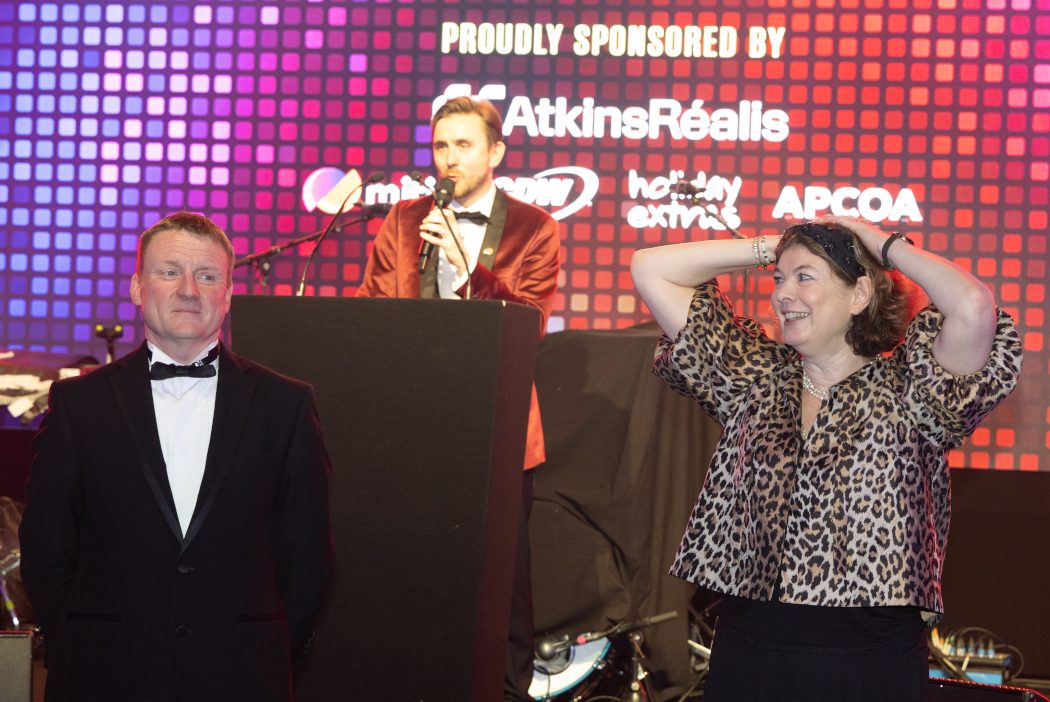
Bigger events are also where corporate entertainment options make the most difference. A live band or background act fills the room with noise. An activity that gets tables competing against each other fills the room with people talking to colleagues they do not normally work with. Whoever plans the event still needs to decide on a venue, a rough timing plan, and who is responsible for keeping the room moving once the formal part of the evening is over, since a bigger group loses momentum faster than a small one.
Why does an interactive host beat a generic quiz?
An interactive host beats a generic quiz because a good host reads the room and adjusts on the spot, where a fixed quiz sheet cannot. The gap between “everyone stares at a laminated question sheet” and “the whole room is on its feet, laughing” usually comes down to who is running it, not what the format is called on the invite.
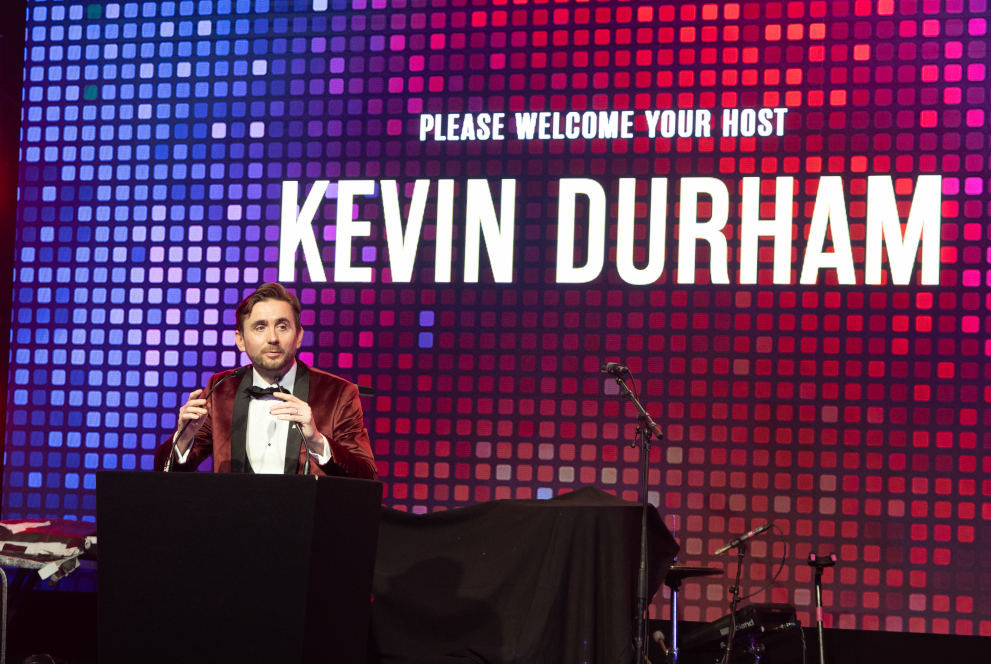
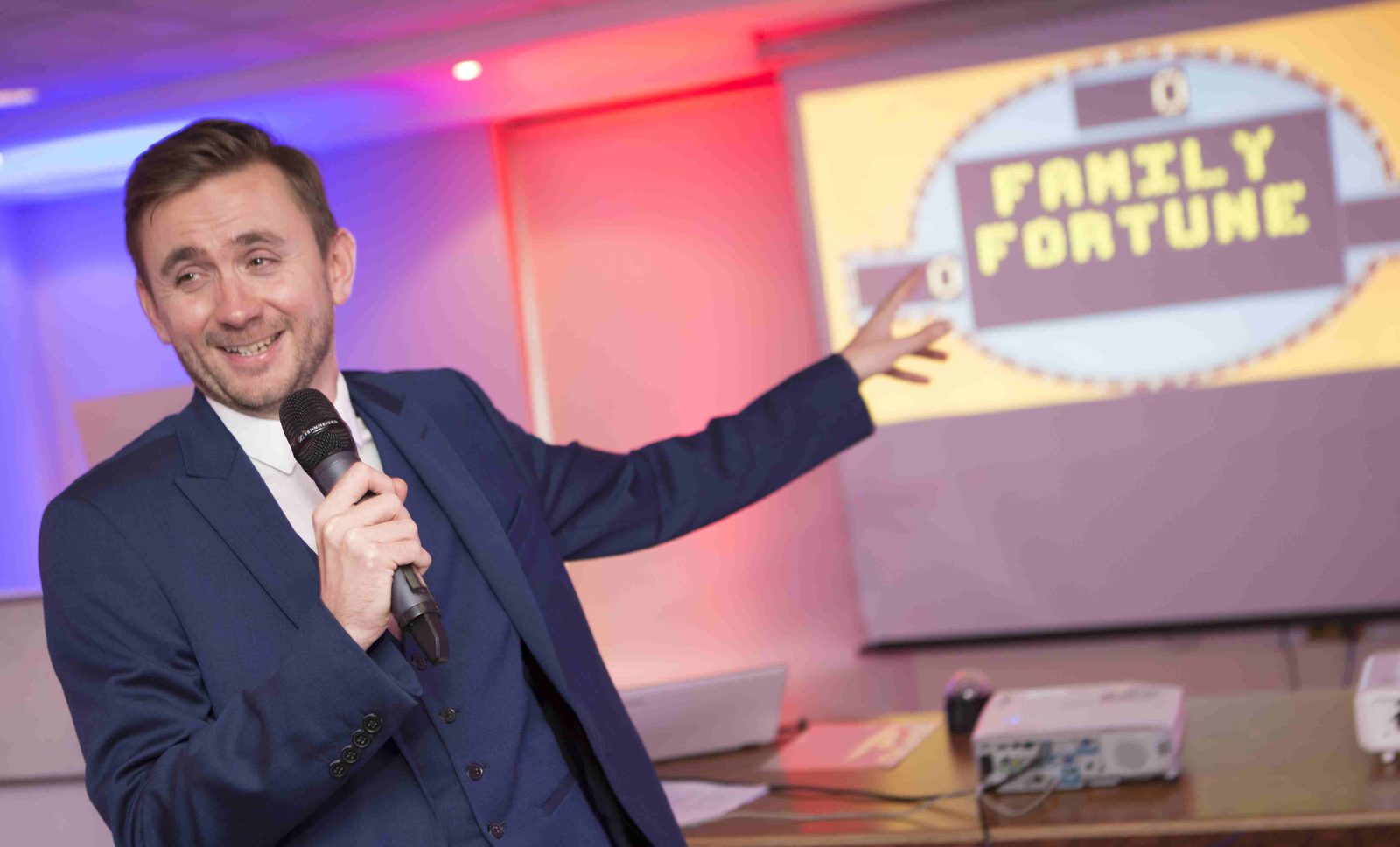
This is the part of the job I specialise in. My entertainer format covers interactive games, quizzes, and table-to-stage competitions built to get the whole room playing rather than three volunteers up front while everyone else watches, including formats like Family Fortunes, The Generation Game, and Play Your Cards Right, adapted for the crowd in the room. A game-show host who tailors the questions to your team, rather than running the same fixed script at every event, is the difference between a quiz people tolerate and one they still talk about the following week.
How often should a company run work socials?
A company should run work socials on a mix of cadences: something low-key monthly, something bigger quarterly, and one larger event a year that the whole company attends. A single annual party asked to carry all the social weight of the year is asking too much of one evening.
CIPD, the UK’s professional body for HR, frames workplace wellbeing as something that needs an organisational approach rather than a single initiative, and social connection is part of that picture alongside the more obvious wellbeing measures. A UK-wide Wildgoose survey found a meaningful share of employees feel more productive when working alongside people they consider friends, which is as good a reason as any to treat the social calendar as more than an afterthought.
Quick answers: work social ideas
What are good work social ideas for a small team? A rotating lunch, a monthly coffee morning, or a short walk together at lunchtime. None of these need a budget, just a recurring slot in the diary.
What are fun things to do with coworkers outside work? Bowling, crazy golf, a tailored quiz night, or a cookery class. Anything that gives the group a shared task tends to outperform a meal alone.
How often should work socials happen? Aim for something low-key monthly, a bigger event quarterly, and one larger annual event, rather than relying on a single Christmas party to do all the work.
What makes a bigger office social event actually land? Structure. An activity that puts tables or teams in gentle competition gets far more of the room talking to each other than background music and canapes do.
If you are planning something bigger than a coffee morning and want the whole room playing rather than watching, talk to an event host who will build the format around your team.