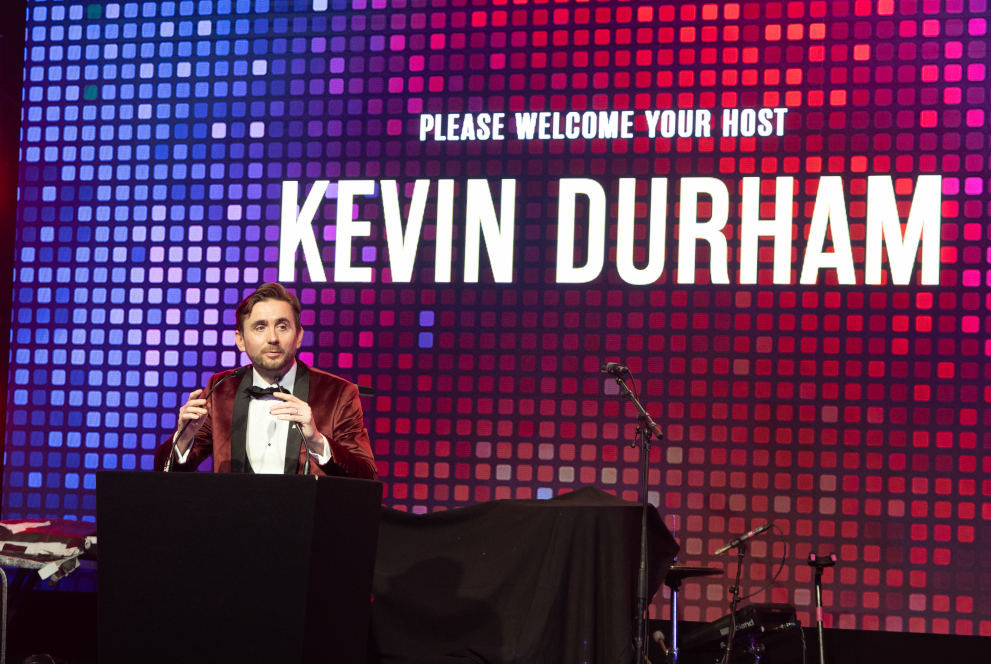
- A wedding MC is the person who runs the reception’s running order: welcoming guests, introducing speeches, cueing the first dance and cake cutting, and keeping the evening moving without anyone noticing the effort behind it.
- “Wedding MC”, “wedding emcee”, and “wedding master of ceremonies” all describe the same role. The words are interchangeable; only the formality of the title changes.
- A wedding MC and a wedding toastmaster do a similar job with a different tone: the toastmaster leans formal and traditional, the MC leans relaxed and contemporary.
- You do not need a wedding MC by law or convention, but couples who use one usually do it to take the pressure off the band, the DJ, or a family member who would otherwise be guessing at the timeline all evening.
Ask five people what a wedding MC actually does and you will get five slightly different answers. Some picture a red-coated toastmaster banging a gavel. Others picture a DJ with a microphone calling out the first dance. Both are right, in a way, and that overlap is exactly why the term causes confusion when couples start planning.
This guide covers what a wedding MC is, how the title relates to “wedding emcee” and “wedding master of ceremonies”, how it differs from a traditional toastmaster, and how to decide whether your wedding needs one.
What is a wedding MC?
A wedding MC is the professional who manages the reception’s programme: welcoming guests, introducing the wedding party and speeches, announcing key moments like the first dance and cake cutting, and liaising with the venue and other suppliers so the day runs to its timeline.
The MC is not the entertainment. They are the person holding the shape of the evening together, so the entertainment, the speeches, and the couple’s own moments land properly instead of colliding into each other.
In practice, that means being the one calm, informed voice in the room when something needs to happen, whether that is calling guests back from the bar for speeches or quietly resetting a timeline that has slipped by twenty minutes.
Wedding MC, wedding emcee, wedding master of ceremonies: is it the same job?
Yes. Wedding MC, wedding emcee, and wedding master of ceremonies describe the same role under three different names, and the choice between them is largely regional and stylistic rather than functional.
“MC” is short for master of ceremonies, an abbreviation recorded from the 1790s. “Emcee” is simply that abbreviation spelled out the way it sounds, a form that entered English in the 1933 and has stayed in common use ever since, especially in American and Australian English. Standard dictionaries define an emcee as, quite plainly, a master of ceremonies.
UK couples and suppliers tend to say “MC” in conversation and use “wedding master of ceremonies” or “wedding emcee” more often in search terms and formal listings. This post uses “MC” through the body copy for that reason, in line with UK convention, while covering all three terms because couples searching for one are usually looking for the same thing.
The role is also the wedding-day version of a job that exists across corporate events under the same name. A master of ceremonies at an award ceremony or conference is doing the same core job of managing the programme and holding the room together, just in a different setting with a different guest list.
What does a wedding MC do at the reception?
A wedding MC keeps the reception on schedule and makes sure guests always know what is happening next, from the moment the wedding party arrives to the last dance.
The core duties usually include:
- Welcoming guests and announcing the arrival of the newly married couple
- Introducing speeches in whichever order the couple has chosen, commonly the traditional order of father of the bride, groom, and best man, though modern weddings increasingly add the bride, the maid of honour, or other family members
- Cueing the first dance, cake cutting, and bouquet toss at the right moment
- Directing the buffet or table service so it does not turn into a scrum
- Liaising with the photographer, band, and venue staff so nobody is caught off guard
Wedding guides describe the MC simply as the reception’s point person, the one with the microphone who is quietly responsible for the evening moving at the right pace. Couples increasingly build their own running order rather than following convention strictly, a shift wedding editors note is becoming increasingly common.
Wedding MC vs toastmaster: what’s the difference?
A wedding toastmaster and a wedding MC do a similar job, but the toastmaster leans formal and the MC leans relaxed.
A traditional toastmaster is associated with the red coat tailcoat, formal announcements, and precise etiquette around toasts and introductions. The style suits grand venues, black-tie weddings, and couples who want a strong sense of ceremony running through the day.
A wedding MC generally drops the formal dress and the fixed phrasing in favour of a warmer, more conversational style, while doing much the same underlying job: managing the timeline, cueing key moments, and keeping guests informed. Neither approach is objectively better. The right choice depends on the tone of your day, not the job description.
Plenty of couples now book someone who blends both: enough structure to keep the day on time, without the stiffness that a strictly traditional toastmaster brings to a relaxed, modern wedding.
Where the wedding MC tradition comes from
The idea of a master of ceremonies is far older than the wedding industry. The title is documented as far back as the 5th century, used within the Catholic Church to oversee the correct order of ritual, before it spread into royal courts and formal civic occasions where getting the sequence of events right mattered as much as the event itself.
The toastmaster tradition has a more specific, and more British, origin story. Professional toastmasters emerged in 1840s London, regulating toasts at large formal gatherings and keeping proceedings from descending into chaos. The now-familiar red coat came later, adopted by a toastmaster who wanted to be told apart from the waiting staff rather than for any ceremonial reason.
Both traditions arrived at weddings the same way: formal events, whether religious, civic, or social, have always needed one person whose job is to hold the running order together. A wedding is simply the latest formal event to inherit that role.
Do you need a wedding MC?
You do not need a wedding MC in the way you need a registrar or a venue, but most couples who skip one end up handing the job to somebody anyway, usually a band leader, a DJ, or a family member who did not sign up for it.
Whether that arrangement works is, as one major wedding planning publication puts it, entirely up to you. A DJ juggling music and microphone duties at the same time is doing two jobs, and the timeline is usually the one that suffers. A relative pressed into the role is doing it without preparation, on a day when they would rather be a guest.
A professional MC acts, in the words of one wedding editorial team, as your eyes and ears for the day: watching the clock, checking in with the venue and photographer, and stepping in the moment something needs managing, so the couple never has to.
Kevin Durham’s wedding MC services coordinate the day’s timeline, coach nervous speakers ahead of time, and keep proceedings moving without the stiff, script-bound feel of a traditional toastmaster, and include a complimentary 4K video guestbook as standard. Kevin brings a 20-year background hosting corporate events, award ceremonies, and large-scale family gatherings to that same approach on wedding days.
What to look for in a wedding MC
If you decide to book one, a few questions separate a professional booking from a guess.
- Ask about their pre-event process. A proper briefing, ideally in person or by call, should happen well before the day, not in the car park an hour beforehand.
- Check who will actually be there. Some bookings made through agencies send whichever host is available on the day, not the one you briefed.
- Ask how they handle pronunciation and names. Family names and surnames get mangled more often than couples expect, and it is an easy thing to check for in advance.
- Ask what happens if something changes late. A running order that slips by twenty minutes, a speech that gets pulled, or a best man who goes missing should not derail the evening.
- Ask what they need from you. A good MC will ask for a full running order, a guest list with pronunciation notes, and a rehearsal or walkthrough where possible.
None of this depends on job title. A toastmaster, an MC, or an emcee can all be the right booking, provided the preparation behind the title is there.
Choosing the right person for your day
Whichever term you search for, wedding MC, wedding emcee, or wedding master of ceremonies, you are looking for the same thing: someone who keeps your day moving, handles the unexpected quietly, and lets you actually be a guest at your own wedding.
The title matters less than the preparation behind it. If you are weighing up whether your day needs one, or want to talk through what a professional event host would do differently on your specific timeline, get in touch to discuss it.