
- The best corporate entertainment ideas share one quality: they fit the audience. What works at a sales conference for 500 does not automatically work at a senior leadership dinner for 40.
- Audience size, formality, and the event’s purpose should determine entertainment choices before any vendor conversations begin.
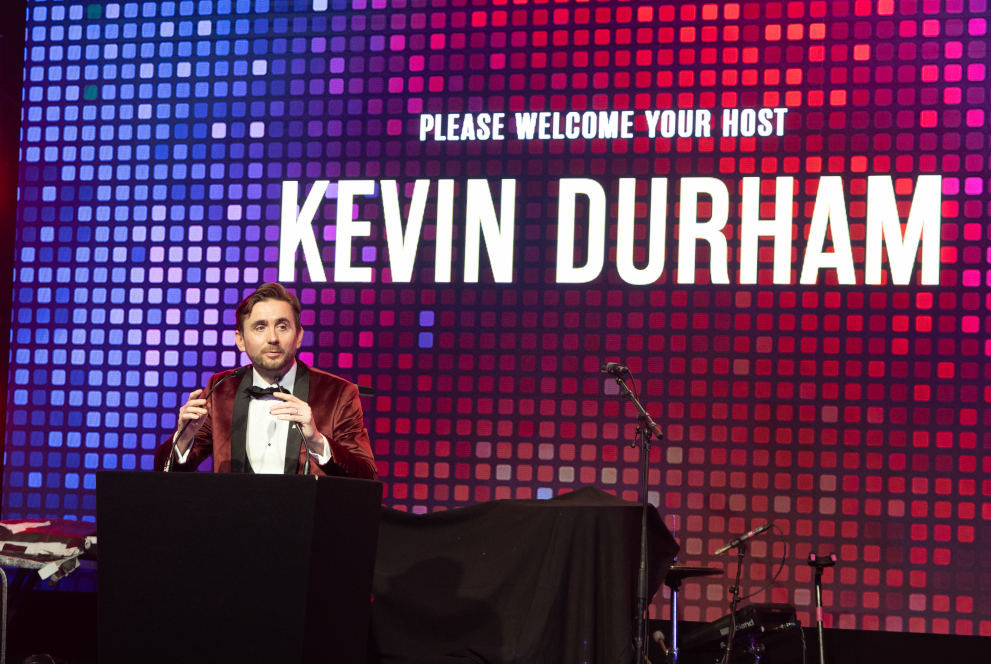
- The professional who hosts and links your entertainment matters as much as the acts themselves. Without the right person holding it together, the best acts still produce a fragmented evening.
- Budget conversations in corporate entertainment routinely ignore the connective tissue cost. The host who manages the transitions is where the evening’s coherence is built.
Corporate entertainment ideas range from the obvious to the genuinely creative, and the range of advice available online covers most of the obvious options: live music, photo booths, magicians, casino nights. This post does something different. It covers why some corporate entertainment ideas work and others fail, which formats suit which events, and the one element that almost every corporate entertainment budget underestimates.
What are corporate entertainment ideas?
Corporate entertainment ideas are the activities, performances, and formats that engage an audience during a business event: a conference, an awards dinner, a team day, a product launch, or a client hospitality evening.
The definition is deliberately broad because the category is broad. A headline comedy act at a 500-person sales conference is corporate entertainment. So is a quiz format at a 30-person team away-day. So is a live charity auction at a black-tie fundraising gala. The thread that connects them is that they are designed to engage a professional audience in a business context, often alongside formal programme elements like speeches, presentations, or award categories.
The quality of corporate entertainment ideas is not a function of budget or originality. It is a function of fit. The right entertainment for your event is the format that suits the audience, the venue, the formality, and the programme’s objectives.
Corporate entertainment ideas for evening events
Evening corporate events offer the widest range of options because the programme has the most flexibility. A dinner or gala format can accommodate entertainment before, during, or after a meal, and the tone can shift from formal to relaxed as the evening progresses.
The formats that work consistently at UK corporate evening events:
Live music. A live band during drinks reception or dinner works for almost every audience size and tone level. The key decision is when: live music during dinner requires a volume level that allows conversation, while post-dinner music can be louder and more participatory.
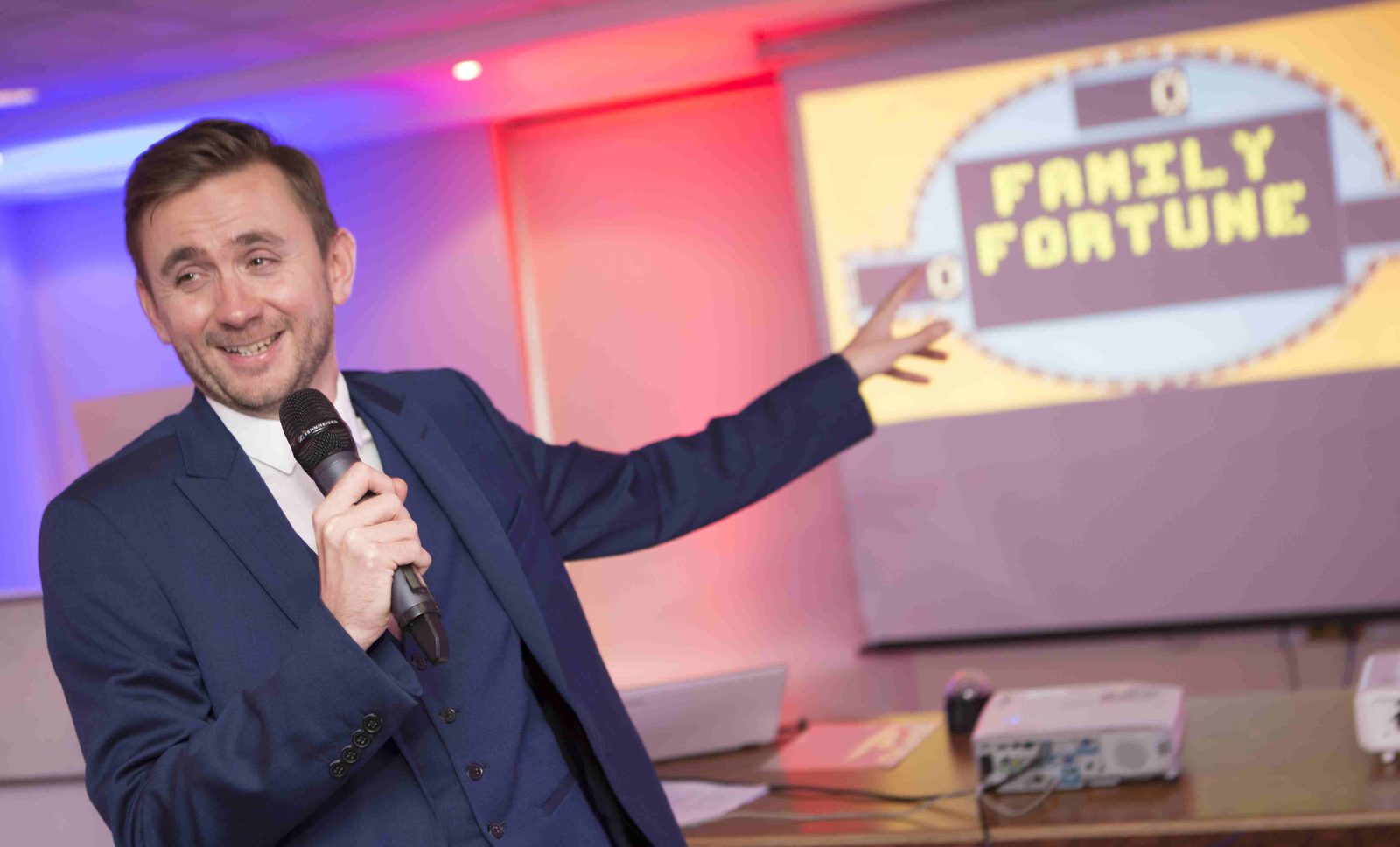
Game show formats. Interactive game show formats that put audience members at the front of the room have grown significantly in UK corporate entertainment over the last decade. Formats adapted from television, including Family Fortunes, The Generation Game, and Play Your Cards Right, work well because they create stakes, generate genuine laughter, and involve the whole room even when only a few people are participating directly. I run these as part of my own entertainment service, and the conversion from sceptical audience to fully engaged room is usually complete by the third round.
Comedy acts. A stand-up set or comedic host works well when the audience knows each other well enough for shared references to land. For mixed-audience evenings that include clients or external guests, comedy acts need more careful selection: topical material that hits the wrong note in a room full of colleagues and clients is difficult to recover from.
Charity auction segments. For events with a fundraising element, a live auction segment with a skilled auctioneer dramatically outperforms a silent auction or bucket-collection format. The energy of a live auction, when run well, makes giving feel like a celebration rather than an obligation. Over 20 years running charity auctions, I have seen well-structured live auction segments raise three to four times what the same auction would have raised in silent format.
Magicians and close-up entertainment. Table magic during drinks receptions or dinner is a reliable option for adding atmosphere without requiring audience attention or a stage. It works at any audience size and can accommodate guests arriving at different times.
What entertainment works at a full-day conference?
The challenge at a conference is different from an evening event. Delegates arrive for the content, not the entertainment. The entertainment’s job is to maintain energy, create recovery moments in a dense schedule, and avoid competing with the event’s primary purpose.
Corporate entertainment ideas that work within a conference format:
A conference quiz or team challenge. A mid-morning or post-lunch quiz, structured around the event’s themes or general knowledge, gives delegates a break from passive listening and creates a reset moment in the day’s energy. Cvent research notes that 65 per cent of consumers say they understand content better when they experience it through a live, participatory format: the same principle that makes a quiz more effective than another presentation. It works best when facilitated by the conference host rather than a separate entertainer, which avoids the programme disruption of introducing a new face mid-day.
After-dinner entertainment at a conference dinner. If the conference includes an evening meal, this is where a headline entertainment act fits most naturally. The formal day has ended, delegates are relaxed, and the entertainment can have more freedom than anything during programme hours.
Awards or recognition segments. A well-run awards segment, even an informal one, gives the conference a meaningful high point. The award ceremony format within a conference context needs the same precision as a standalone event: category management, winner management, and a host who knows the names.
Keynote performers. Some conferences use a skilled communicator, whether a comedian, storyteller, or motivational speaker, to close the day rather than leave on a purely functional note. This works when the performer’s style aligns with the event’s tone and the audience has not already sat through six hours of dense content.
How do corporate entertainment ideas vary by event type?
The entertainment format that works depends on three variables: audience relationship, event formality, and primary objective.
Audience relationship. An internal staff event can accommodate entertainment that relies on shared references, in-jokes, and participation from people who know each other. A client hospitality evening or mixed-audience event needs entertainment that does not rely on existing relationships to land.
Event formality. A black-tie awards ceremony has a different entertainment register from a casual team social. Game shows, interactive formats, and audience participation work better in informal contexts. Live performance, structured entertainment, and formal recognition segments suit higher-formality events.
Primary objective. If the event’s primary purpose is networking, entertainment that forces prolonged passive attention reduces the time available for the event to do its actual job. Short entertainment moments at transition points in a networking event work better than long performance sets.
The most common corporate entertainment mistake I encounter is selecting an act or format before defining which of these three variables should take priority. Entertainment selected because it is well-reviewed, because it fits the budget, or because it worked at a previous event with a different audience, profile, and purpose is entertainment that may not land.
What corporate entertainment should you avoid?
The entertainment options that consistently underperform at UK corporate events share a common characteristic: they require the audience to do something they have not consented to.
Forced participation. Audience members who are pulled from their seats and put in front of colleagues, clients, or senior leadership without choosing to be there rarely perform as entertainment. When it goes wrong, the discomfort is visible to the whole room.
Acts without a brief. Any external entertainer who has not been briefed on the audience, the event’s tone, and what topics or references are off-limits is a risk. This applies particularly to comedy formats, where material that works for a general audience may land badly in front of a specific corporate group.
Entertainment mismatched to the programme position. High-energy entertainment immediately after an emotional speech, or light comedy immediately before a serious presentation, creates a tonal collision that neither element recovers from easily. Sequence and timing matter as much as the quality of the act.
The gap moment. When entertainment ends, something needs to happen next. Events without a professional host at the front of the room often have a visible gap between entertainment segments where no one is clearly in charge. This is the moment where the evening loses momentum, and it can take the rest of the night to recover.
Where does the event host fit in?
The missing element in most corporate entertainment conversations is the professional who holds the evening together between acts. Entertainment works best when each element is introduced, contextualised, and transitioned from by someone who understands the programme and the audience.
An experienced event host is not a separate line item to an entertainment budget. They are the connective tissue that makes the entertainment work as a programme rather than a sequence of unrelated acts. Without a host, you have segments. With a host, you have an event.
The distinction matters most in these moments:
- The transition from formal dinner to entertainment
- The gap between an entertainment act and a presentation or speech
- The management of pace when an act runs over or under time
- The recovery when something goes technically wrong
A host who has managed 200 corporate evenings knows what to do in all four situations. An entertainment act who has been told “just come on after the dinner speaker” does not.
How to choose corporate entertainment for your event
Start with audience and objective, not format. Once you know who is in the room and what the evening needs to achieve, the right entertainment category becomes much clearer.
For any format you are considering, ask:
- Has this worked at a similar audience size, formality, and industry before?
- Has the act or entertainer been briefed on the specific audience?
- Who is managing the transitions between this entertainment and the rest of the programme?
The last question matters most. If the answer is “we hadn’t thought about that,” budget for a professional host before finalising the entertainment spend. The conference host or awards evening host who manages transitions, timing, and the unexpected will do more for the quality of the evening than any single entertainment act.
If you are planning a corporate event and want to discuss how professional hosting fits alongside the entertainment you have in mind, get in touch.
If you are weighing up options, my guides on choosing an entertainer, corporate party entertainment and virtual corporate entertainment go deeper on each.