In short
- Large group team building activities fail for one reason more than any other: too many people watching, not enough people playing.
- The fix industry-wide is breaking a big room into smaller rotating subgroups, typically 8 to 12 people, so nobody’s stuck spectating for the whole session.
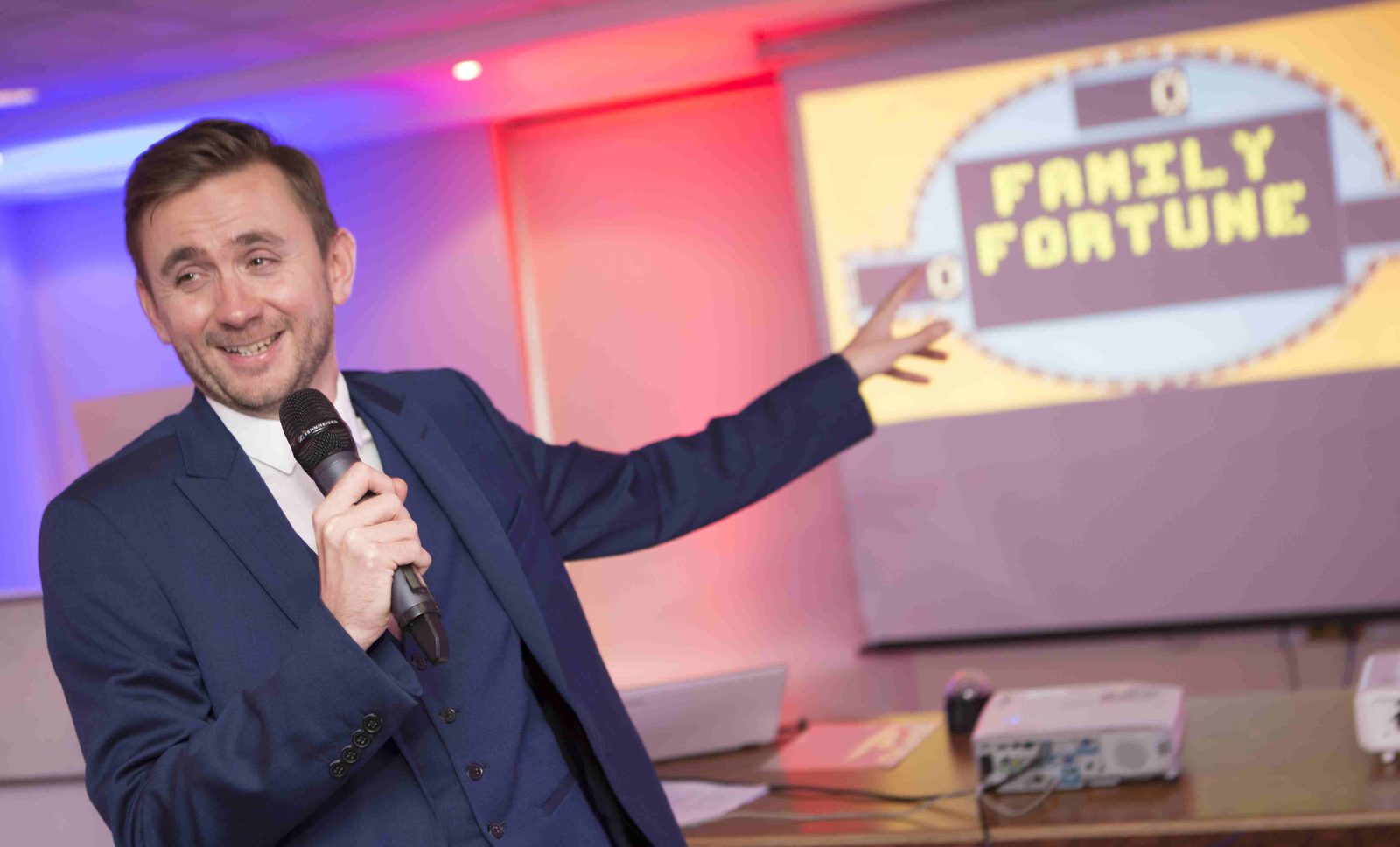
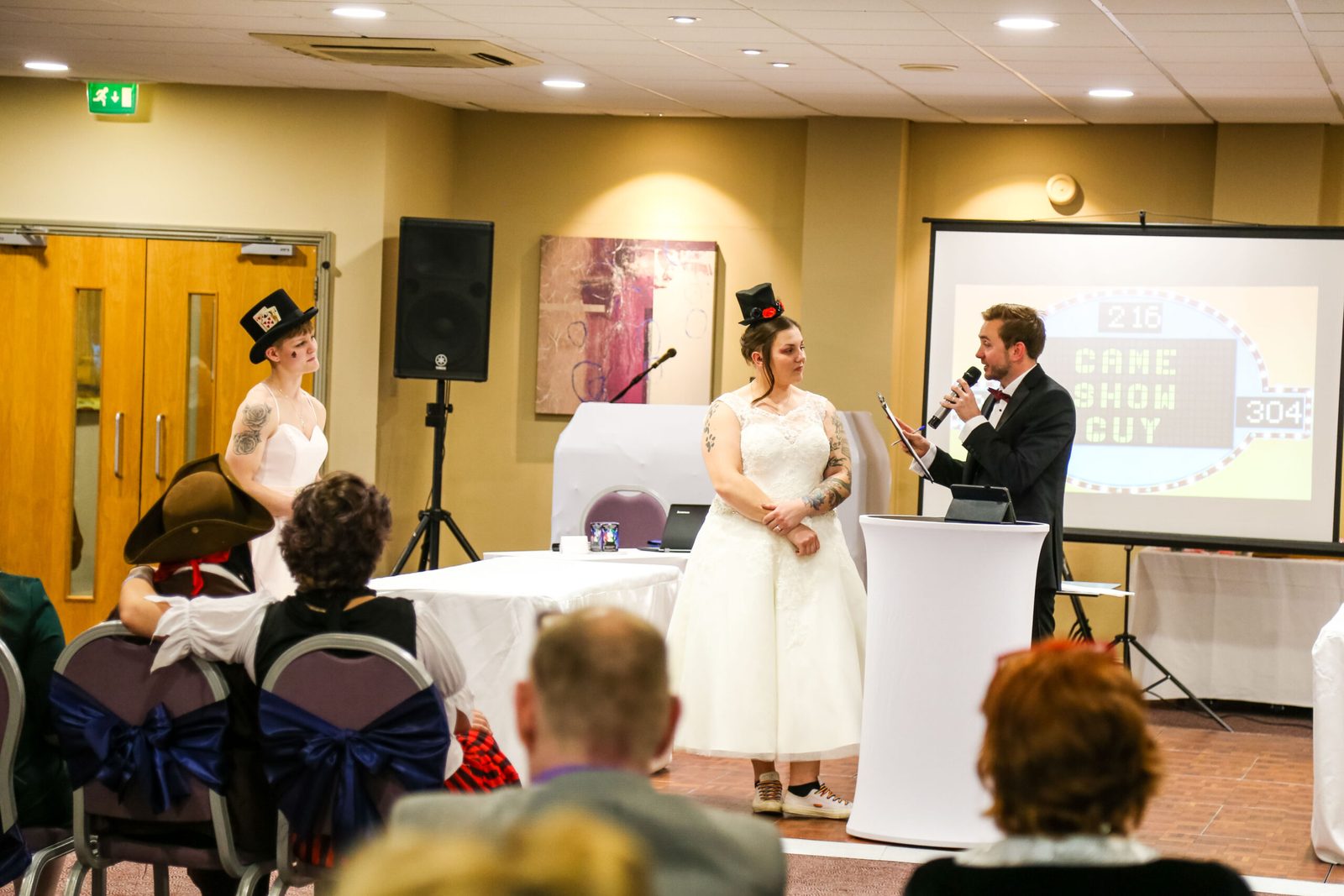
- My version of that fix, for Family Fortunes specifically, is splitting the whole room into two big teams and rotating who’s up at the buzzers each round.
- Play Your Cards Right scales differently: it runs table-by-table, so almost every table in a large room is playing at once.
- The show itself stays the same regardless of headcount: a produced format built for your room.
The hardest number in team building isn’t the budget. It’s the headcount. Once a room passes about eighty or a hundred people, most activities that worked brilliantly for a team of fifteen simply stop working, not because the format is bad, but because most of the room ends up watching instead of playing.
This guide covers what actually holds a large group’s attention: the rotating-subgroup principle nearly every team-building resource lands on, and how I apply it specifically through hosted, interactive entertainment built for rooms this size. It’s the same problem I’ve spent years solving for award ceremonies, conferences and large-scale corporate events, where a room full of people watching one person at a microphone is exactly the outcome you’re trying to avoid.
Why do large group team building activities usually fail?
Large group team building activities usually fail because too few people are actively involved at once. A quiz with one person holding the microphone and ninety people listening isn’t team building, it’s a lecture with a scoreboard.
The fix that keeps coming up across industry guidance on group sizing is breaking a big room into smaller rotating subgroups, typically 8 to 12 people, so everyone gets genuine airtime rather than passive attendance. That principle holds whether you’re running a DIY activity or a hosted one.
Large group team building activities that actually work at scale
Formats that work at scale share one trait: they’re built around simultaneous participation, not sequential turns. SessionLab’s collection of large-group games leans heavily on exactly this, activities where multiple sub-teams are doing something at the same time rather than queuing for a turn.
Practical options that hold up past 80 to 100 people include: rotating subgroup challenges, simultaneous table-based competitions, and hosted formats with a live scoreboard that gives every sub-team something to chase throughout. What doesn’t scale well: anything that needs one person or one team at the front while everyone else waits their turn.
How does splitting the room into two teams solve the large-group problem?
Splitting the room into two teams solves the large-group problem by turning everyone into a player, not an audience member. For Family Fortunes, my signature move is dividing the whole room into two big teams and rotating who’s up at the buzzers each round, so nearly everyone actually gets a turn rather than the same five confident colleagues doing it all.
This works because it removes the biggest failure point in large-group formats: dead time. Nobody’s sitting through twenty minutes of watching someone else play before their go comes round. The rotation keeps the pace tight and the whole room invested in every round, not just their own.
Play Your Cards Right: a different way to scale for large groups
Play Your Cards Right scales table-by-table rather than through a central split, which suits rooms where guests are already seated at tables, like award ceremonies, conferences and gala dinners. Nearly every table plays at once, so a room of 200 has roughly the same energy as a room of 40, just spread across more tables.
This is a genuinely different mechanism from the Family Fortunes room-split, and I choose between them (or combine them) based on the venue and how the room’s seated. A theatre-style large group suits the split-room format. A banqueting-style large group with round tables suits Play Your Cards Right. Some large events benefit from both across an evening: a split-room round for a big shared moment, table-by-table rounds woven through dinner so nobody’s just sitting and watching between courses.
What does it take to run a hosted format for a large group?
Surprisingly little from you. What I bring, and the show itself, is the same for a room of two hundred as it is for a room of twenty. I am set up and ready within minutes of arriving, and it is the format that does the scaling, not anything you have to lay on.
What does scale with headcount is the writing. For a large group I still build the questions and rounds around the specific audience, but I structure the rotation and pacing more tightly, because a large room forgives dead air far less than a small one does. I’ve used this exact interleaving approach at award ceremony hosting work too: mixing game rounds through a bigger evening keeps the energy up for the people who aren’t up on stage collecting anything, which is most of the room at any large event.
How many people can one host actually manage?
There’s no hard ceiling with the right format. I’ve run interactive game show entertainment for rooms well past a hundred people using the split-room and table-by-table approaches above. The limit isn’t headcount, it’s whether the format has a mechanism for keeping that many people simultaneously involved. Large-team resources consistently point to the same conclusion: past a certain size, the activity has to be redesigned for scale, not just run louder.
The honest answer for any format, including mine, is to ask directly before booking: how does this specific activity keep 150 people playing at once, not just 15 up front. If the answer is vague, it probably doesn’t scale. I’d rather walk a client through exactly how the rotation or table mechanic works before they book than let them assume it’ll simply be a bigger, louder version of a small-group activity, because that assumption is where most large-group days go wrong.
What does a hosted large-group format actually cost?
I won’t quote a figure here, because it depends on headcount, format and how long you want on the day, and I’d rather talk it through properly than throw out a number that doesn’t fit. What I can say is that cost doesn’t scale linearly with headcount the way people often expect.
What I bring, and the show itself, doesn’t change much between a room of fifty and a room of two hundred. What does change is planning time: a bigger room needs a more carefully structured rotation to avoid dead spots, and that planning happens well before the day itself. If you want a proper conversation about what would actually work for your headcount, get in touch through eventhost.info rather than assuming a large group automatically means a large, generic package.
Quick answers: large group team building activities
What group size counts as “large” for team building? Most guidance draws the line somewhere around 50 to 80 people, where activities designed for a single team stop working and formats need a built-in rotation or scaling mechanism.
Do large groups need more budget than small ones? Not necessarily proportionally. A hosted format’s core doesn’t change with room size; what scales is planning time, not what I bring on the day.
Can a large group activity still feel personal? Yes, if the questions and rounds are written for that specific audience rather than generic. A quiz with your company’s actual in-jokes lands the same way at 150 people as it does at 15, because everyone recognises the references even if they’re not the one holding the buzzer.
Does engagement really matter for a one-off team day? It’s not just a nice-to-have. UK employee engagement sits at roughly one in four, and a genuinely well-run large-group day, one where people actually play rather than watch, is one of the more direct ways to move that number, even if only for an afternoon. For the fuller picture of what else fits into a team building activities day, see the wider guide.