
In short
- The best team building activities for small groups (roughly 3 to 15 people) are more personal and less staged than a whole-company day, built around everyone actually contributing.
- Trust and connection exercises like the Human Knot or Paper Holding Challenge work well because there’s nowhere to hide in a small circle.
- Icebreakers like Two Truths and a Lie or Blind Drawing need almost no prep and suit a single team meeting.
- Hosted formats still work for small groups. I just run a smaller, more intimate version, tables of five to seven rather than a whole-room split.
- The goal for a small group is depth, not scale: fewer people means more chance for a genuine moment, not less.
A team of eight doesn’t need what a company of two hundred needs. The best team building activities for small groups lean into that intimacy rather than trying to imitate a bigger event on a smaller budget.
This guide covers team building activities for small groups that actually work: quick icebreakers, trust exercises, collaborative challenges, and where a hosted format still earns its place even at this scale.
What counts as team building activities for small groups?
Most team building activities for small groups are designed for roughly 3 to 15 people, sometimes stretching to 20. Below that range, informal chat usually does the job better than a structured activity. Above it, you start needing the logistics and pacing of a bigger event.
The advantage of staying in this range is that everyone gets real airtime. In a room of 100, most people watch. In a group of eight, everyone plays, answers, or contributes almost every round. That’s the whole appeal, and it’s worth designing the day around it rather than fighting it.
Group size also changes what kind of trust you’re building. A whole-company day tends to build broad, surface-level familiarity across a lot of people. A small group day can go deeper, because everyone already half-knows everyone else, and the activity just gives that existing relationship room to develop.
Quick icebreakers for a single team
For a normal team meeting or a short slot, these need no equipment and work well for any small group:
- Two Truths and a Lie: still the most reliable format in existence. Zero cost, five minutes.
- Blind Drawing: pairs sit back to back, one describes an image, the other draws it from instructions alone. HRMorning ranks it as one of the best small-team formats specifically because it forces precise communication.
- Penny for your thoughts: everyone draws a coin and shares a personal story or memory tied to the year stamped on it. Genuinely reveals things a normal 1:1 never would.
- Question Time: a round of increasingly specific personal questions, works especially well for a newly formed small team that hasn’t properly gelled yet.
Trust and collaboration exercises for small groups
Once you’ve got 20 to 30 minutes and a bit of space, these exercises work because a small group can’t hide behind numbers:
- The Human Knot: the group stands in a circle, grabs two different people’s hands, and works together to untangle itself without letting go. SessionLab notes it’s built for groups of 7 to 12, which puts it squarely in small-team territory.
- Paper Holding Challenge: in groups of 2 to 5, teammates hold as many individual sheets of paper off the floor as possible without folding or touching them together, forcing genuine coordination.
- Salt and Pepper and similar pairing games: quick, low-stakes ways to mix up who’s talking to whom within a small team.
These land well precisely because a small group has nowhere to hide. Everyone has to actually engage, which is exactly what playmeo’s list of small-group activities is built around.
Why do small groups need different activities from a company-wide day?
A small group needs activities built for depth, not scale. The whole point of a small team day is that everyone gets real airtime, and an activity designed for a room of 200 (rotating stages, multiple simultaneous tables) wastes that advantage rather than using it.
The flip side matters too: an activity built for eight people, dropped into a room of 150, usually falls flat because most of the room ends up watching rather than playing. Matching the format to the actual headcount is the single biggest factor in whether a team day lands.
Does hosted, interactive entertainment work for small groups too?
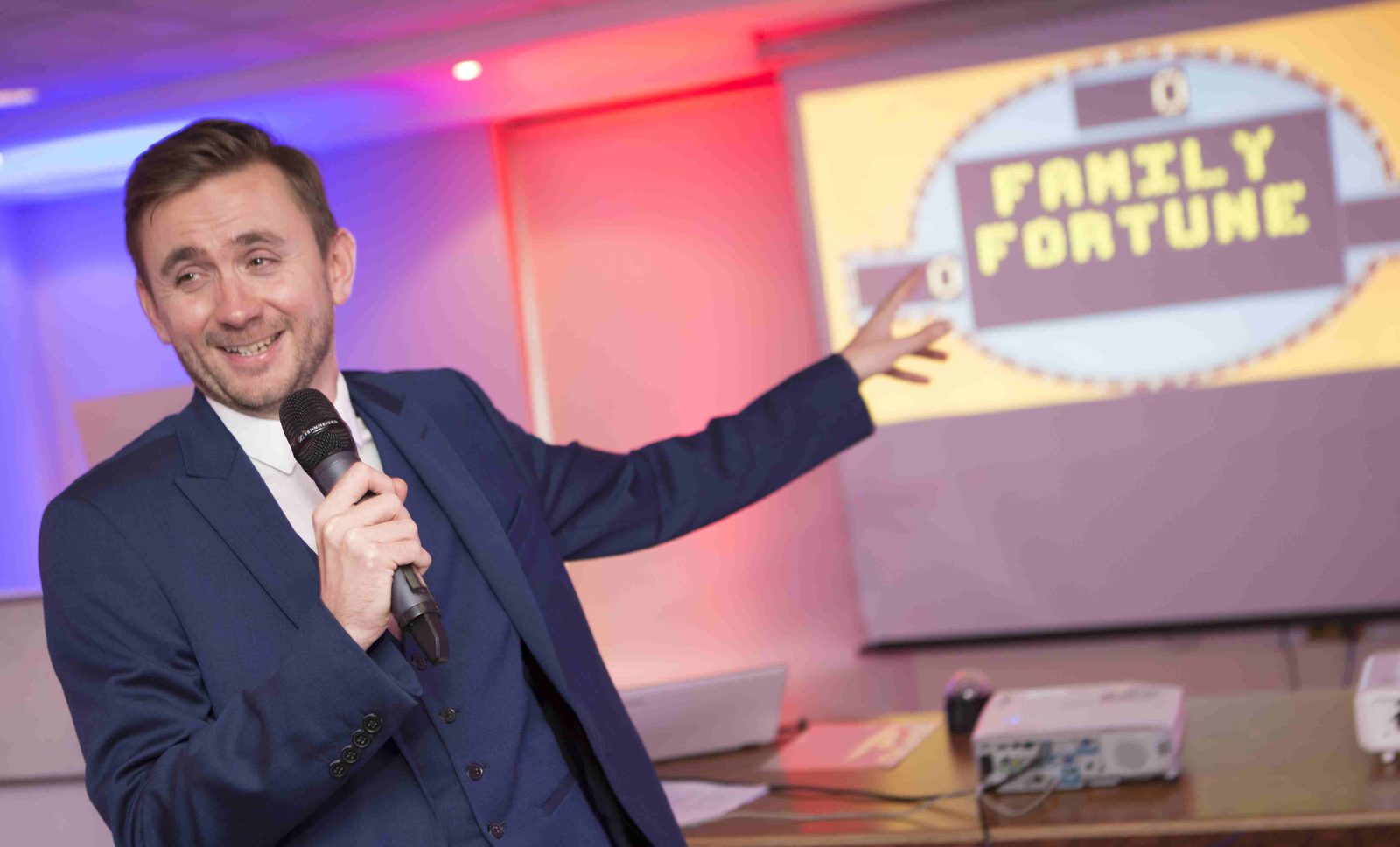
Yes, scaled down. I run the same TV-style formats, Family Fortunes, The Generation Game, Play Your Cards Right, for a single small team as I would for a room of two hundred, just adjusted for the size in front of me. For a group of eight to fifteen, that usually means everyone plays every round rather than rotating in and out, because there’s no need to split a group that small into shifts.
The show doesn’t change: the same produced format drops into whatever room you’ve got. What changes is the pacing. A small group can move through more rounds in less time because there’s no queue and no waiting for a table to finish.
I still write the questions specifically for the group in front of me, in-jokes and all, which matters even more at this scale. A generic quiz sheet is easy to spot in a room of eight. A round built around your team’s actual running jokes lands completely differently, and it’s part of why very few entertainers offer that level of customisation for a group this size.

How do you plan a small group team building day?
Start with the goal, not the activity. A newly merged team needs different exercises from a team that’s been together five years and just wants a good afternoon off. I ask what the day actually needs to achieve before suggesting a format, the same discipline I bring to a full team building activities day at any size.
Keep the guest list genuinely small if that’s the point. Adding “just a couple more people from another team” changes the dynamic fast, and a Human Knot built for ten doesn’t work cleanly for eighteen.
Budget planning is simpler at this scale too. A small group means fewer catering covers, a smaller room, and often no need for a dedicated venue at all if your own office has a spare meeting room. That frees up spend for the activity itself rather than the logistics around it, which is exactly where a hosted format tends to earn its keep for a group this size.
Quick answers: team building activities for small groups
What’s the ideal group size for team building activities? Most small-group formats work best between 3 and 15 people. Below that, informal time together often works better than a structured activity.
Do small groups need a hosted format at all? Not always. A single team meeting can run entirely on free icebreakers. A hosted format earns its place when the day matters more, an anniversary, a milestone, or a genuine “thank you” to the team, and you want something more memorable than a quiz sheet.
What if only part of the team can attend? Keep the activity flexible enough to fold in stragglers without breaking the format. Icebreakers and hosted games both handle this better than tightly choreographed physical challenges do.
Is a small group day less valuable than a big company event? Not at all. UK employee engagement sits at roughly one in four, and a genuinely good small-team day, built around real connection rather than scale, often moves that needle further than an expensive whole-company event that most people quietly sit through.