In short
- The hard part of christmas party games for large groups is not the game, it is stopping most of the room from becoming spectators.
- The single most useful technique: rotate different people up each round rather than running two fixed teams all night.
- Team and table-based formats work best at scale because everyone contributes without anyone being exposed alone.
- A big room needs someone actively driving the energy, because it drains far faster than in a small group.
- The right game for 100 people is rarely the same as the right game for 10.
Games that work brilliantly for a team of ten often fall apart at a party of a hundred, for one simple reason: at scale, it is easy to end up with a handful of people playing while everyone else watches. Here is how to choose christmas party games for large groups that actually keep the whole room involved, based on what I have seen work at big corporate events.
Why are christmas party games for large groups harder to get right?
Christmas party games for large groups are harder to get right because size works against participation. A game that naturally includes ten people will, at a hundred, tend to occupy a few volunteers at the front while the rest of the room drifts. The bigger the group, the easier it is to accidentally build a spectator sport.
Energy is the other challenge. In a small room, a lull recovers quickly. In a large one, a flat moment spreads: whole tables disengage, conversations start up, and the room fragments into small groups who stop paying attention to the front. A big group needs more deliberate structure and more active energy management, not less.
There is also the mix of people to think about. A large corporate party often spans several departments who barely know each other, different age groups, and a wide range of appetites for being in the spotlight. A game that assumes everyone is up for the same thing will lose a big chunk of the room. The formats that work at scale give people different ways in, so the outgoing crowd and the reserved crowd can both feel part of it without either being forced.
The event is worth that effort. An academic study on the company Christmas party and employee happiness found it functions as a genuine annual ritual for staff, so a party that leaves most of a large room watching is a real missed opportunity.
What is the best technique for keeping a large group involved?
The best technique for keeping a large group involved is to rotate different people up for each round rather than running two fixed teams for the whole night. It sounds small. It is the single biggest thing that separates a big-group game that works from one that does not.
I use this at scale constantly. With two fixed teams, the same handful of faces play every round while everyone else spectates from the start. By rotating who comes up each round, far more of the room gets an actual turn over the course of the evening, and nobody sits watching the same two teams for an hour. It also keeps the pace up, because fresh players keep each round lively and no single round drags on.
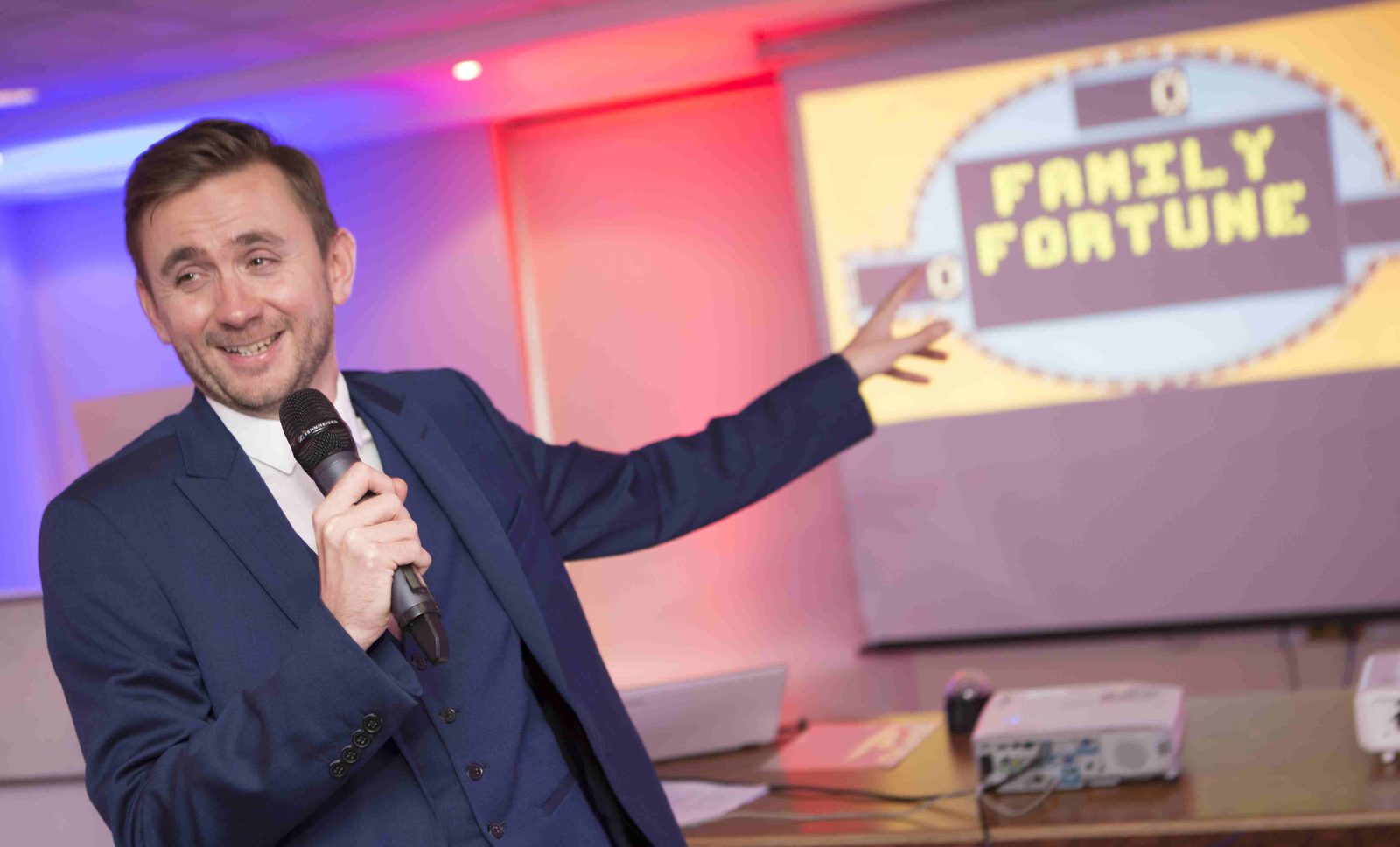
Having hosted events for crowds far larger than any Christmas party, up to festival audiences of over 80,000, the principle holds at every scale: the more of the room that gets to actively take part, the better the whole thing feels. You can see the formats built for this on the game-show hire page.
Christmas party games that work for a large group
The christmas party games that work for a large group are the ones where everyone can contribute at once, usually through teams or tables rather than individuals at the front. Formats that scale well include:
- A team quiz run across every table simultaneously, so hundreds of people play at the same time.
- A game-show format where each round pulls fresh volunteers from different tables.
- A “table versus table” competition with a running scoreboard across the night.
- Name that tune played in teams, which gets a big room roaring quickly.
- A bingo-style game everyone holds a card for, which includes the entire room by default.
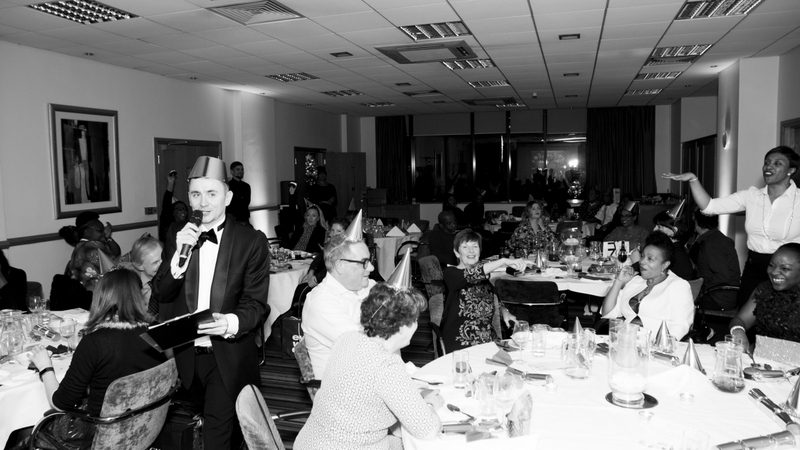
The common feature is that participation does not bottleneck at the front. When the activity happens at the tables, or rotates through the room, a group of two hundred can be as involved as a group of twenty. That is what you are aiming for. This kind of interactive format sits at the heart of the corporate entertainment options that suit bigger parties.
Sound and sightlines matter more than people expect at this size, too. In a large room, guests at the back can quickly feel like they are watching something happening to other people if they cannot hear or see it clearly. A format built for scale accounts for that: it uses the whole room, keeps everyone holding something or doing something at their table, and does not rely on people at the back straining to follow a game playing out fifty feet away. Get that wrong and the room splits into the people near the front who are involved and the people at the back who have quietly started their own conversations.
Why does a large group need a host more than a small one?
A large group needs a host more than a small one because the bigger the room, the harder it is to hold together without someone actively driving it. A small team can run a quiz off a phone. A room of a hundred and fifty needs someone reading the whole room, managing the pace, and lifting the energy the moment it dips.
There is evidence behind why the active version works: people engage with and remember an experience far more when they take part than when they watch, the same effect that makes active learning beat passive formats. At scale, keeping that many people actively taking part rather than drifting into spectating is a real skill, and it is precisely the job a professional host does without it showing.
Quick answers: christmas party games for large groups
What is the best way to involve a large group? Rotate different people up each round rather than running fixed teams, and run activities at the tables so the whole room plays at once rather than a few people at the front.
What games work for 100 people or more? Team quizzes, a rotating game show, table-versus-table competitions, and bingo-style games all scale well because everyone can take part simultaneously.
Do you need a host for a large group? For anything above a small team, yes. A big room drains energy fast and needs someone actively managing the pace and keeping people involved.
Why do big-group games often fail? They tend to occupy a few volunteers while everyone else watches. The fix is structure that spreads participation across the whole room.
One planning tip for a big party: decide the game and the room layout together. A format that needs people to move around works in one venue and is a nightmare in another, and a seating plan that mixes departments does half the ice-breaking for you before a single game starts. The logistics and the entertainment are not separate decisions at this scale; they shape each other.
If your Christmas party is a big one and you want the whole room playing rather than a few people at the front, tell me the numbers and the venue and I will suggest a format built to scale. There are more ideas on the christmas party ideas page.