- Good corporate Christmas party ideas start with three decisions: budget per head, format, and guest list, locked in before you contact a single venue.
- Book your venue 6 to 9 months ahead for a good choice of December dates, and no later than 4 to 6 months out even at the last resort. Popular Friday and Saturday dates disappear by October.
- UK budgets typically run £70 to £150 per head including venue, food, drink and some entertainment. Keep total cost per head at or under £150 (including VAT) if you want the event to qualify for HMRC’s tax exemption on staff parties.
- A daytime or midweek event is cheaper and easier to book than a Friday evening in December, and often suits teams better if people are working the next day.
- One in four UK adults has a dietary restriction, so build a pre-order form into your planning from the start, not as an afterthought two weeks out.
- The entertainment matters less than most organisers think. What actually makes a party work is someone experienced holding the room together between segments.
Every December, the same problem repeats itself across UK offices: the party gets discussed in September, the venue shortlist happens in October, and by the time anyone commits, the good dates and the good venues are gone. Corporate Christmas party ideas are easy to find. A plan that actually gets you to the night without a scramble is harder.
This guide covers the full planning sequence: when to book, what to budget, which format suits your team, and the logistics that quietly decide whether the evening feels effortless or chaotic. If you want a deeper look at entertainment formats specifically, that is covered in its own guide. This one is about everything around it.
Corporate Christmas party ideas: where should you start?
Start with three decisions before you look at a single venue: your budget per head, your format (lunch, evening dinner, or something less traditional), and who is actually invited.
These three decisions drive everything else. A budget of £50 a head points you toward a shared party night or a daytime event. A budget of £120 a head opens up exclusive venue hire and a proper sit-down dinner. Deciding early who is invited (whole company, one department, partners and plus-ones or not) stops the guest list creeping upward after the venue is already booked.
Most UK corporate Christmas parties run £70 to £150 per head once venue, food, drink and some entertainment are included, though this varies a lot by region and company size. London averages sit noticeably higher than the rest of the UK. Get the number agreed with whoever holds the budget before you start talking to venues, not after.
When should you book a corporate Christmas party?
Book your venue 6 to 9 months out if you want real choice, and no later than 4 to 6 months out as an absolute minimum. December has a fixed number of Fridays and Saturdays, and every company in the country wants the same ones.
Top venues in major UK cities typically fill their December calendars by June, and confirmed bookings for the wider market peak in October and November, by which point the popular dates and venues are already gone. Holiday-specific venue demand generally needs 4 to 6 months’ lead time at a minimum, because entertainment and event spaces are also fielding private parties and public holiday programming through the same weeks.
If you are reading this in spring or early summer, you are exactly on schedule. If it is already October, you are not too late, but your venue and date options will be considerably narrower, and you should expect to pay a premium for whatever is still available.
What’s a realistic corporate Christmas party budget in the UK?
A realistic corporate Christmas party budget in the UK sits between £70 and £150 per head, with the exact figure depending on your region, company size, and how much of the evening is exclusive hire versus a shared party night.
Company size changes the maths considerably. Smaller businesses often spend more per head because fixed costs (room hire, staffing) are spread across fewer people, while larger businesses can spend less per head on a bigger, more elaborate event because those same fixed costs are shared across a bigger group:
| Company size | Typical spend per head | Typical total budget |
|---|---|---|
| Small (10 to 20 staff) | £60 to £90 | £600 to £1,800 |
| Medium (50 to 100 staff) | £50 to £80 | £2,500 to £8,000 |
| Large (200+ staff) | £45 to £70 | £9,000 to £70,000+ |
These figures come from Groopeze’s 2025 cost analysis, which also notes that exclusive private venue hire generally costs more per head than a shared party night, where hotel packages bundling a three-course meal, DJ and decorations can come in around £60 a head.
There is one number worth building your budget around deliberately: £150 per head. That is the threshold for HMRC’s staff party exemption. If your total cost per head, including VAT, transport and any entertainment, stays at or under £150, the party is exempt from tax as a benefit in kind. Go even a penny over and the whole amount becomes taxable, not just the excess. The event also needs to be open to all employees generally, not restricted to certain teams, and it needs to be a recurring annual fixture rather than a one-off. If you are already running a summer event, the £150 allowance applies per person per tax year across both events combined, so you may need to choose which one to apply it to.
Always build in a contingency of 10 to 15 per cent on top of your working budget. Menu changes, last-minute headcount increases and additional taxis for stragglers all eat into a tight number faster than organisers expect.
Building your corporate Christmas party timeline
A Christmas party that feels effortless on the night is the result of a timeline that started months earlier, not a burst of activity in the final fortnight.
6 to 9 months out:
- Agree budget per head and total ceiling
- Confirm headcount range and who is invited
- Shortlist and visit venues
- Decide format: lunch, evening dinner, or shared party night
4 to 6 months out:
- Book the venue and pay the deposit
- Confirm date, timings and catering format (sit-down, buffet, canapés)
- Check accessibility, parking and transport links
2 to 3 months out:
- Send a pre-order form covering menu choices, dietary needs and allergies
- Book any entertainment
- Set an RSVP deadline
4 to 6 weeks out:
- Chase non-responders
- Confirm entertainment running order and timings
- Arrange transport or taxi coordination for the end of the night
1 to 2 weeks out:
- Submit final headcount to the venue
- Brief the team on timings, address and parking
- Confirm who is handling any last-minute changes on the night
This sequence draws on the same logic as venue planning checklists used across the UK events industry: front-load the decisions that lock in scarce resources (venue, date), and leave the flexible decisions (menu choices, final numbers) for closer to the event.
Which format suits your event: dinner, lunch, or shared party night?
The right format depends on your budget and your team, not on tradition. A sit-down evening dinner is the default, but it is not automatically the best option for every company.
A daytime or lunchtime event has real advantages: people are fresher, less likely to overdo the drinks, and lunchtime slots are both easier to book and often better priced than evening ones. It also removes the late-night taxi logistics entirely. The trade-off is a shorter, more contained event rather than a long, relaxed evening.
An evening event suits teams who want a proper night out, and it gives more room for entertainment and a longer social window. Within that, the day of the week matters more than most organisers assume. Christmas parties held Sunday to Thursday are generally cheaper than the same event on a Friday or Saturday, and midweek dates are considerably easier to book at short notice.
A shared party night, where your company joins others at a hotel or venue running the same package on repeat through December, is the most budget-friendly option for smaller teams, typically landing at the lower end of the per-head range. Exclusive hire costs more but gives you full control over the room, the running order and who else is in the building.
What entertainment should you book?
Whatever entertainment you choose, the goal is the same: get people talking to each other, not just standing near each other.
The current shift in UK corporate Christmas parties is away from passive entertainment and toward things people actually do. Interactive formats like team game shows, photobooths and treasure hunts are displacing purely watch-from-your-seat acts, partly because they work for non-drinkers too. That matters more than it used to: roughly 36 per cent of 18 to 24-year-olds now identify as teetotal, so an evening built entirely around the bar leaves a chunk of the room with nothing to do.
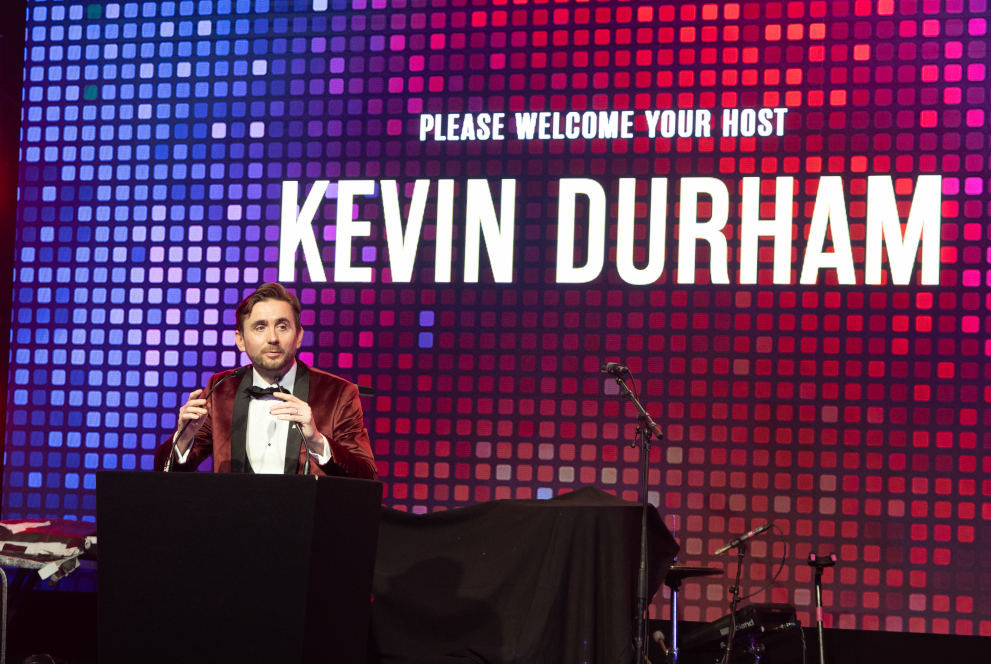
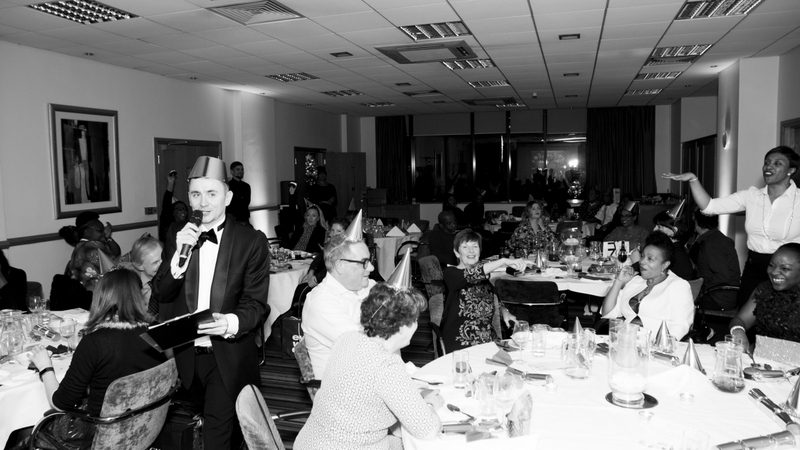
In my experience running corporate entertainment formats like Family Fortunes and The Generation Game at company events, the sessions that land best are the ones where the whole room can see themselves competing, not just watching two volunteers on stage. It gives quieter team members a reason to get involved without having to perform.
Some companies are also folding their Christmas party into a wider end-of-year event, pairing it with an awards evening or a short year-in-review session before the entertainment starts. This works well if you already run an annual awards night and want to avoid asking people to turn out for two separate evenings in the same month.
This guide deliberately stays at the planning level rather than the format level. If you want a full breakdown of specific entertainment options and how to choose between them, that deserves its own guide rather than a rushed section here.
Getting the logistics right: transport, dietary needs, and accessibility
The details that go wrong at Christmas parties are rarely the big decisions. They are the small logistics that nobody owned.
Dietary needs are the most common gap. One in four UK adults has a dietary restriction, so a pre-order form covering allergies and preferences needs to go out well before the event, with the kitchen given at least two weeks’ notice on the final numbers. Leaving this to a show of hands on the night guarantees someone gets forgotten.
Transport and accessibility decide how many people actually enjoy the end of the evening. A venue within a short walk of a major transport hub measurably improves attendance compared with one that needs a taxi or a long walk in December weather. If your venue is harder to reach, agree taxi arrangements or a shuttle in advance rather than leaving people to sort it themselves at 11pm.
Finally, confirm parking, cloakroom capacity and step-free access if any part of your team needs it. None of these take long to check. All of them are the kind of thing that only gets noticed when it is missing.
Why the details determine whether the party works
I have hosted enough corporate events, Christmas parties, conferences and awards evenings alike, to notice the same pattern every time. The parties that feel flat are almost never the ones with the wrong entertainment. They are the ones where no one was actively holding the room together between the dinner, the speeches and whatever comes after.
That is the same lesson I have taken from hosting full-day conferences: energy does not sustain itself. It needs someone deliberately managing the peaks and the lulls, briefed properly in advance so nothing on the night is a surprise. A Christmas party has fewer moving parts than a conference agenda, but the same principle holds. The evening runs smoothly because someone experienced is holding it together, not because the venue or the menu happened to be good.
If you are planning a corporate Christmas party and want an experienced host to run the evening, from welcome to last orders, get in touch to check availability for December.
For entertainment that involves the whole room rather than a few volunteers, see corporate party entertainment.
Booking entertainment for this December?
Kevin hosts a live game show where every guest plays on their own phone. See the corporate Christmas party entertainment page and check your date.