

- Home
- Blog
- Event Host Blog
- End of year awards: planning a company evening that covers everyone
End of year awards: planning a company evening that covers everyone
 By Kevin Durham, event host and MC
1 November 2026 · updated 26 October 2026
8 min read

In short
- Build the end of year awards category set off your org chart, not a list of award names. If you cannot say how someone in payroll reaches the stage, payroll is not in your awards.
- Split the awards into two blocks with something in between. Twelve in a row after dessert is where the room goes quiet.
- Warmth comes from the citation: give the room the reason before the name.
- HMRC’s £150 per head exemption is an aggregate across your annual functions, not a per-party allowance.
Most companies reach late autumn, look at the budget, and decide this is the year they do end of year awards properly. A room, a dinner, some trophies, a proper thank you.
Then the categories get drafted by whoever is free, the awards end up stacked after dessert, and the citations get written in the language of the values poster in reception. Nobody talks about it in February.
I host award ceremonies for a living, and the internal year-end ones are a different animal from an industry ceremony. Everyone knows each other, they know who deserved it, and they are back at their desks on Monday with whoever did not win.

What are end of year awards, and when should you hold them?
End of year awards are a company’s own award ceremony, held at the close of its business year to recognise its own people: no external entrants, no paid entries, no sponsors. Nothing outside imposes a shape on the night, so it comes from your brief. That is the freedom and the problem in one.
Two windows work. December fuses the awards into the Christmas party and saves a budget line, but you are competing with the busiest fortnight in the calendar and a room that came out to let its hair down. January buys you a sober, well-attended evening and a natural link into the year ahead, minus some of the celebration.
Decide that before you book anything: it has a tax consequence. HMRC exempts an annual function available to employees generally where the cost per head does not exceed £150, and the guidance is blunt that the figure is not an allowance. Run two or more and only those that best use the £150 in aggregate are exempt. The cost per head includes VAT, plus any transport or accommodation you lay on.
So if you already run a summer event at £60 a head, a £120 awards dinner is a payroll conversation as well as a diary one.
How do you choose a category set that covers the whole business?
Start from your org chart rather than a list of award names, and ask one question of every function on it: in a normal good year, what would somebody in this team do to get on that stage?
If you cannot answer it, that function is not in your awards. It is in the audience.
Sales-heavy sets happen this way, rarely on purpose. Revenue arrives with a number attached, so it is easy to judge and announce. Payroll closing twelve months without an error, or the facilities manager who moved an office over a weekend: just as hard, and nobody wrote a number down.
The gap shows in the research. Gallup and Workhuman’s study of more than 7,500 US employees found only 26% strongly agree that they get recognition similar to colleagues performing at a similar level, and Gallup’s later work puts the share saying they get the right amount of recognition at just 22%. An evening that confirms what three quarters of your staff suspect is worse than no evening.
Three layers get you a balanced set.
- Cross-business categories any function can win, judged on behaviour rather than output. These make the evening belong to everybody.
- One category per major function, in that function’s own terms. Six of these beats sixteen.
- The headline award, decided last, once you can see what the set already covers.
Keep long service separate from performance: it is the one award where nobody has to lose.
The CIPD’s Good Work Index asked 4,392 UK employees with a line manager, between December 2025 and February 2026, whether their manager recognises a job well done. 69% agreed, 16% sat on the fence and 12% disagreed. Your evening is for the near three in ten who are not hearing it.
Funny office awards work as their own short segment, when the room can tell which awards are the jokes.

Where should the awards sit against dinner and entertainment?
Put them in two blocks with something between them, and never leave all of them until after dessert.
A block of twelve awards is twelve walk-ups, twelve citations, twelve handshakes, twelve photographs. The first four are an event. By the eighth, the back tables are having their own evening, and your biggest winner collects a trophy from a room that has stopped watching.
A client in late 2025 wanted an award ceremony that was not a standard award ceremony, so I interleaved the presentations with game-show rounds built for that audience. Everyone stayed to the end, which at a year-end evening is the only attendance figure that matters. That is the awards hybrid.
A running order that holds a year-end evening
Here is the shape I would build for 100 or so people and twelve awards. The senior speech goes early and stays short, because it is the only part of the night nobody can opt out of, and the gap between the two blocks is what lets the second block land.
- 7.00pm: arrivals and a drinks reception
- 7.30pm: seated, welcome from the host, two minutes from your most senior person
- 7.40pm: starter and main
- 8.45pm: first awards block, the cross-business categories, six at most
- 9.20pm: dessert, and whatever holds the room between the blocks
- 9.50pm: second block, the function awards, long service, then the headline last
- 10.20pm: close, the rest of the night is theirs
The run of show template covers segment timings, pronunciation notes and hard stops. The wider build is in the complete guide to planning an award ceremony.
How do you keep end of year awards warm rather than corporate?
Give the room the reason before the name, and write that reason in the words a colleague would use rather than the words a values framework would.
A citation that works is short, specific and evidenced: what they did, what changed because of it, and one detail only somebody close to the work would know. Read aloud, that is 30 to 40 seconds. Longer becomes a performance review delivered to 200 people.
Ask each nominator for one sentence in their own words, and read it as written. It is never polished. It always beats the version that went through comms. Then cut what nobody came for: the year’s numbers, the sponsor-style slides, the thank-you list.
One thing not to do: invent a category so every team goes home with something. Gallup’s position on praise has held for years: it should be given only when warranted, because unearned praise can do more damage than none. A room of colleagues tells the difference instantly.
What about the prizes and the tax?
Most of what you hand over is taxable, and the exemptions are narrower than people assume.
- Cash goes straight into the employee’s gross pay for PAYE and National Insurance.
- Small non-cash gifts. The trivial benefits exemption needs all four conditions met: £50 or less, not cash or a cash voucher, no contractual entitlement, and not given in recognition of particular services performed. That last one is exactly what an award is. Do not assume it applies.
- Long service. A non-cash award is exempt if the employee has at least 20 years’ service, it is worth under £50 per year of service, and you have not given them one in the last 10 years: up to £1,000 at 20 years.
Who in the business can actually be there
A category somebody can win at an evening they cannot attend is worse than no category at all.
Hybrid and remote colleagues come first. The ONS found 28% of working adults in Great Britain hybrid worked between January and March 2025, so a chunk of your shortlist may need a hotel for a 10.20pm finish. Then the people whose shift does not stop: night cover, weekend teams, part-time staff with school pickups.
Government guidance on inclusive communication says to weigh accessibility across every aspect of an event, from publicity to venue facilities. An award ceremony adds a check a conference does not: winners have to get onto the stage, so walk that route before booking the room.
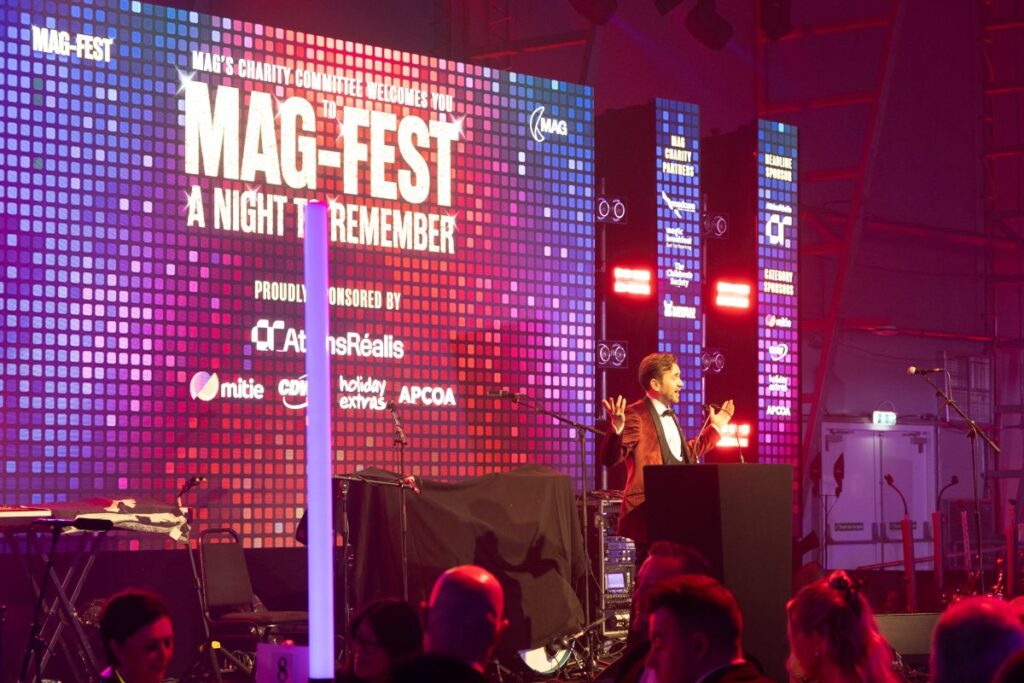
What does the host do at an end of year awards evening?
The job of an award ceremony host is to hold the room between the awards, and at an internal evening that means working with the inside knowledge, not around it.
Awards are where hosting mistakes are most visible. A name mispronounced. A winner left standing at the wrong moment. A joke that lands badly in a room of people who know each other far too well. My prep is a full nominee briefing, pronunciation checks on every name, and a run-through with the organising team before anyone sits down. The night is won in the briefing, not on the stage.
The rest is live. I have covered a sponsor video that failed to play, handled a finalist list that changed late, and pulled a room running badly over back to the final award with its energy intact.
One trap at a year-end evening is the kindest-sounding option: a senior colleague volunteers to host, then spends their own party working, trying to present instead of enjoying it. The room notices the strain.
One host, the whole evening
Your winners will remember getting on stage. Everyone else remembers whether the room stayed alive between the awards. That gap is the whole job.
If you are planning end of year awards and want to talk the evening through, call 07596 851647. I will tell you honestly whether the running order you have will hold the room.