

- Home
- Blog
- Event Host Blog
- Quiz night games ideas for the gaps between the rounds
Quiz night games ideas for the gaps between the rounds
 By Kevin Durham, event host and MC
2 November 2026 · updated 3 November 2026
8 min read

TL;DR: the quiz night games ideas that earn their place between rounds
- A between-rounds game is not a round. Its job is to move people, raise money or reset the room, then get out of the way.
- Pick by what you have: kit, floor space, a volunteer, a slot in the running order. Most of these games fail on the slot, not on the idea.
- Allow double the time you think. Explaining a game usually takes longer than playing it.
- Paid games are regulated in the UK. A raffle at the event and a paid coin toss sit under different rules, with different caps.
The questions are only half of a quiz night. The other half is the gaps: while answer sheets are marked, while the main course lands, while a room that has sat still for forty minutes decides whether it is still interested. That is where a quiz is won or quietly lost.
Closer to a kit list than a wish list: what each game needs, how long it really takes, where it belongs, and the room size it suits. The question rounds themselves I have covered separately in quiz round ideas and in my guide to quiz night hosting.
Why do you need games between the quiz rounds?
Because marking takes time, and a seated room cools faster than organisers expect. Four minutes of silence while someone totals the sheets is four minutes of people on their phones, and you have to win them back.
Timing matters too. Attention follows a daily cycle, and research on circadian attention places a dip from roughly 14:00 to 16:00, which is where an afternoon company quiz lands. An evening quiz has the opposite problem: the room arrives warm from dinner and drifts late on.
From the microphone, these games are my controls. If the last round dragged, I want everyone standing. If the room is already loud, I want something short and seated.
What does a between-rounds game actually need?
Five things, and check all five before you commit: kit, floor space, a volunteer, a slot, and a prize worth standing up for.
Kit is the one people get right. The volunteer is the one they forget. Almost every game needs a second pair of hands watching for the person who sat down late or stayed standing when they should not have. If nobody has that job, the host does, and the host cannot do that and hold the room. The prize matters more than its value: it only needs to be worth the three minutes you are asking for.

Quiz night games ideas that need nothing but a coin and a microphone
These four need no setup, no printing and no floor space. I reach for them when a round has overrun and I have ninety seconds to change the temperature.
Heads or tails. Everyone stands, picks heads or tails with their hands, and sits when the coin goes against them. Three or four flips and you have a winner. It needs a crowd: with thirty people it is over in two flips.
Stand up, sit down. No coin, no prize, pure warm-up. “Stay standing if you have been here more than five years. If you have ever sent an email to the wrong person.” The last one standing gets the applause.
Spot prize. A prize taped under one chair, announced with no warning. Ninety seconds, nothing to explain, and it buys a laugh when the room is flagging.
Beat the quizmaster. One table nominates a champion, who picks a category and goes head to head with the host on three questions. Tables can stake points on the outcome. It takes a host happy to lose in public, which is the point.
Which quiz night games ideas raise money, and what are the rules?
The money-raisers are the games people pay to take part in, and in the UK those are regulated, so work out which box yours sits in before you sell a ticket.
Closest guess. A sealed answer, a jar or a weight, and a sheet on every table at a pound a guess. It runs quietly all night and needs no stage time until the reveal. It also tends to work: when Francis Galton watched 800 entrants guess an ox’s weight in 1906, the median guess of 1,207 lb came within about 1% of the true 1,198 lb.
The raffle, drawn as a game. Most raffles are announced. Draw three tickets at a time instead, bring the winners up, and let them choose their prize in the order drawn. Same draw, four times the noise.
The rules, for England, Wales and Scotland. A raffle sold at the event is an incidental lottery: no licence needed, but only £500 of the proceeds may go on prizes and £100 on expenses, rollovers are banned, and tickets can be sold only at the event while it runs. Donated prizes have no cap.
A paid coin toss is not a lottery but equal-chance gaming, and the non-commercial gaming rules cap each player at £8 and the prize fund at £600, on premises without a premises licence. A paid competition escapes lottery rules only if it turns on genuine skill that stops some entrants winning, which multiple-choice rarely does. An office sweepstake is a work lottery only if everyone playing works at the same location.
Jokers and clue-buying sit inside the quiz rather than between rounds, and I have written those up with the table quiz rounds they attach to.
Which games die in a big room, and which die in a small one?
Big rooms kill detail, small rooms kill elimination. That one line decides most of these choices.
In a room of 400, nobody past table twelve can see a coin, a card or a jar. Anything visual has to be on the screen or it does not exist. Games that ask people to move are harder still: HSE guidance says to keep pedestrian routes clear and leave seated rows room to move in and out freely. A race to the front sounds fun until sixty people try to leave their tables at once.
In a room of forty, the opposite. Elimination games end too quickly, anonymous games are not anonymous, and anything singling out a guest lands harder.
I have presented to crowds of over 80,000 at family festivals, and the lesson holds in a ballroom too. If the back row cannot tell what is happening, they are not playing. They are watching.
How long does a between-rounds game really take?
Longer than the version in your head: explaining it is part of the running time. These are the figures I plan with.
| Game | Explaining | Playing | Realistic total |
|---|---|---|---|
| Heads or tails | 90 sec | 2 to 3 min | 5 min |
| Stand up, sit down | 30 sec | 3 min | 4 min |
| Beat the quizmaster | 60 sec | 2 min | 4 min |
| Closest guess, reveal only | 30 sec | 2 min | 3 min |
| Raffle drawn as a game | 60 sec | 4 min | 8 min |
| Spot prize under a chair | 20 sec | 60 sec | 90 sec |
| A phone game for the whole room | 3 min | 7 min | 11 min |
The phone line surprises people. Getting several hundred guests onto a game takes about three minutes however good the software is: somebody always has a flat battery, somebody always types the code wrong.
Where each game belongs in the running order
Think in slots rather than games. There are five.
- Before round one. Stand up, sit down. Nothing to win, nothing to explain, and it gets the first laugh out of the way.
- After round two. The first real lull. Heads or tails, with the prize visible on stage.
- During the main course. Nothing from the stage. Sell closest-guess sheets table to table instead.
- Before the final round. Beat the quizmaster, or a spot prize if the room is flagging rather than restless.
- After the final round, while scores are checked. The raffle, drawn as a game, then the results.
One rule I would not break: never put a long game immediately before the final scores. People who think they might win stop listening.
How I run the between-rounds games on my own software
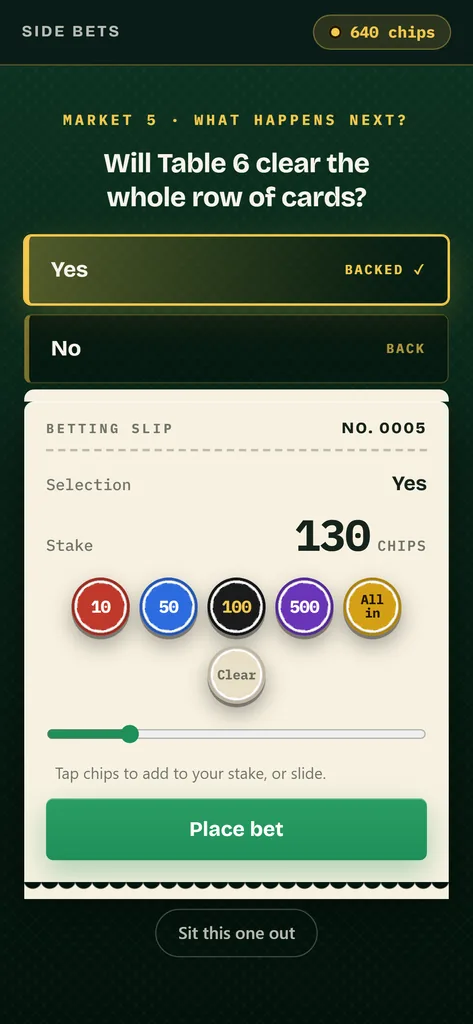
I run sixteen games of my own, and four of them exist precisely for these gaps. Side Bets puts a market on the big screen between rounds and the room stakes play chips on what happens next. No real money moves, which keeps it clear of the gambling rules. The Cut is an elimination game on everyone’s phone that can take 300 players down to one in a few minutes. A higher or lower board and a giant on-screen coin toss solve the visibility problem that kills the physical versions in a big room.
Every game can be played three ways: as a show with teams at the front, at the tables, or on each guest’s phone. I write the content for the audience in front of me: a graduate intake and a board of directors do not want the same night.
What makes a between-rounds game fair for everyone in the room?
A fair game is one where nobody has to explain why they are sitting it out. That is a design question, worth ten minutes beforehand.
Print anything you hand out properly. RNIB treats a minimum of 14-point Arial at a 4.5:1 contrast ratio as the accessible baseline, and a quiz room is darker than the office where the sheet was designed. Offer a seated route into any standing game, and a free route into any paid one. Attitude is Everything, the charity behind the live events access charter, has made that case since 2000.
Two more. Skip forfeits that single out a guest: they are funny to everyone except the person doing them. And if you are adding recorded music, the venue usually holds TheMusicLicence, but check rather than assume: music played outside a domestic setting counts as a public performance.
The night is won in the briefing, not on the stage, and the gaps are no exception. If you would rather hand the gaps to someone who runs them for a living, that is what my quiz show is for.