

- Home
- Blog
- Event Host Blog
- Quiz round ideas that keep a whole room playing, not just watching
Quiz round ideas that keep a whole room playing, not just watching
 By Kevin Durham, event host and MC
16 October 2026 · updated 20 October 2026
8 min read
In short
- The best quiz round ideas change what people are doing, not just what the questions are about: listening, looking, guessing, gambling, standing up.
- Mix round types so every kind of player gets a moment. The person who knows no capital cities often wins the music round.
- Six to eight rounds is plenty for a two-hour night. Fewer, shorter rounds beat a long evening of ten questions at a time.
- Put a gentle round first, your most active round after food, and a round with big swings last.
- If one team plays while everyone else watches, it is a show. If you want a quiz, every table has to be answering.
Most lists of quiz round ideas are lists of subjects: films, sport, geography, food. Subjects matter less than you would think. What decides whether a room stays with you is the format of each round, and whether the whole room is playing or only the loudest person on each table.
I host quiz nights for companies and fundraisers as a quiz master, on software I built for the job. This is the set of rounds I would pick from, sorted by what they do to a room.
What makes good quiz round ideas?
Good quiz round ideas give every team something to do and something to argue about. A round works when a table leans in and talks, and fails when one person writes the answers while four others check their phones.
Three things separate a strong round from a weak one:
- More than one way in. A good question can be worked out, half-remembered or guessed. A bad one is known or not known.
- A change of activity. After two rounds of listening and writing, the room needs to look at something, hear something or move.
- A visible score. Rounds mean more when teams can see what they did to the table.
A knowledge round on its own can go flat by question six. Variety is the fix, and it is why the list below is organised by type of round, not by topic.
Classic quiz round ideas that always work
These are the pub quiz round ideas every team already understands, which is their strength. Nobody needs the rules explained, so you can start quickly.
- General knowledge. The opener. Keep it broad and kind, so every team scores early and settles in.
- Picture round. Faces, logos, landmarks or close-ups, shown on a screen or printed handouts. It gives the visual thinkers their moment and changes the rhythm of the night.
- Music round. Name the song, the artist or the year from a short clip. If you play recorded music, check the licence position first, because music in a quiz usually needs a music licence.
- Connections. Nine ordinary questions and a tenth that asks what links the answers. Teams who missed a few can work backwards, which keeps them in it.
- Who am I? Clues from hardest to easiest, with more points for an early answer. It rewards nerve as well as knowledge.
Choose the era of your music and picture rounds deliberately. A study of nearly 2,000 people found that the music with the deepest personal meaning tends to come from the teenage years, peaking around age 17. Work out roughly when your room was seventeen and you have your playlist.
What are some fun quiz round ideas for adults?
Fun quiz round ideas for adults are rounds where the laugh comes from the room, not from the question sheet. Adults at a work or charity night want to compete, tease each other and be surprised by who knows what.
- The company round. Questions about the business, the year it has had and the people in it. This is always the round with the biggest reaction, because nobody can look the answers up.
- Higher or lower. A run of numbers (prices, populations, years, chart positions) where teams only have to call the direction. Everyone can play, and everyone has an opinion.
- Survey says. Instead of one right answer, teams guess the most popular answers given by a group of people. It turns a quiz into an argument about what other people think.
- True or false. Fast, simple and ideal for the whole room at once.
- Guess the year. Three or four events, one year. Teams score for being close, so a good guess still earns something.
Keep the humour pointed at the answers and the teams as a whole, not at individuals. A round that embarrasses one person loses the table they are sitting at.
Which interactive quiz round ideas get the whole room involved?
Interactive quiz round ideas are the ones where every person answers for themselves, not through a team captain with the pen. They are the best cure for the quiet half of each table.
- Phones as answer pads. Each guest answers on their own phone, with a countdown and a leaderboard on the big screen. On my own quiz app, points reward being right and being quick, so nobody waits for the slowest table.
- Stand up, sit down. The whole room stands, answers a two-way question by a show of hands, and sits if they are wrong. Last one standing wins a prize.
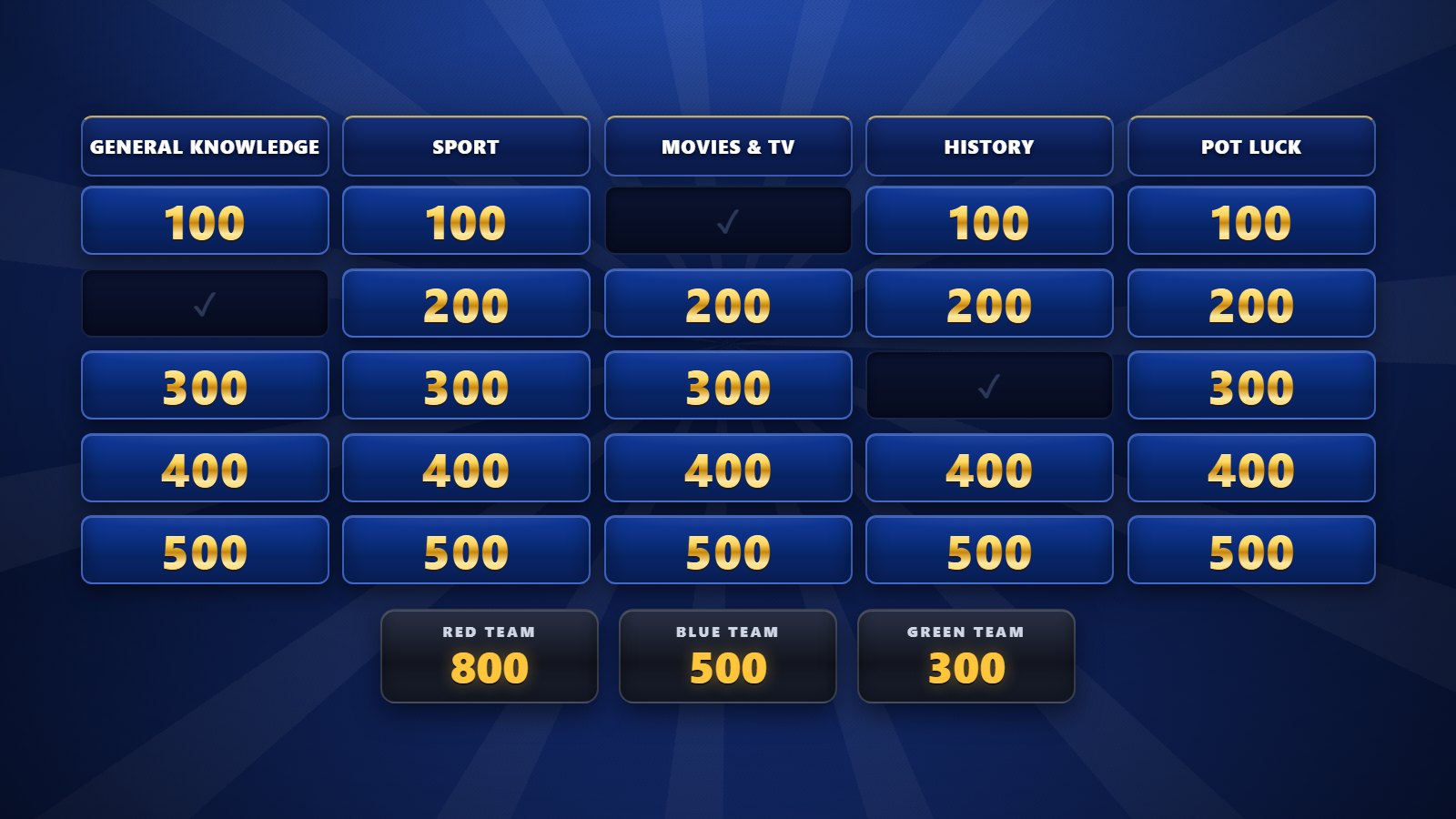
- Buzzer board. A category board with values from easy to hard, where teams pick their risk and race to buzz. This is the format behind my Quiz Show game, which adds steals on a wrong answer.
- Knockout. Everyone answers, and the lowest scores are cut each round until a handful remain. I run this as The Cut, with the whole room answering on their phones.
- Table challenge. One physical or creative task per table against the clock, scored like a round.
One interactive round in the middle of a night changes the energy for everything after it.
What are some unusual quiz round ideas?
Unusual quiz round ideas change the scoring, not just the subject. If you want different quiz round ideas from the ones every pub runs, play with risk.
- Wipeout. Teams answer as many questions as they dare, but one wrong answer loses every point from that round. Cautious tables bank three answers. Brave ones lose the lot.
- Joker round. Each team nominates one round in advance to count double. It makes teams judge their own strengths, and it is very funny when they misjudge.
- Closest wins. One question with a number for an answer, and the nearest team takes the points. It doubles as a tie-breaker.
- Bluff round. Three statements or three stories, one of them true. Teams vote on which.
- Odd one out. Four items, one that does not belong, and a point for explaining why.
- Backwards round. Give the answer and ask teams to write the question.
Use one unusual round per night, two at most. They are the seasoning. A whole evening of twists is exhausting to score and harder to follow.
Pub quiz rounds and corporate rounds are not the same
A pub quiz is played by people who chose to come to a quiz. A corporate quiz is played by a room of people who came to a dinner, a conference or a Christmas party, and many of them would not call themselves quizzers.
That changes the brief. Pub regulars enjoy being stretched. A work audience wants to feel clever and to win something for their table, so the rounds should be broader, shorter and more forgiving. It also means more of the room needs to be playing at any moment, which is why I lean on formats where every table or every phone answers every question. There is more on that difference in my guide to running a corporate quiz night.
How many rounds should a quiz have?
A quiz should have six to eight rounds if it is the main event of the night, and two or three if it sits around a dinner. Guidance for fundraising quizzes suggests about six to eight rounds of ten questions in two hours, and that is the upper limit, not a target.
For a corporate room I would run fewer questions per round. Six questions in a round that moves is better than ten in a round that drags, and it leaves time for the scores, the heckling and the bar. Marking is the hidden cost: every round needs collecting, checking and announcing, so count that time in.
What order should quiz rounds go in?
Quiz rounds should run from easy and familiar to active and risky, with the biggest swings saved for last. The order matters as much as the content.
A running order that works for most rooms:
- General knowledge, to settle everyone and get every team on the board.
- Picture round, handed out or shown early so tables can chew on it.
- Company or themed round, while attention is high.
- An interactive round straight after food, when the room needs waking up.
- Music or a novelty round, for a change of pace.
- A high-stakes finale, so no team is out of it until the end.
Never put two rounds of the same activity back to back. Two listening rounds in a row is where a room starts to drift.
How I build a running order
Every game I run can be played three ways: as a show with teams at the front, table against table, or with every guest on their own phone. I mix them through the evening so nobody spends the night watching.
A typical night might open with a phone round that everyone plays at once, move to the category board played from the tables, and finish with a knockout. The questions are written around the company beforehand, and I switch between games from the microphone, which is the reason I built my own quiz software in the first place: the energy drops every time a host stops to find the next slide.
More quiz guides
Each of these goes deeper on one part of the night:
- Christmas quiz rounds for a work party.
- Halloween quiz questions with answers for adults.
- Pub quiz questions: 100 general knowledge questions with answers.
- Funny team names for an office or charity quiz.
- Sports quiz questions with answers, sorted into rounds.
Which round should you finish on?
Finish on a round where the points are big enough to change the result. If the leaders are uncatchable with a round to go, half the room has stopped caring.
A knockout, a wipeout round or a final question worth double all do the job. So does a simple closest-wins question for the top three teams, played out loud in front of everyone. What you want is a room that is still noisy when the winner is announced.
If you would like the rounds written for your people and hosted so the whole room plays, tell me about the night and I will suggest a running order as your quiz host.