
- Home
- Blog
- Event Host Blog
- Odd one out quiz: nine checked sets and how to make the answer unarguable
Odd one out quiz: nine checked sets and how to make the answer unarguable
 By Kevin Durham, event host and MC
29 October 2026 · updated 24 October 2026
8 min read
In short
- An odd one out quiz round gives teams four items and asks which one does not belong, and the point is the reason, not the guess.
- The answer is only unarguable if the question states the axis out loud: “three of these are national capitals” closes the loopholes that “which is the odd one out” leaves open.
- Nine ready-made sets below, in three difficulty tiers, each with the answer and the reason, every one checked against a source.
- Score two points per set, one for the item and one for the reason, and write the reason down before the night so a ruling takes five seconds.
- The round plays at the tables, on every guest’s phone, or as a category on a big-screen board.
An odd one out round is the cheapest way to make a quiz feel clever. Four items go up, one does not belong, and a table that spots why gets the small thrill of having worked something out rather than remembered it. It is also the round most likely to end in an argument, because most sets published online have two answers and the writer only noticed one.

How does an odd one out quiz round work?
An odd one out round gives teams a group of items, usually four, where three share a property and one does not. Teams write the item they think is the outsider and, in the better version, the reason.
Most UK pub quiz formats run it as one round of six to eight sets inside a longer night. It works read aloud, printed on the answer sheet or shown on a screen, and it needs no music licence and no pictures, which makes it the easiest specialist round to add at short notice.
Two details separate a good round from a bad one. Teams should be told how many items share the property, and they should be asked for the reason. Without the reason, a four-item set is a one-in-four guess and the whole room scores.
What makes an odd one out answer unarguable?
An odd one out answer is unarguable when exactly one property divides the four items three against one, and the question says what that property is. Everything else is decoration.
A set has to pass four tests before it goes anywhere near a running order.
- One axis, stated. Ask “three of these are X, which is not” rather than “which is the odd one out”. You lose a little mystery and you lose every argument with it, which is a trade worth making in a room that has had a drink.
- No second three-one split. Run the set past continent, language, era, size, first letter and category. If any of those splits it three against one too, the set has two answers.
- Checkable in one click. The reason wants to sit on a page you can open on your phone while a captain stands over you.
- Nothing contested. If the source itself hedges, leave it out. A set resting on a disputed classification will be argued with, correctly.
The trap of two defensible answers
Here is a set that looks fine and is not: flute, clarinet, oboe, trumpet. The intended answer is trumpet, the only brass instrument among three woodwinds. The problem is that the flute is also alone: it is the only one of the four played without a reed, since the clarinet is single-reed and the oboe is double-reed. Two answers, both defensible, and the team that says flute has done more thinking than the team that says trumpet.
The fix is not a cleverer set. It is a stated axis: “three of these are reed instruments”. Trumpet is now the only answer and the flute objection has nowhere to go.
The same thing happens with geography. Edinburgh, Cardiff, London, Manchester looks like a capitals set, but London is the only UK capital and Manchester the only non-capital, so there are two three-one splits in one line. I binned it. The Sydney set survived into tier one below only because the question names the axis as national capitals, which stops anyone pointing out that Sydney is the capital of New South Wales.
How hard should an odd one out round be?
I pitch an odd one out round in three tiers and climb through them, so the easy sets get the quiet tables playing before the hard ones decide the scores.
- Tier one, easy. The three share something a pub crowd knows cold. Most tables get the item, half get the reason.
- Tier two, medium. One of the four is a plausible impostor: the right field, the wrong detail. This is where the round earns its place.
- Tier three, hard. The property is precise and the impostor is a near miss. Expect two or three tables out of twenty.
Six to eight sets is a round. Run four easy, two medium, two hard, and give the hard ones an extra thirty seconds.
Three easy odd one out quiz questions, with answers
- Three of these are noble gases: helium, neon, argon, nitrogen. Answer: nitrogen. The noble gases are group 18 of the periodic table, and nitrogen sits in group 15.
- Three of these are national capitals: Ottawa, Canberra, Wellington, Sydney. Answer: Sydney. Canberra is Australia’s capital, and Sydney is a state capital only.
- Three of these are tennis majors: Wimbledon, the French Open, the US Open, Indian Wells. Answer: Indian Wells. The four majors are the Australian Open, the French Open, Wimbledon and the US Open.
Three medium sets for a mixed room
- Three of these are Beatles studio albums: Revolver, Rubber Soul, Abbey Road, Band on the Run. Answer: Band on the Run, a 1973 Wings album credited to Paul McCartney and Wings.
- Three of these are Shakespeare tragedies: Macbeth, Othello, King Lear, The Tempest. Answer: The Tempest, grouped with the comedies rather than with the eleven tragedies.
- Three of these have won the men’s football World Cup: Spain, Germany, Argentina, the Netherlands. Answer: the Netherlands, runners-up in 1974, 1978 and 2010 and never winners.
What are the hardest odd one out sets to crack?
- Three of these are double-reed instruments: oboe, bassoon, cor anglais, clarinet. Answer: clarinet, a single-reed instrument, while the cor anglais is a double reed in the oboe family.
- Three of these rivers reach the North Sea: Thames, Tyne, Tees, Severn. Answer: Severn. The Tees ends in the North Sea, while the Severn runs out through its estuary into the Bristol Channel.
- Three of these elements are named after countries: polonium, francium, germanium, californium. Answer: californium, named after California, a US state and university rather than a country.
A fourth, if you want a tie-breaker: three of these countries are landlocked, so Austria, Hungary, Switzerland, Slovenia gives Slovenia, which has a 47 kilometre Adriatic coastline while the other three are landlocked.
How should you score an odd one out round?
Score two points per set: one for naming the item, one for giving the reason.
That rewards the thinking rather than the guess, and it spreads the scores out in a round that would otherwise bunch every table on four out of six.
- Accept any reason that is factually the stated axis in different words. “Not a noble gas” and “wrong group on the table” are the same answer.
- Do not accept a reason that happens to be true but is not the axis. That is the line that keeps the round consistent.
- Half marks are more trouble than they are worth with twenty tables.
One more for the warm-up, which most rooms get and almost nobody can explain: three of these are Nobel Prize categories, so physics, chemistry, literature, mathematics gives mathematics, because the six categories have never included it.
What do you do when a team argues?
Read out the reason you wrote down before the night, rule once, and move on. The ruling is never the problem in a room, the hesitation is.
How I run an odd one out quiz on my own software
I run it on screen, from software I wrote myself, with the four items appearing together and the stated axis above them so nobody can claim they were asked a different question. Every set is written for the people in the room, which is the part a printed round cannot do.
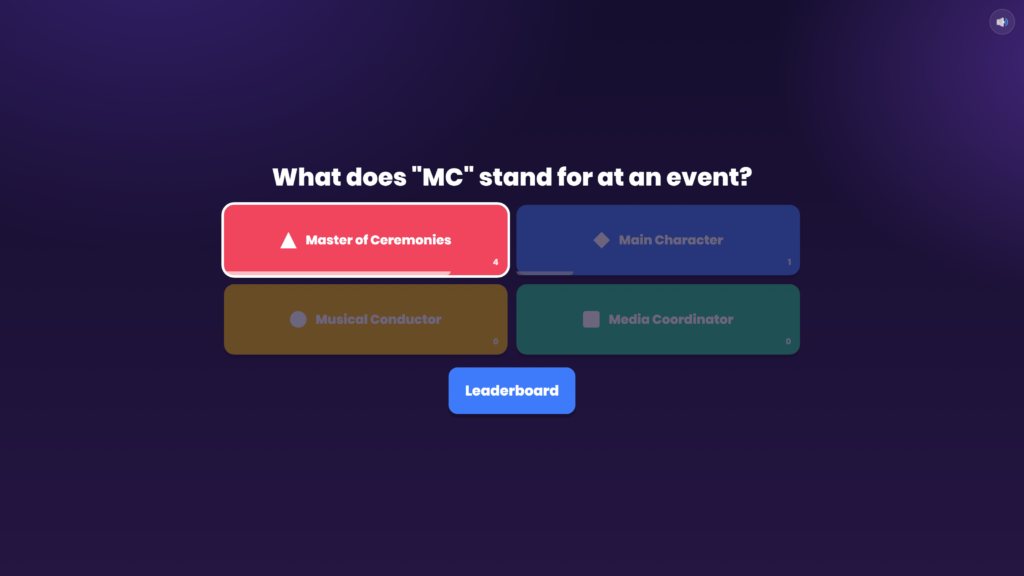
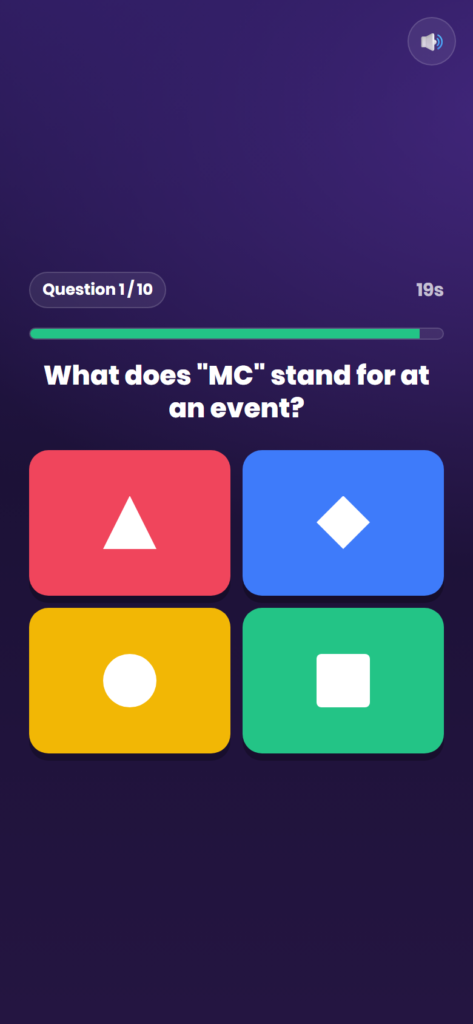
It plays three ways. At the tables, every table is a team and the answers come in on the sheet, which suits a round inside a longer quiz night. On every phone, through Quiz Live, each guest answers and types the reason, with the leaderboard moving after each set. On a big-screen quiz show board it becomes a category, easy sets at the low values, the hard ones at the top, and a miss can be stolen.
If you are building a whole night, there are more quiz round ideas to pair this with. If you would rather hand it over, I will write the sets for your audience and host the evening as your quiz master. One host, the whole evening. Call me on 07596 851647 and tell me who is in the room.