
- Home
- Blog
- Event Host Blog
- Games to play at work: what actually happens when you run one
Games to play at work: what actually happens when you run one
 By Kevin Durham, event host and MC
2 November 2026 · updated 3 November 2026
8 min read
Search for games to play at work and you get lists of fifty. None of them tell you what happens in the ninety seconds after you say “right, we’re going to play a game”, and that is the part that decides everything.
TL;DR
- The number of people decides the game. Eight round a desk and eighty in a room need different mechanics.
- Around a third of employees dislike team-building activities, so build the opt-out in before you start.
- Add the rules and the team sorting to your estimate. A “ten minute game” is twenty.
- Hybrid colleagues need the same device as everyone else, or they are an audience watching a party.
- Four games that hold a work crowd, and why.
What makes games to play at work succeed or fail?
Games to play at work succeed when the format fits the number of people, the time you actually have and the fact that nobody chose to be there. They fail for one of three reasons: too much explaining, too few people playing, or someone being put on the spot.
That last one does the most damage. Engagement is a state of mind, not an activity you can schedule, which is why the CIPD factsheet lists psychological safety among its drivers. A game that embarrasses one person tells the other twenty what happens if they volunteer.
How many people are you actually playing with?
Count the people first, then pick the game, because group size changes the mechanics. Below about a dozen, everyone can speak, so the best games are conversational and need no scoring. Above about forty, individual turns die and everything runs through teams.
The middle, roughly fifteen to forty, is hardest. Too big for a chat, too small to hide in, and where most borrowed-from-the-internet games collapse.
At scale my default is to split the whole room into teams and rotate who plays each round, so as many people as possible get a go and it stays snappy. I have presented to festival crowds past 80,000, and the lesson carries into a meeting room: you cannot afford a dead minute, because the moment energy drops, phones come out.
The people who do not want to play
This is the part the listicles skip, and the most common reason a game at work goes wrong.
Acas had YouGov ask 1,052 British employees which work social activities they liked least. In the results, published in March 2025, team-building activities topped the list at 31%, while 19% disliked any social activity with colleagues at all. Both halves matter: 26% liked everything on the list.
So one in five would rather not, and one in four is genuinely up for it. Forcing the first group does not convert them. It costs you the room, because everyone else watches a colleague made uncomfortable and quietly decides not to be next.
Some of that reluctance is clinical. The NHS describes social anxiety as a long-term, overwhelming fear of social situations, and lists group conversations, parties and being watched among the triggers. Some is sensory: Acas notes neurodivergent staff may be masking at work, and its guidance suggests asking about accessibility needs before meetings.
Practical version, and it costs nothing:
- Make scoring team-based so a quiet person contributes without speaking.
- Never pull someone to the front without asking privately first.
- Give people a real job that is not playing: scoring, judging, filming.
- Run it inside working hours. Acas recommended exactly that, so people with caring responsibilities are not asked to give up their own time.
Acas defines an inclusive workplace as one where everyone feels valued. A game is a small test of whether that is true.
What about hybrid and remote colleagues?
Design for the remote people first, or leave them out entirely. A game where the room plays and three faces on a screen watch is worse than no game, because you have made their exclusion the entertainment.
Hybrid is not a minority case. The Office for National Statistics found that 44% of workers in Great Britain reported home or hybrid working, 28% of them hybrid, in its figures published in February 2023. Attention on a call is also thinner than you think: Microsoft’s Work Trend Index, published in September 2022, reported that 42% of meeting participants multitask by sending an email or a ping.
The fix is mechanical, not social. Put everyone on their own phone or laptop, including the people sitting next to each other in the room. Once the game lives on the device rather than in the air, remote players stop being second class and in-room players stop shouting over each other. Every game I run can be played on the app as well as from the front, for exactly that reason.
How long do games to play at work really take?
Take the playing time, then add two minutes for the rules and two or three to sort teams. A ten minute game is a twenty minute agenda item. Plan for that and most overruns disappear.
That maths is why I keep rules to one sentence.
If a round needs a diagram, it is the wrong round for a Tuesday morning. Teams get sorted by where people already sit, never by counting off around the room, which wastes three minutes and splits up the only two people who were talking.
For a team meeting, ten to fifteen minutes is the ceiling. For a Friday afternoon, half an hour. For an away day, a hosted show runs 45 to 90 minutes and earns its slot.
Where in the working day should a game go?
Put it immediately after lunch, or in the last slot of the working day. Those are the two slots where a game does a job rather than interrupting one.
The after-lunch dip is real, and it is the hardest part of hosting a full conference day. Microsoft’s Human Factors Lab study of back-to-back meetings, published in April 2021, found stress-linked beta wave activity rising across two hours without breaks, while short breaks kept it level and left participants measurably more engaged.
A game is a break with a purpose.
What does not work: first thing, before people have properly arrived, or wedged in before a difficult announcement, which reads as manipulation.
Four games that genuinely work with a work audience
Small list, deliberately. These four are my own games, and I run them at corporate events because they solve the problems above rather than fill fifteen minutes.
Common Ground
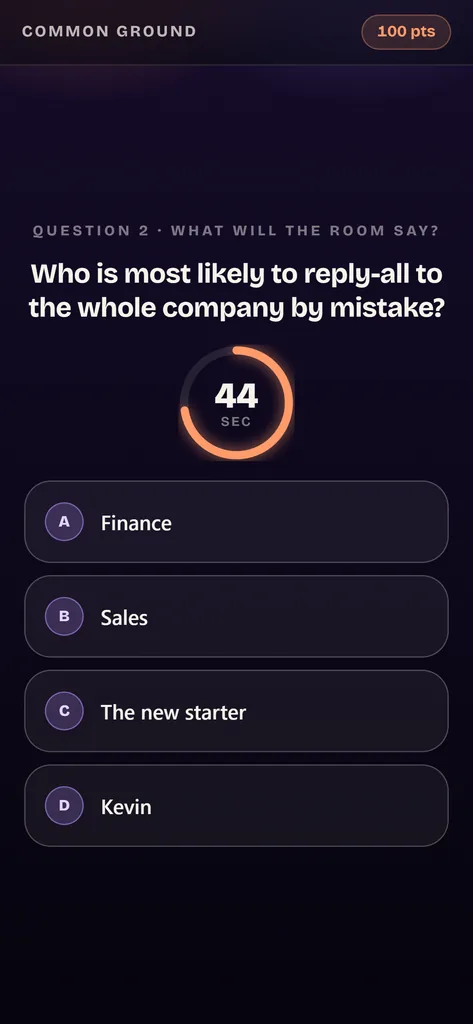
Common Ground asks everyone to find what they unexpectedly have in common. It plays on phones, so it works at a desk cluster of eight or a conference of 300 unchanged, and it is the one game where the quietest person often wins. It leaves colleagues something true to talk about, which the usual icebreaker questions rarely manage.
Side Bets
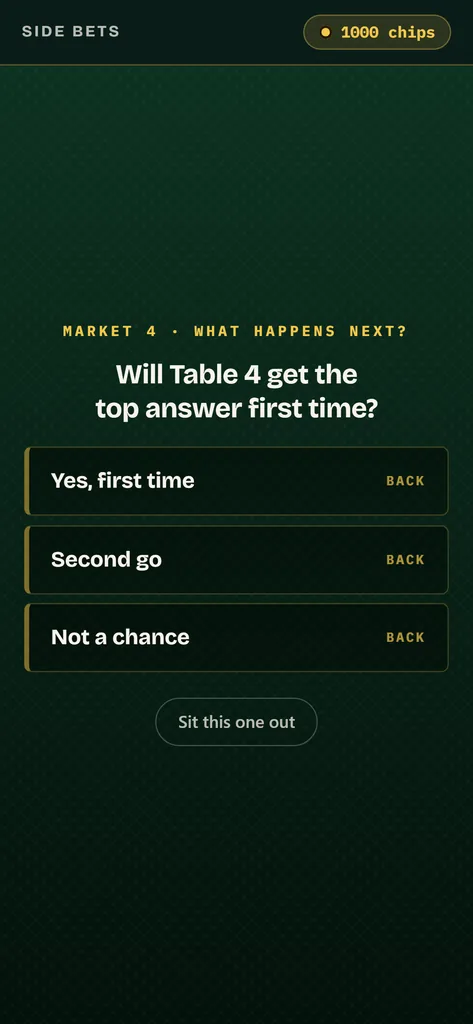
Side Bets lets people wager on outcomes rather than perform. That makes it the best game here for the reluctant 19%, because you can win without being looked at, and it keeps everyone not currently playing invested in those who are.
Category Clues
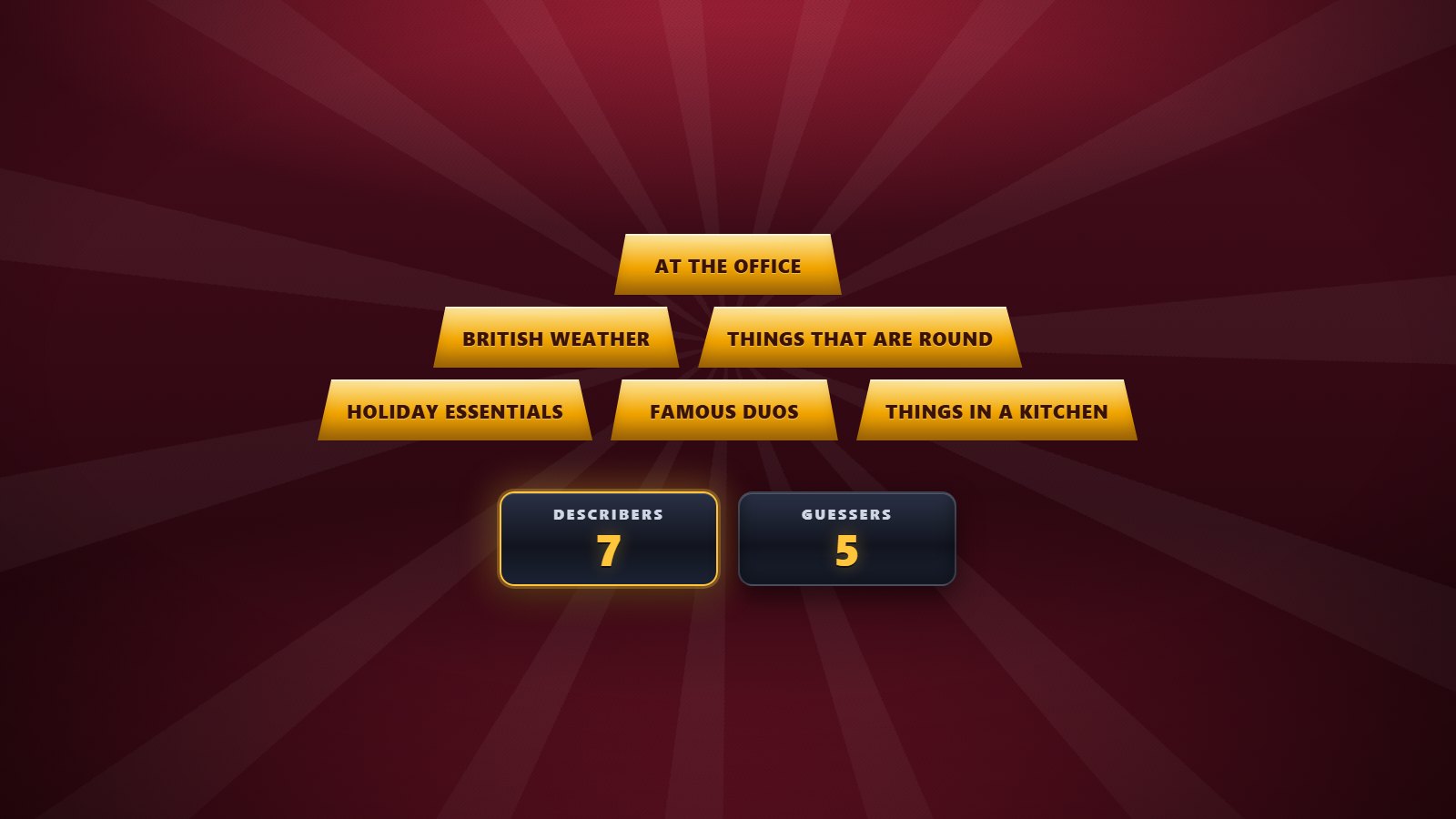
Category Clues is a big-screen team game that runs at the tables, so every table is a team and nobody comes to the front. Rules take one sentence. It is the round I reach for when a room is too big for conversation and too small to be a show.
Who’s Bluffing?
Who’s Bluffing? needs people willing to talk, so it is the one to be careful with. Use it with a team that already knows each other, not a merged department meeting for the first time. When it lands it lands harder than anything else here, because the laugh comes from the people, not the questions.
Which games should you avoid at work?
Avoid anything that requires solo performance, physical contest, or personal disclosure. Those three cover most of what goes wrong.
Solo performance means singing, acting or being interviewed on your feet. Physical contest means someone in the wrong shoes competing in front of their line manager. Personal disclosure, the “two truths and a lie” family, asks people to hand private information to colleagues who will remember it. Elimination formats are the fourth trap: knock people out and you have built a room of spectators.
I once judged an egg-and-spoon race on the silliness of the walk rather than who won. Change what you reward and you change who is willing to play.
What I do differently when the audience is colleagues
The night is won in the briefing, not on the stage. For a work crowd that means asking the organiser who the room is, what happened at the last one, and whether anyone must not be put on the spot. The questions and the presenting style are then written for those people. A graduate intake gets a different show from a board of directors.
Late in 2025 a client asked for an awards night that was not a standard awards night, so I interleaved the award presentations with game-show rounds, because standard ceremonies drag for everyone who is not winning. Everyone stayed to the end. Your winners remember getting on stage; everyone else remembers whether the room stayed alive. Event managers tell me the same thing in different words: their last generic presenter left the evening flat with nobody holding it together, and when a senior colleague hosted it got awkward, because that person tried to present instead of enjoying the event as a guest.
I will not oversell it, though. Gallup’s State of the Global Workplace for 2026 puts employee engagement at 20%, down from a 23% peak in 2022, with no region improving, and the CIPD’s Good Work Index of 4 August 2026 surveys more than 5,000 UK workers on the same ground. A fifteen minute game fixes none of that. Done properly, it does show the people running the company know who works there.
If you would rather hand the whole thing over, that is my corporate entertainment work. Call 07596 851647 and tell me what went wrong at the last one.