

- Home
- Blog
- Event Host Blog
- Higher or lower game: how to run it at a party or work event
Higher or lower game: how to run it at a party or work event
 By Kevin Durham, event host and MC
21 October 2026 · updated 17 October 2026
7 min read

In short
- The higher or lower game is simple: one card or number is shown, and you call whether the next one is higher or lower.
- Agree three rules before you start: are aces high or low, does a pair count as wrong, and can a player stick to bank their place?
- From a full deck with aces high, the 8 is the true coin flip: 24 cards beat it, 24 sit below it and 3 make a pair.
- For a big room, win control of the cards with a number question, give every table a turn and play for points or play money, never cash.
- I run it as a Play Your Cards Right style game on my own software, at the front, at the tables or on every guest’s phone.
The higher or lower game is one of the easiest party games there is to explain, which is exactly why it works at a work do. Nobody needs to know any trivia. They just need an opinion about the next card, and the room will give them one whether they asked for it or not.
This guide covers the card game rules, the odds, the number-question version and how to turn it into a game show that keeps a whole room shouting at the screen.
What is the higher or lower game?
The higher or lower game is a guessing game where a card or a number is revealed and players predict whether the next one will be higher or lower. Get it right and you carry on. Get it wrong and your turn ends.
There are two main versions:
- The card game: a standard 52-card deck, a row of cards and a lot of nervous guessing.
- The number game, where someone states a figure (“the UK drinks 50 million cups of tea a day”) and players say whether the real answer is higher or lower.
Television put the two together. The American show Card Sharks launched on NBC in April 1978, and the British version, Play Your Cards Right, followed on ITV on 1 February 1980. Contestants used a survey question to win control of a row of giant cards, then called higher or lower down the row. The format lives on online too: one version shows two cards and asks which is higher, and a single wrong answer sends you back to zero.
What are the higher or lower card game rules?
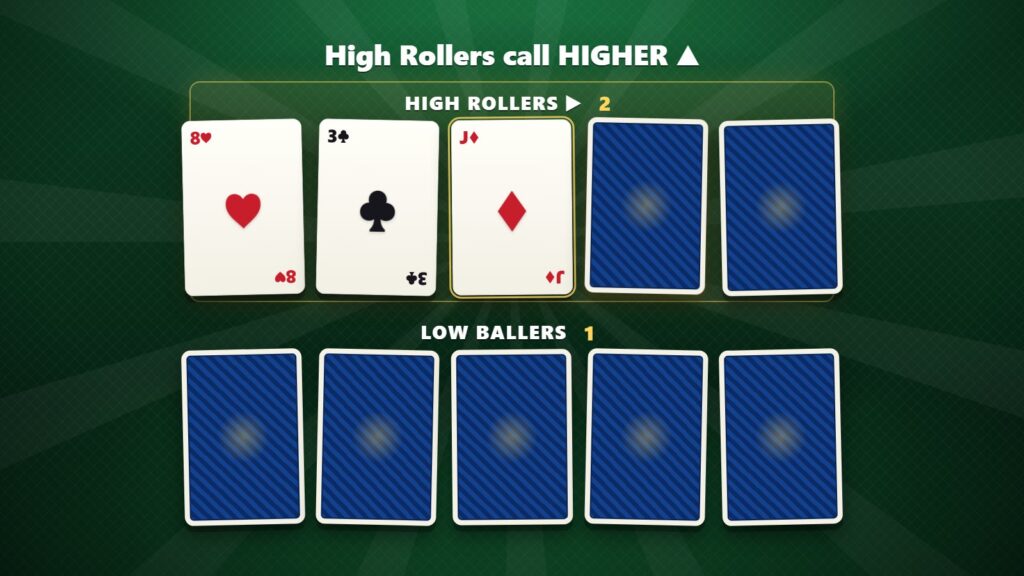
The higher or lower card game rules are short: deal one card face up, call higher or lower before the next card turns, and keep going until you make a wrong call or reach the end of the row. Everything else is a house rule, so settle it before the first card.
Here is how to play the higher or lower card game with a group:
- Shuffle a standard deck and deal a row of five cards face down for each player or team.
- Turn the first card face up. On the TV show, players could change the first card before play began, which is a kind rule if someone draws a 7 or an 8.
- The player calls higher or lower, and you turn the next card.
- A right call earns the next call. A wrong call ends the turn.
- After a right call, the player can stick. On television this was called freezing, and a later wrong guess only sent them back to the frozen card.
- The first player or team to clear the whole row wins.
The three house rules that cause the most arguments:
- Aces. On the British show aces were high and twos were low. Pick one and say it out loud.
- Pairs. Count a matching card as a wrong call, as the show did. It keeps the tension up and earns a groan from the whole room.
- Sticking. Allow it. Without a stick option, the game is pure luck and the clever players have nothing to do.
Higher or lower odds: when to stick
The odds in the higher or lower card game are easy to work out. Knowing them makes you a better host, not just a better player. With aces high there are 13 ranks, so from a full deck the middle card is the 8.
| Card showing | Higher | Lower | Pair |
|---|---|---|---|
| 2 | 48 | 0 | 3 |
| 5 | 36 | 12 | 3 |
| 8 | 24 | 24 | 3 |
| Jack | 12 | 36 | 3 |
| Ace | 0 | 48 | 3 |
So a 2 or an ace is a gift, and an 8 is a coin toss with a small chance of losing either way. If aces are low, the coin-flip card moves down to the 7. A player looking at an 8 with three cards banked should stick, and the room will tell them not to. That argument is half the fun.
How do you run a higher or lower game show for a big room?
To run a higher or lower game show for a big room, win control of the cards with a number question, put the cards on a big screen and give the room a reason to care about every call. The card game alone only involves the person calling. The show is everybody else.
- Win the cards first. Ask a number question. One team guesses, the other says higher or lower, and whoever is right takes control of the cards. That mirrors the TV format and gives the quieter tables a way in.
- Make the cards readable from the back. Big numerals, high contrast. Colour blindness affects about 1 in 12 men, so never rely on red and black alone.
- Let the room shout. The calls from the floor are the entertainment.
- Keep the turns short. One wrong call and the turn is over, and the next team is up before anyone has finished their drink. Speed is what stops it feeling like a lecture on probability.
- Skip the drinking-game version. It turns up in plenty of search results, but at a work event it is a liability, not a laugh.
What are good higher or lower game ideas?
Good higher or lower game ideas are number questions with one checkable answer and a figure that sounds plausible both ways. Read out the claim, let the teams call it, then reveal the real number.
| You say | Call | The real figure |
|---|---|---|
| The UK drinks 50 million cups of tea a day | Higher | About 100 million |
| Wembley Stadium has 1,000 toilets | Higher | 2,618 toilets |
| Wembley seats 100,000 people | Lower | 90,000 seats |
| The Wembley arch is 150 metres tall | Lower | 133 metres |
| Ben Nevis is 1,500 metres high | Lower | 1,345 metres since a 2016 re-measure |
| The UK population was 65 million in mid-2024 | Higher | An estimated 69.3 million |
| The UK temperature record set in July 2022 was 38°C | Higher | 40.3°C at Coningsby, 19 July 2022 |
The best ideas come from the room itself. How many cups of coffee did the office get through last month? How many customers did you serve last year? How many years has the longest-serving person on table four been with the company? Company figures land harder than national ones because someone in the room should know the answer, and usually doesn’t.
Should people play higher or lower for money?
No. Play for points or play money, not cash. The Gambling Commission’s guidance on private gaming says it can happen in a workplace, but no charge can be made for taking part. Cash stakes bring in rules a work party does not need. Points keep it friendly, and a leaderboard does the same job as a pot.
How I run higher or lower on my own software
I run higher or lower as a game-show round on software I built myself. It is my own Play Your Cards Right style game, not the licensed TV show, and you can hire the game for your own event. Giant cards fill the screen, a light-hearted number question decides which team takes control, and the team calls each card while the room joins in. After every right call they can stick and bank their place, or push on. One wrong call flips the busting card for everyone to see and the turn is gone. The first team to clear its row wins.
Every game I run can be played three ways:
- As a show. Two teams at the front, a row of five cards each, the room watching.
- At the tables. Every table is a team and calls on its own turn, so nearly every table plays.
- On the app. With Side Bets, every guest stakes play money on their own phone: will this team clear the whole row, yes or no?

How long should a higher or lower round last?
A higher or lower round should last a few minutes. Three rounds at the tables fill about fifteen minutes, which makes it a good palate cleanser between longer games or a fast finale.
Any longer and the luck starts to show.
It sits well alongside a survey game such as Family Fortunes. There are more formats in my game show ideas guide.
Booking a higher or lower game show for your event
If you want the higher or lower game at your event but would rather not build the cards, write the questions and hold the microphone yourself, I’ll do all three. Nobody remembers a normal night. I host corporate game shows as part of a wider evening of corporate entertainment, so the game fits the night rather than interrupting it.
One host. The whole evening. Call me on 07596 851647 and tell me about the room.