
- Home
- Blog
- Event Host Blog
- Wheel of Fortune game: how to run a spin-and-solve round at an event
Wheel of Fortune game: how to run a spin-and-solve round at an event
 By Kevin Durham, event host and MC
8 November 2026 · updated 2 November 2026
7 min read
In short
- A Wheel of Fortune game is a word-puzzle round: teams spin for a value, call a letter and score that value for every time the letter appears.
- Run it as a six-step loop: category, spin, call a consonant, reveal matches, buy a vowel or solve, pass control.
- Score a consonant as the spin value times the number of matches, and keep a Bankrupt wedge on the wheel so a big bank is always at risk.
- Call it “Spin and Solve”, charge nothing to play, and build the puzzles yourself.
- Wheel of Fortune is not one of my games. The nearest I host is Guess the Phrase, which has letters and lamps but no wheel.
A Wheel of Fortune game is a word-puzzle round in which players spin a wheel for a value, call a letter and win that value for every time it appears in a hidden phrase. I’m Kevin Durham, a professional event host and MC, and this guide shows how the show plays it and how to build your own version, with the scoring worked out.
What is a Wheel of Fortune game and how does the television show play it?
The Wheel of Fortune game is a television word-puzzle format in which contestants spin a wheel, call letters to reveal a hidden phrase and race to solve it. The American version, read in November 2026, says it is based on hangman and has aired since 6 January 1975.
The wheel has 24 wedges: mostly cash values, two Bankrupt and one Lose a Turn. A contestant spins, calls a consonant and is paid the value times the number of matches. After a hit they may spin again, buy a vowel for a flat $250, or try to solve. A wrong letter, lost turn, Bankrupt or failed solve passes control on.
ITV’s British version ran from 19 July 1988 to 21 December 2001 and returned in 2024, with vowels at £100.
The idea began in a car: Merv Griffin played hangman with his sister on family trips as a child, and those games inspired the show.
Can you run a Wheel of Fortune game at your own event?
You can run a spin-and-solve word game at your own event if you build it yourself, charge nothing to play and do not present it as the television show. I have no connection with the programme or its producers. The name, wheel and board are its owners’ brand, and a registered trade mark lets an owner take legal action against anyone who uses the brand without permission. On your running order I would call it “Spin and Solve”. This is not legal advice.
The second trap is money. The Gambling Commission’s private gaming guidance, last updated 14 September 2023, says private gaming can happen in a workplace, but no charge may be made for taking part, whether it is called voluntary or compulsory. Play for points and a prize the company pays for. If the round sits inside a fundraiser, take advice first.
How do you run a Wheel of Fortune game at a party, step by step?
Run a Wheel of Fortune game as a six-step loop on one hidden phrase, repeated for every puzzle. Keep the loop identical, so nobody is thinking about the rules by the second puzzle.
- Show the board: one blank tile per letter, with the category above it.
- The team in control spins: a printed wheel, twelve cards in a bag, or a spinner on a laptop.
- On a number, the team calls a consonant. Every match is revealed and scores the spin value times the count. A missing or repeated letter passes control.
- After a hit the team chooses: spin again, buy a vowel for a flat 200 points, or solve.
- A wrong solve passes control. A right one banks that puzzle’s score.
- Show the full phrase and move on. No recap of the rules.
I allow three to four minutes a puzzle, so five fill a twenty-minute slot.
How do you score a Wheel of Fortune game?
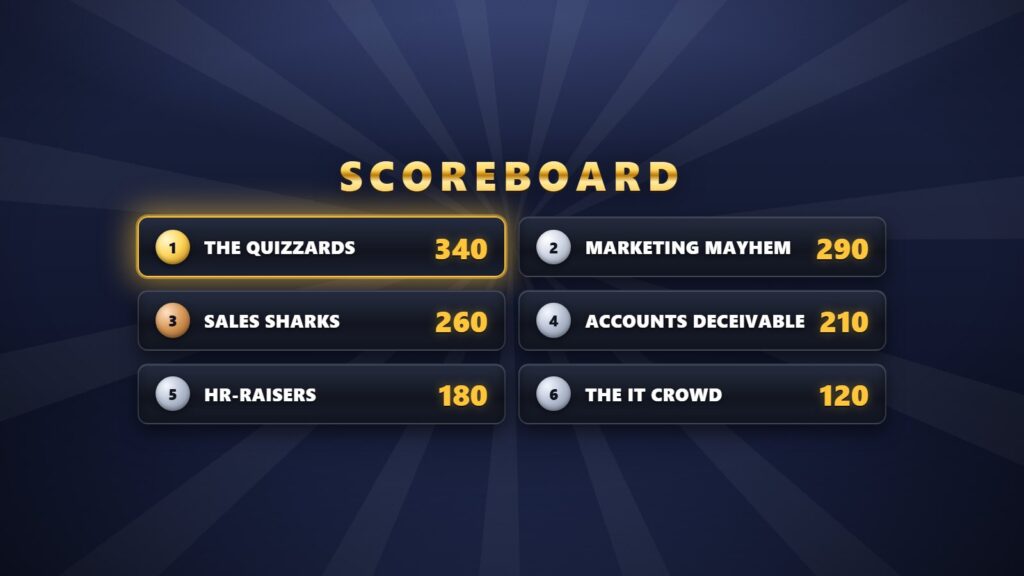
Score a Wheel of Fortune game by multiplying the spin value by the number of times the called consonant appears, then adding it to that puzzle’s bank. Vowels score nothing and cost a flat price. As on the show, only the team that solves keeps its bank, and a Bankrupt wipes the bank for that puzzle.
My party wheel has twelve wedges: ten numbers (100, 100, 200, 200, 300, 300, 400, 500, 800 and 1,000), one Lose a Turn and one Bankrupt. The numbers total 3,900, so an average number wedge is worth 390, and one spin in six hands the turn on. Here is a puzzle, “Better late than never”, with two teams:
| Turn | Action | Matches | Puzzle bank |
|---|---|---|---|
| Red | Spins 300, calls T | 4 | 1,200 |
| Red | Spins 500, calls N | 2 | 2,200 |
| Red | Buys the vowel E for 200 | 5 | 2,000 |
| Red | Spins Bankrupt | 0 | 0, turn passes |
| Blue | Spins 200, calls R | 2 | 400 |
| Blue | Solves the phrase | 0 | 400 banked |
Blue wins with 400 against Red’s nothing, and that swing is what I want in a room: a groan and a cheer in the same breath. With one Bankrupt wedge in twelve, a team holding 2,000 risks about 167 points a spin (2,000 ÷ 12) to gain about 390 a letter.
As the bank grows, solving beats spinning.
How do you choose puzzles and categories for a Wheel of Fortune game?
Choose phrases of 12 to 26 letters that everyone in the room already knows, and give each a category. The show’s puzzles are mostly common figures of speech, which is the right model for a mixed room.
| Category | Puzzle | Letters | Most frequent consonant |
|---|---|---|---|
| Phrase | Better late than never | 19 | T (4) |
| Phrase | Practice makes perfect | 20 | C (3) |
| Phrase | Safety in numbers | 15 | N and S (2 each) |
| At work | Employee of the month | 18 | M, T and H (2 each) |
| At work | Annual general meeting | 20 | N (4) |
| Event | Family fun day | 12 | F and Y (2 each) |
Open with a high-count consonant, such as the first or fifth puzzle, so the first big spin pays off while the room learns.
For a final puzzle, borrow the show’s bonus round. On the American version the board reveals R, S, T, L, N and E, the contestant adds three consonants and a vowel, and then has ten seconds to solve. All six letters sit in the first eleven of Robert Lewand’s order on Wikipedia’s letter frequency page. So pick the phrase with care: on “Better late than never” those six letters light 14 of the 19 tiles, which is too easy. On “Employee of the month” they light 8 of 18.
Running a big room: tables, toss-ups and clear tiles
In a big room, make each table a team, send one spokesperson to the wheel and let the table argue over every letter. I rotate the spokesperson every puzzle, as in my Family Fortunes rounds, so nearly everyone gets a go.
The show also plays toss-ups, per the American article: letters appear at random one at a time, and the first to ring in with the answer wins. It suits a hundred people, because every table plays at once and no spin is needed.
The show passes control on when a contestant takes too long, so set a fifteen-second clock. Keep tiles black on white, and never rely on colour alone: colour blindness affects roughly 1 in 12 men and 1 in 200 women.
The game I host that is closest to a Wheel of Fortune game
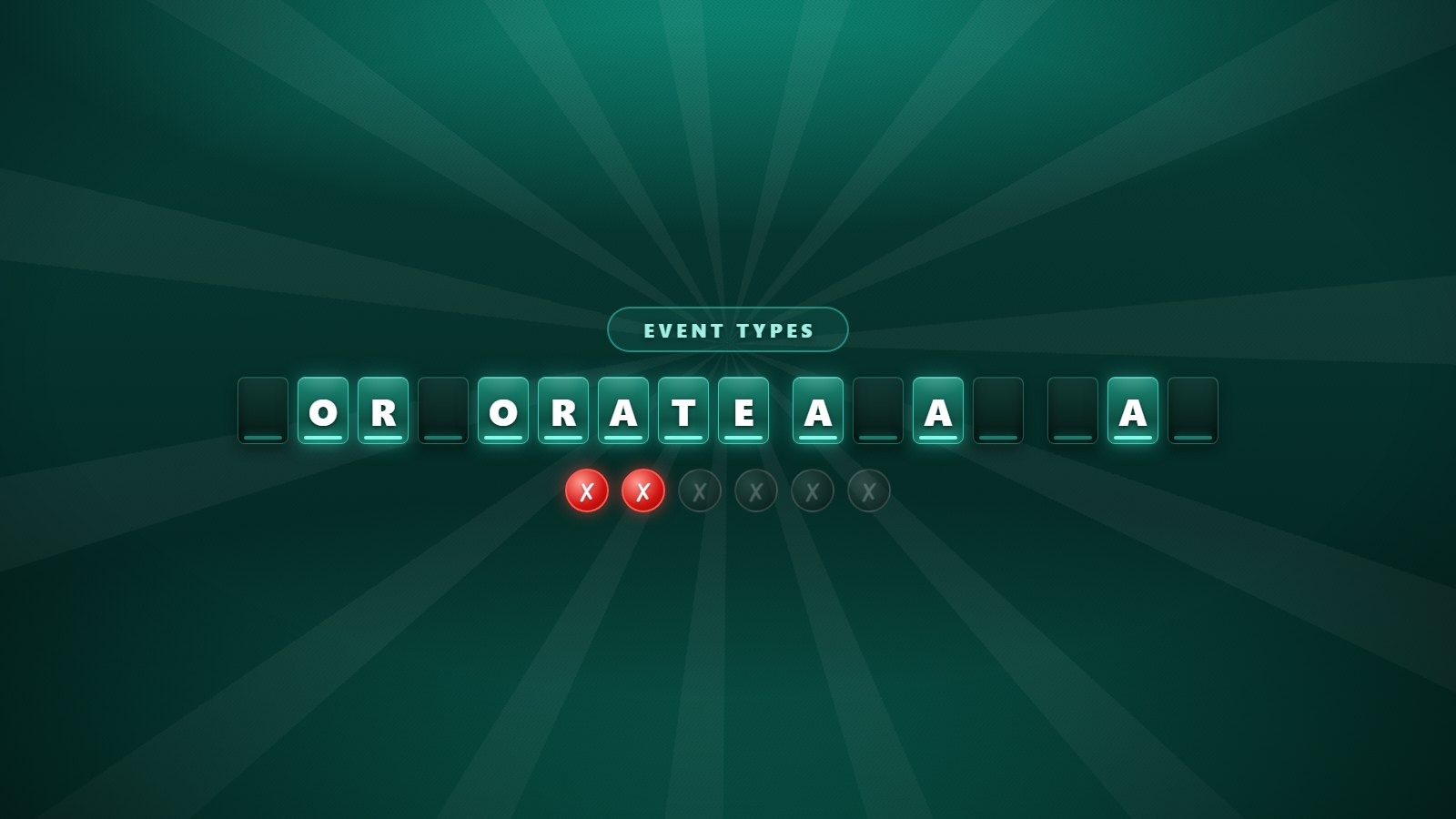
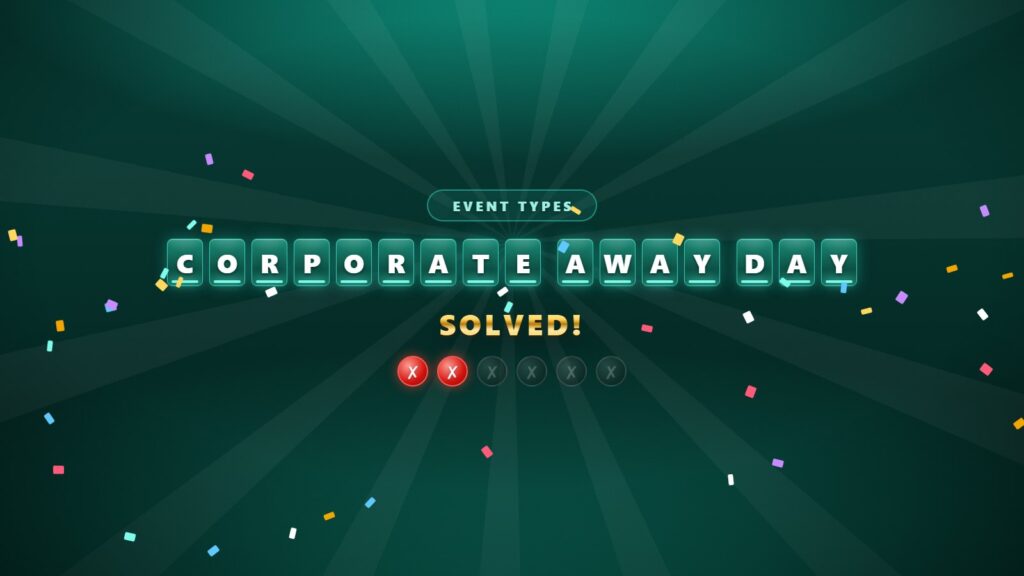
Wheel of Fortune is not one of the games I host, and I would rather say so than imply it. The nearest is Guess the Phrase: a hidden phrase on the big screen, lit up one letter at a time. Teams call letters in turn, every match lights everywhere it appears, and a wrong letter lights one of six lamps. Any team can solve the whole phrase at any moment.
My page for it carries the search label “Wheel-of-Fortune style”, and the resemblance stops there: no wheel, no cash value, no vowel price. It sits nearer to hangman, the game the show grew from, with lamps in place of a gallows. I write the phrases for your room, such as the running joke or the product name everyone will spot. Five phrases make a ten-minute block.
When is it worth hiring a host for a word-game round?
Do it yourself with 20 to 40 guests, one confident colleague with a microphone and twenty minutes to fill: a word round is forgiving.
Bring in a professional host when the room is bigger than a hundred, when speeches or awards surround the game, or when the last game fell flat because nobody held the pace. The unglamorous work is mine to take: ruling on a near-miss solve before the argument starts, keeping every spin to its clock, covering the slide that will not load, so nobody on your team has to. I also host family events, where the same round works with prizes in place of points.
For a quote, tell me the date, the room size, the running order and what went wrong last time. Call 07596 851647 or email hello@eventhost.info, and I will tell you which phrases I would put on the board. I work as a professional event host across the UK and Europe, and fees are agreed for each event.