
In short
- Audience engagement at a live event is about getting the room to take part, not watch politely from their seats.
- Attention drops at predictable moments: after lunch at a conference, and once the non-winners at an awards night decide the evening is over for them.
- You earn participation by reading the room’s energy, addressing people directly, and giving them a reason to lean in.
- The move I lean on most is splitting the whole room into two teams and rotating each round, so nearly everyone plays rather than a chosen few.
- Design the night for participation from the running order up, and the energy holds to the last item.
I can tell within about a minute of walking on whether a room is going to give me anything back. Audience engagement at a live, in-person event has nothing to do with likes, click-through or the numbers a marketing dashboard reports. It is the difference between a room that leans in and a room that checks its phones while you talk at it. After twenty years of hosting festivals, conferences and award ceremonies, I have learned that a room does not participate by accident: someone has to design for it, and then earn it live.
What is audience engagement at a live event?
Audience engagement at a live event is the degree to which the people in the room actively take part rather than passively watch. That covers everything from laughing, answering back and putting a hand up, to being on their feet in a team game. It is worth being clear about the framing, because the phrase gets borrowed by digital marketing, where engagement means opens and shares. In a room, engagement is physical and social: are these people with you, and are they doing something, or are they waiting for the bar to reopen. The plain test I use is whether I could stop mid-sentence and the room would fill the gap.
Why does audience engagement die halfway through?
Audience engagement usually dies at predictable, designed-in moments rather than at random. The clearest is the graveyard slot after lunch at a conference. That mid-afternoon slump is a real physiological thing: research on the post-lunch dip finds a genuine drop in alertness in the early afternoon, rooted in the body clock rather than the sandwiches. The second killer is the awards evening once the big categories are done and everyone who was not going to win has quietly clocked off. The third is subtler and entirely self-inflicted: a host who simply announces the next item, reads the running order aloud and wonders why nobody is with them. A room mirrors the person at the front. Announce at them, and they spectate. Involve them, and they show up.
How do you read a room’s energy?
You read a room’s energy by watching the audience, not your notes. At a family festival with a crowd past 10,000, you cannot afford a flat minute, because a crowd that size is always one dull moment from drifting to another stage. You learn to scan for the tells: how fast the laughter comes back, whether people are turned towards you or towards each other, how long a round of applause actually lasts. Then you adjust live. If the energy is high you can push and play; if it is sagging you pull the next lively moment forward and park the admin. None of that shows to the audience, which is the point. The read happens constantly, and the running order bends to it rather than the other way round.
How do you get an audience to actually take part?
You get an audience to take part by giving them a specific, low-risk reason to, then making the first move feel safe. Most people will not volunteer into a vacuum. The trick is direct address and a clear, easy ask: a show of hands before a raised microphone, a question aimed at one table rather than the whole room, a moment where taking part costs nothing and sitting out feels like missing something. I also give people a reason to lean in early, before the content asks anything of them, so the first act of participation happens while the stakes are low. Once a room has taken part once, it will do it again. The hard yard is the first ask, and that is where a host earns the booking.
Audience participation looks obvious when it works and awkward when it does not, so it helps to see it live. Here is a clip from one of my events where a whole room is mid-game.
There is nothing staged about that reaction. It is what happens when the ask is framed well and people trust the person making it.
Audience engagement ideas that work in a real room
The best audience engagement ideas share one trait: nearly everyone can join without being singled out. A few formats I return to, each written for the specific crowd in front of me:
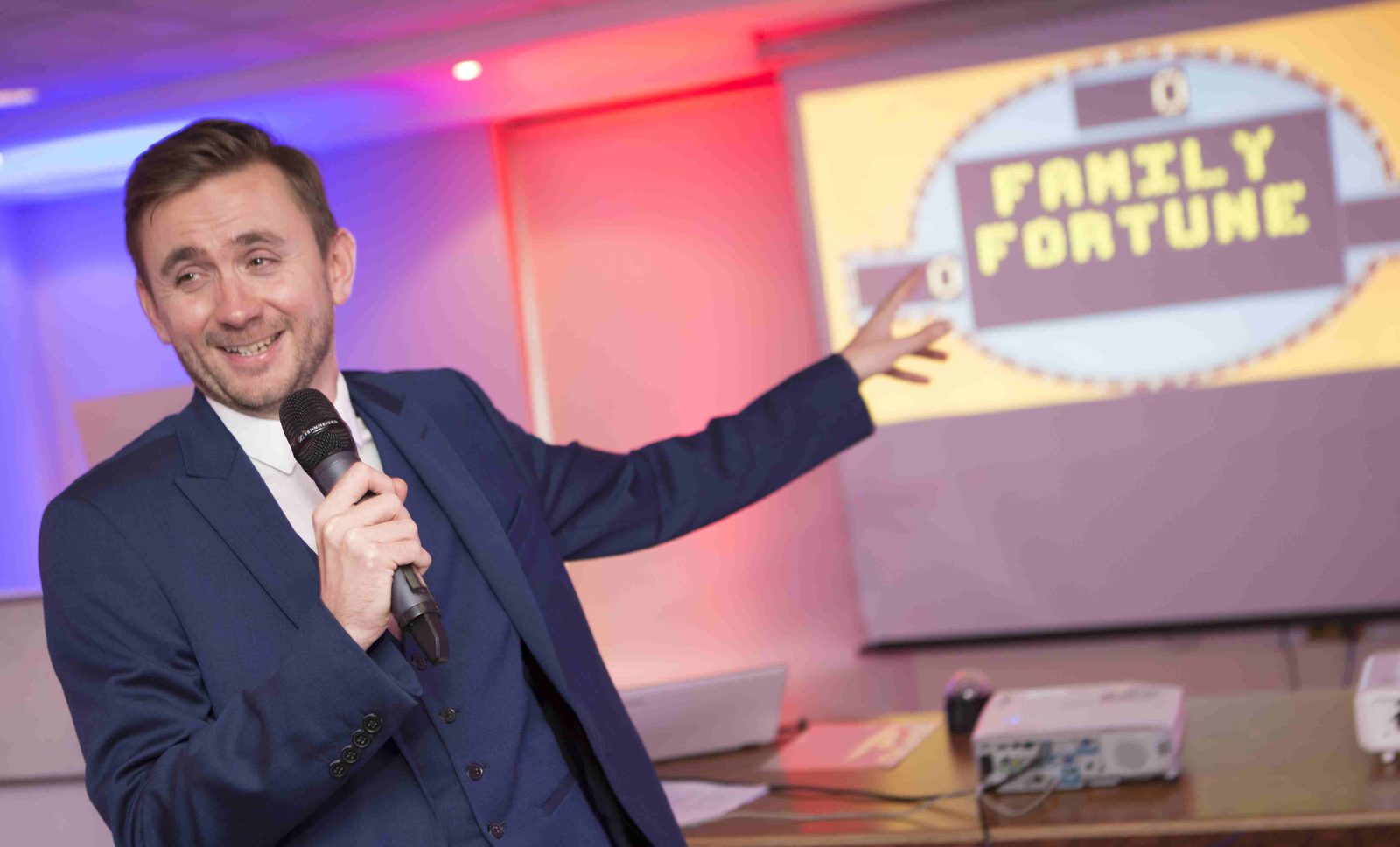
- A survey-style team game where I write the “our survey says” questions for that audience, then split the room in two so it stays snappy and almost everyone gets a go.
- A cards guessing game run table by table, so it plays out across the whole room at once rather than with three people stranded on a stage.
- A gentle, silly heat, like a modified egg-and-spoon race judged on the daftness of the walk rather than who wins, which pulls in the people who would never normally put a hand up.
None of that is a fixed script bolted onto any event. It is an interactive audience event shaped around the people, the sector and the mood of the night, which is why the same format flexes from a boardroom crowd to a family field.
 corporate event” class=”wp-image-40935″/>
The split-room move that turns spectators into players
My single most reliable move is to split the entire room into two teams and rotate who plays each round. It sounds small. It changes the maths of the night. Instead of three brave souls on stage and a few hundred watching, almost everyone has a stake, a team to belong to and a reason to shout. It is the difference between a show performed at a room and a show the room is in.
The clearest proof was an awards hybrid I built in late 2025, where a client wanted an awards evening that did not drag for everyone not collecting a trophy. I interleaved the presentations with game-show rounds, so the categories became the punctuation between rounds people actually wanted to play. Everyone stayed to the final award. That is what solving the non-winner problem looks like in practice.
How do you design a whole night for participation?
You design a night for participation by planning the energy, not just the agenda. Active involvement is not only more fun, it sticks: a large meta-analysis of teaching found that active learning beat passive lecturing on both performance and retention, and a room full of adults at an event is no different. They remember the bit they were in. So I build the running order around deliberate peaks and recovery moments, put the most participatory segment where the energy would otherwise sag, and make sure the host is carrying the client’s message between segments rather than leaving dead air. For corporate entertainment this is the whole job, and across a full day it is what separates a good conference host from someone reading the agenda aloud. Plan for participation up front and you are not rescuing the energy on the night, you are spending it where it counts.
Quick answers: audience engagement
How do you engage an audience that has gone quiet after lunch? Move the liveliest, most participatory segment into the graveyard slot rather than a dense talk, and get people physically doing something within the first couple of minutes.
What are the best audience participation ideas for a mixed corporate crowd? Team formats where nearly everyone can join without being singled out work best, because they lower the social risk of taking part.
How do you get shy guests involved without embarrassing them? Start with low-stakes group asks like a show of hands or a table game, and never put a reluctant person on a spotlit stage without an easy way out.
Is audience participation right for a formal event? Yes, when it is judged well: even a black-tie awards evening holds better when the room has something to do between the serious moments.
A room that takes part remembers the night, and it remembers the client who put it on. If you want an evening built for participation from the running order up, tell me about your event, or call 07596 851647.