
- Home
- Blog
- Event Host Blog
- Catchphrase game: how to run a picture-puzzle round at your own event
Catchphrase game: how to run a picture-puzzle round at your own event
 By Kevin Durham, event host and MC
5 November 2026 · updated 1 November 2026
7 min read
In short
- A Catchphrase game is a round in which teams guess a familiar phrase from a picture that hints at it, revealed a piece at a time.
- Run it in six steps: reveal, buzz, one guess per team, lock out the wrong guessers, score by how early the solve came, next picture.
- Score 3, 2 or 1 points by reveal stage, so an early guess is a brave one.
- Build your own puzzles. The sixteen below are original, and nothing here uses the television programme’s pictures or lines.
A Catchphrase game is a party round in which players work out a familiar phrase from a picture that gives it away only in part. Everybody in a room can shout at a picture, and nobody needs to know anything except the phrase.
This guide covers how the format works, a scoring method with the arithmetic shown, and a set of puzzles I wrote for this page.
What is a Catchphrase game, and where does it come from?
A Catchphrase game asks players to identify a well-known phrase from a visual puzzle. The name comes from an ITV television programme. The Wikipedia article, read on 1 November 2026, says it ran from 1986 to 2004, returned in 2013 and is still on air.
On that show, an animation is drawn slowly on a big screen, and contestants buzz in once they think they can see the phrase. The producer’s programme page describes picture puzzles of well-known phrases. Those two pages are all I rely on for the television format.
The idea is older than television. A rebus is a puzzle that combines pictures with letters to depict words or phrases, and the Wikipedia entry traces it to medieval heraldry, where a stag lying in water could stand for a bishop called Lyhart.
Can you run a Catchphrase game at your own event?
You can run a picture-puzzle round at your own event as long as you build it yourself and do not present it as the television programme. I have no connection to ITV or the show, and none of its animations, scripts, puzzles or catchphrases appear on this page.
The name and mascot are the broadcaster’s brand. A registered trade mark lets its owner take legal action against unauthorised use of the brand, so on a poster or running order I would call the round “picture puzzles” or “name that phrase”. This is not legal advice, and a one-off round for your own colleagues is a different thing from something you publish or sell.
How do you run a Catchphrase-style round step by step?
Run a Catchphrase-style round as a loop of six steps, repeated for each picture. Keep the loop identical, so teams stop thinking about the rules by the second puzzle.
- Put the first piece of the picture on screen, with the category if you want to give one.
- Reveal a second piece after about fifteen seconds, and a third after fifteen more.
- Any team may call a guess at any time, one spokesperson per table, hand up or buzzer.
- A wrong guess locks that team out of the current picture only. Other teams carry on.
- The first correct team scores, then the full picture and the phrase go up.
- Next picture. No recap, no discussion of the rules.
Six pictures is about ten minutes.
How do you score a Catchphrase game?
Score a Catchphrase game by how much of the picture was showing when the team solved it: 3 points at the first reveal, 2 at the second, 1 at the third. Nothing is deducted for a wrong guess, because the lock-out already is the penalty.
Here is a worked round of six, with two teams:
| Picture | Solved by | At reveal | Points |
|---|---|---|---|
| 1 | Red | First | 3 |
| 2 | Blue | Second | 2 |
| 3 | Red | Third | 1 |
| 4 | Blue | First | 3 |
| 5 | Red | Second | 2 |
| 6 | Blue | First | 3 |
Red finishes on 3 + 1 + 2 = 6 points and Blue on 2 + 3 + 3 = 8. Red solved fewer pictures, but Blue won two of them off a single piece, which is what gets a room cheering. If you finish level, show one extra picture and give it to the first correct team.
Sixteen original picture puzzles with answers
Every puzzle below is described in words, so you can draw it, find clip art or ask a colleague to sketch it. They are my own rebus-style ideas, built from everyday sayings.
| Round | Picture to show | Answer |
|---|---|---|
| Sayings | A tiny teacup with a thundercloud and lightning above it | Storm in a teacup |
| Sayings | A pig with feathered wings flying past a clock tower | When pigs fly |
| Sayings | A grey elephant sitting politely at a dining table | Elephant in the room |
| Sayings | A jar tipped over with beans pouring out | Spill the beans |
| Sayings | A hammer cracking a frozen pond | Break the ice |
| Sayings | A cat leaping out of a paper bag | Let the cat out of the bag |
| At work | An arrow curling back to the number 1 inside a square | Back to square one |
| At work | A set of goalposts on wheels being pushed away | Moving the goalposts |
| At work | A head poking out of a cardboard box | Think outside the box |
| At work | An apple hanging a hand’s width above the ground | Low-hanging fruit |
| At work | A tennis ball sitting alone on one half of a court | The ball is in your court |
| Word shapes | The word HEAD written above the word HEELS | Head over heels |
| Word shapes | The word GLANCE written backwards | Backward glance |
| Word shapes | The word READING between two ruled lines | Reading between the lines |
| Word shapes | The word SECOND with a crack down the middle | Split second |
| Word shapes | The word TIME written twice | Double time |
Run them in that order. They get harder, and the room should win early.
How do you make your own picture puzzles?
Make your own picture puzzles by choosing a phrase first, then asking which single image gives it away. If you cannot draw it in one picture, pick a different phrase.
There are three techniques. Draw the phrase literally, as above. Combine a picture with letters, which is the rebus. Or use the shape of the word itself. The picture superiority effect says pictures are more likely to be remembered than words, which is one reason a picture round lands in a noisy room where a spoken question would not.
For the reveal, a slide deck does the job. Cover the picture with blank shapes and remove them one at a time, or use the entrance effects Microsoft lists for PowerPoint: Appear, Fade In and Wipe. Put one picture on each slide.
Look at the screen from the back table, and do not let a puzzle depend on telling red from green, since colour blindness affects roughly 1 in 12 men and 1 in 200 women. Then swap in your own world: a product name, the department everyone jokes about.
Handling the room during a picture round
Handle the room by keeping the clock moving and deciding in advance what counts as close enough. Teams argue wording, and arbitrating in public kills the pace.
Say the rule before you start: the meaning has to be right, the exact words do not. Then stick to it, even when it costs your own table a point. Hold the reveal timings steady, let the groan of a wrong guess land, and never explain a puzzle after the answer.
In a big room, play it at the tables with one spokesperson per team. I use the split-room rotation from my Family Fortunes rounds, so the spokesperson changes every picture and nearly everyone gets a go. When the room starts guessing under its breath, I call on the person who obviously knows.
The game I host that is closest to a Catchphrase game
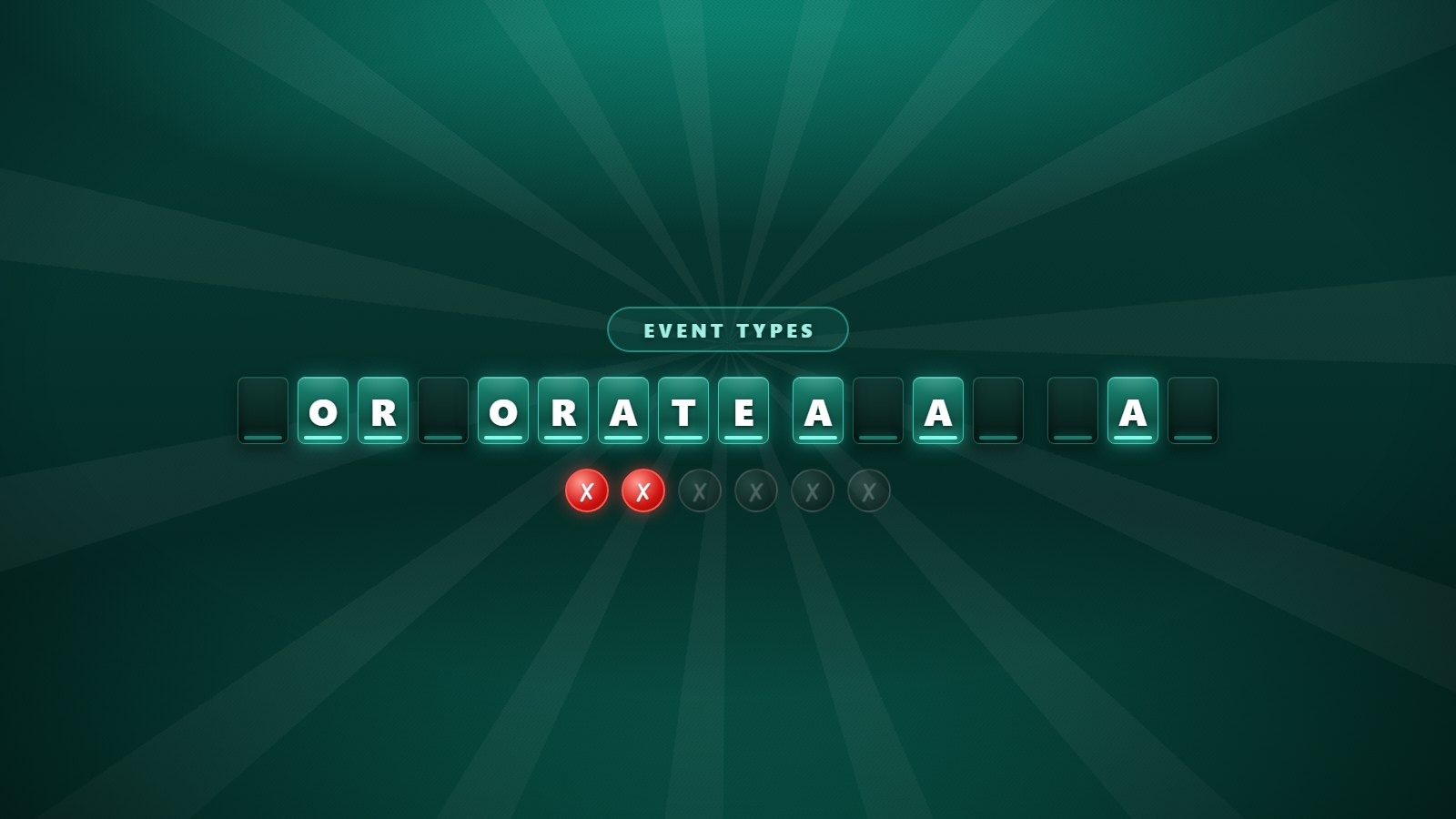
The closest game I host is Guess the Phrase, and it is a different format: a hidden phrase on the big screen is lit up one letter at a time, and teams call letters before the wrong-guess lamps run out. It is not a picture game and I do not describe it as one.
I write the phrases for the room in front of me, including your company in-jokes and the line everyone in the office will spot. My Quiz Show has picture questions, and takes your own logos and photos. For a whole evening of rounds there is corporate game show hire, and for a staff party there is Christmas party entertainment.
One client who booked me for a Christmas awards party put it this way on the reviews page: “We really liked the intertwining of awards and the game. Everyone had a brilliant time and Kevin was fantastic.” (Christmas awards party client.) The credit belongs to the room that joined in. The reviews page shows a 5.0 average on Google.

When is it worth hiring a host for this?
Do it yourself if you have 20 to 40 guests, one confident colleague with a microphone and ten minutes to fill. A picture round is forgiving.
Bring in a professional event host when the room is larger than a hundred, when the evening has awards or speeches around it, or when the last game died because nobody was in charge of the pace. The evening runs smoothly because someone experienced is holding it together: deciding the close-enough calls, keeping the clock honest, covering the dead moment when a slide will not load, and fitting the round into the running order. If you want me to host it, I will build the puzzles around your people.
For a quote, tell me the date, the room size, the running order and what went wrong last time. Call 07596 851647 or email hello@eventhost.info, and I will tell you what I would put on the screen. I host as a professional event host across the UK and Europe, and fees are agreed for each event.