

- Home
- Blog
- Event Host Blog
- Deal or no deal game: how to run a box-and-Banker round at an event
Deal or no deal game: how to run a box-and-Banker round at an event
 By Kevin Durham, event host and MC
7 November 2026 · updated 2 November 2026
7 min read

In short
- A deal or no deal game is a box game: one player keeps a sealed box, opens the rest and decides after each round whether to sell their box to the Banker.
- Play for points or a prize list and charge nothing to take part. The Gambling Commission’s private gaming guidance rules out a charge for participation.
- Script each offer as a share of the average of the values still in play, rising from about 40% in round one to about 90% at the end.
- Give every table a box and a vote, so the room is the player’s adviser and not an audience.
- Deal or No Deal is not one of my own games, which makes this a build-it-yourself guide.
A deal or no deal game is a box game in which one player keeps a sealed box, opens the others a few at a time and decides after each round whether to sell their box to the Banker for an offer. I’m Kevin Durham, a professional event host and MC, and this guide shows you how to build one for a work or family event, with the offers worked out so you are not guessing on the night. Nobody needs to risk a penny for the tension to be real.
What is the Deal or No Deal game and how does it work?
The Deal or No Deal game is a television format in which a contestant picks one of 22 sealed boxes, opens the others in rounds, and after each round answers “deal” or “no deal” to the Banker’s offer for their box. The British Wikipedia entry, read in November 2026, sets out the rules.
The sums run from 1p to £250,000 in the Channel 4 version and from 1p to £100,000 in the ITV1 revival. The first round opened five boxes and each later round three, though Wikipedia notes the pattern changed from series 12. Lose a big amount from the board and the offer drops. Lose a small one and it rises. If the contestant never deals, two boxes remain, and the Banker sometimes offers a swap.
The format began in the Netherlands as Miljoenenjacht, created by John de Mol Jr. Noel Edmonds presented the British show from 31 October 2005 to 23 December 2016, and Stephen Mulhern has fronted the ITV1 revival since 20 November 2023.
Can you run a Deal or No Deal game at your own event?
You can run a box-and-Banker game at your own event if you build it yourself, charge nothing to play and do not present it as the television programme. I have no connection with the show or its producers. A registered trade mark lets its owner take legal action over unauthorised use of a brand, so on your running order call it “Sell or Swap”. This is not legal advice.
Money is the other trap. The Gambling Commission’s private gaming guidance, last updated 14 September 2023, says private gaming can take place in a workplace, but no charge may be made for taking part, and a “voluntary” donation can count as one. So there is no entry fee, no donation to play and no cash stakes. Use points and a prize list the company pays for. If the game is part of a fundraiser, take advice first.
Setting up the boxes for a room
Set up the game with one numbered box per table, the values on the big screen and one sealed list of which value is in which box. The list belongs to someone who is not the host, so nobody presenting can give the answer away.
- Boxes: ten suit ten tables. A bigger room can pair tables on a box.
- Values: use points, or a ladder of prizes from a sticker to the top prize. Make the board steep, a lot of small values and a few big ones.
- The keeper: on the show, an independent adjudicator seals the boxes and is the only person who knows the values. A finance colleague does the same job well.
- The board: put every value on the big screen in large numerals. The show shows low values in blue and high in red. Do not rely on colour alone: colour blindness affects roughly 1 in 12 men and 1 in 200 women.
- The player: draw a table number at random and bring that table’s representative to the front.
How do you script the Banker’s offers?
Script the Banker’s offer as a share of the average of the values still in play, and raise the share each round. The average is the total of those values divided by the boxes left, the player’s own box included. Early offers sit well below it, so “no deal” is the tempting answer.
On the real show, the Banker’s offer is usually below the expected value, particularly early on. One analyst’s regression of the US syndicated version put it at about 37% of the average at the first offer and 84% at the seventh. My scale for a four-round game is 40%, 55%, 70% and 90%, and it is my own.
Worked example: ten boxes holding 1, 5, 10, 25, 50, 100, 250, 500, 750 and 1,000 points. The total is 2,691. This run has the player clearing small values, so the offers climb.
| Round | Boxes opened | Values left | Average | Banker’s share | Offer |
|---|---|---|---|---|---|
| 1 | 1, 5, 10 | 7 | 382 | 40% | 153 |
| 2 | 25, 50 | 5 | 520 | 55% | 286 |
| 3 | 100, 250 | 3 | 750 | 70% | 525 |
| 4 | 500 | 2 | 875 | 90% | 788 |
The last offer of 788 points sits between the two values left, 750 and 1,000. Take it and the player beats the worse box. Refuse and it is a coin flip for 1,000, and the room splits down the middle.
Two rules keep it honest. Keep every offer between the smallest and largest value still in play. And work the arithmetic before the night, so the host is not on a calculator while the room waits.
Why do players turn down good offers?
Players turn down good offers because they weigh each offer against what they hoped for, not against its size. A 2008 study of contestants in the American Economic Review found choices were explained largely by earlier outcomes in the game, with risk aversion falling after expectations were shattered or surpassed.
That sits close to loss aversion, part of Kahneman and Tversky’s prospect theory. For the host it is practical: after a big swing on the board, in either direction, expect a bolder player and a louder room. Pause before the offer.
Running the room while it plays
Manage the room by giving every table a job in each round. The player picks table numbers, that table opens its box, and its value comes off the big screen. The room becomes the 21 advisers on the show, not an audience.
Your value board should read from the back table like this one, a Family Fortunes round.

- The host announces how many boxes to open, and the player names the tables.
- A helper cuts the lights or music and the “Banker” rings from offstage. A person on a phone is enough.
- The host reads the offer, then waits. Silence is the best special effect you have.
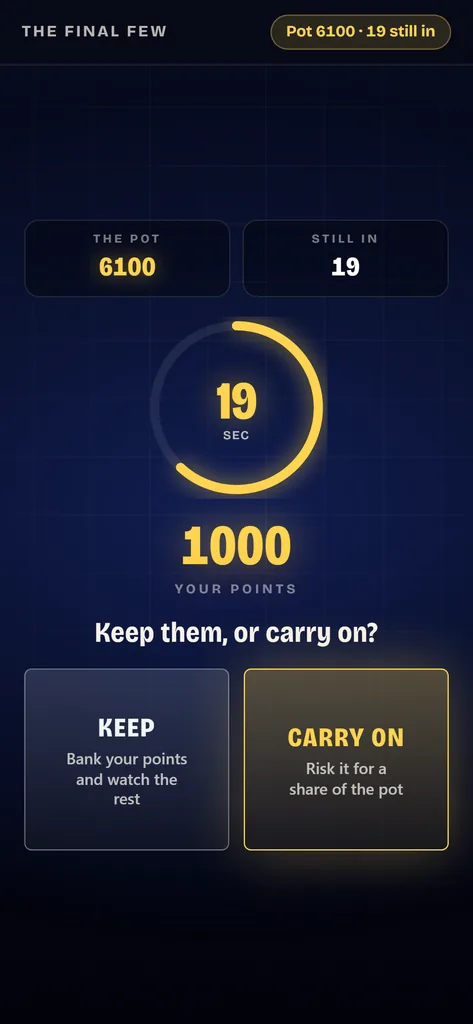
- The room shouts advice, and the player has twenty seconds to decide.
Plan about fifteen minutes for ten boxes. If the player deals, open their box anyway. The television show also plays out what they would have won, and the groan is part of the fun.
For a family day, swap points for stickers, small toys and a trophy, and let children play in pairs with a grown-up. I host family events from fun days to festivals.
The games I host that share the Banker’s tension
Deal or No Deal is not one of the games I host, and I would rather say so than imply it. Two of mine share its bank-it-or-push-on tension. In my own Play Your Cards Right style card game, a team that calls a card correctly can stick and bank its place, or push on. The plain card version is in my higher or lower guide.
A client on my reviews page said of a Christmas party: “We did Play Your Cards Right and Family Fortunes. We all had a great time. Kevin was absolutely fantastic. Everyone joined in and we really recommend him.” (Corporate Christmas party client.) That is the room’s doing, and I only held the microphone. The page shows a 5.0 average on Google.
When is it worth hiring a host for a box game?
Do it yourself with a small team or a family room: a dozen to forty people, a confident colleague on the microphone and a quarter of an hour to fill. A box game is forgiving, and the maths above does the hard part.
Bring in a professional host when the room has more than a hundred guests, when awards or speeches surround the game, or when the last game fell flat because nobody held the pace. A professional earns the fee on the unglamorous parts: timing the pause, keeping the clock honest, covering the slide that will not load. For a whole evening of rounds, see my corporate game show hire.
If you want that at your event, tell me the date, the room size, the running order and what went wrong last time. Call me on 07596 851647 or email hello@eventhost.info. Fees are agreed for each event. You can read more about me as a professional event host working across the UK and Europe.