
- Home
- Blog
- Event Host Blog
- History quiz questions and answers, by era, with a tie-breaker
History quiz questions and answers, by era, with a tie-breaker
 By Kevin Durham, event host and MC
7 November 2026 · updated 3 November 2026
6 min read
In short
- Below are 32 history quiz questions and answers in four rounds of eight: Romans to the Middle Ages, 1500 to 1900, the twentieth century, and world history.
- Each answer was checked against a named page opened in November 2026. Where a date is disputed, I ask for the name instead.
- Every round runs from easy to hard, so each table gets some points.
- Finish on a tie-breaker with a number for an answer.
History quiz questions are the round that everybody half-remembers from school, which is why it starts arguments at a table. The set below suits a work social, a club night or a charity quiz, and it deliberately avoids royals and the dates every pub quiz already uses.
What makes good history quiz questions?
Good history quiz questions have one checkable answer, name something people have heard of and reward a sensible guess. Ask for an event, a person or a number that sources agree on, and avoid anything historians still argue about.
- Ask who, what and which, and keep “in which year” for the famous dates. A table can reason its way to a person; it can only guess a year.
- Order each round from easy to hard, so every table scores early.
- Check the answer in a named source, not from memory. Quiz arguments are won and lost on that.
- Skip disputed claims. The Domesday Book is usually dated to 1086, but Wikipedia, read in November 2026, notes recent research suggesting it may be later. So question 4 asks for its name, not its date.
History quiz questions: Romans to the Middle Ages
Eight questions on the first thousand years or so of recorded British history.
- Which Roman emperor ordered the invasion of Britain in AD 43? Answer: Claudius.
- Which queen of the Iceni led a failed uprising against Rome in AD 60 or 61? Answer: Boudica (accept Boudicca).
- In which year did building start on Hadrian’s Wall? Answer: AD 122.
- William the Conqueror’s great survey of England became known as what? Answer: the Domesday Book.
- Which Wessex king won the Battle of Edington in 878? Answer: Alfred, the only native-born English monarch to be called “the Great”.
- Which king sealed Magna Carta at Runnymede in June 1215? Answer: King John.
- In which year did the Black Death reach England? Answer: 1348, at Melcombe Regis in Dorset.
- Which tax sparked the Peasants’ Revolt of 1381? Answer: the poll tax.
What are good British history quiz questions from 1500 to 1900?
The best British history quiz questions from this period cover wars, politics and the things that changed daily life: railways, stamps and exhibitions. They are mostly about people and places, so most tables can have a go.
- In which year did the Spanish Armada sail against England? Answer: 1588.
- Which man became Lord Protector in December 1653? Answer: Oliver Cromwell.
- The Acts of Union of 1707 joined England with which kingdom to create Great Britain? Answer: Scotland.
- Which Hull-born MP led the parliamentary campaign against the slave trade for 20 years before it was banned in 1807? Answer: William Wilberforce.
- Which locomotive won the Rainhill trials in 1829? Answer: Stephenson’s Rocket, the only one to complete them.
- In which city did the Peterloo massacre happen in 1819? Answer: Manchester, at St Peter’s Field.
- What was the world’s first adhesive postage stamp, issued in 1840? Answer: the Penny Black.
- The Great Exhibition of 1851 was held in which London park? Answer: Hyde Park, inside the Crystal Palace.
What are good history quiz questions on the twentieth century?
The twentieth century gives you the most recognisable history quiz questions, because many guests have family stories attached. Mix war, politics and social change, and keep a couple of easy ones at the start.
- At what time on 11 November 1918 did the Armistice come into force? Answer: 11am (Paris time).
- Which organisation did Emmeline Pankhurst found in 1903, whose members became known as suffragettes? Answer: the Women’s Social and Political Union, or WSPU.
- The Battle of the Somme began on 1 July of which year? Answer: 1916.
- On what date did the D-Day landings take place? Answer: 6 June 1944.
- Which Labour Health Minister is popularly considered the founder of the NHS, which began in 1948? Answer: Aneurin Bevan, and the NHS began that year.
- Which ship brought one of the first large groups of Caribbean migrants to Tilbury in June 1948? Answer: the Empire Windrush.
- Which waterway did Egypt’s president Nasser nationalise in 1956, triggering a crisis with Britain, France and Israel? Answer: the Suez Canal.
- In which year was the Good Friday Agreement signed in Belfast? Answer: 1998.
World history quiz questions: eight places, eight centuries
World history quiz questions work when each one is a different place and a different century. That stops a table of specialists running away with the round.
- On what date in 1789 was the Bastille stormed? Answer: 14 July.
- Which Ottoman sultan captured Constantinople in 1453? Answer: Mehmed II.
- The Terracotta Army was buried with which emperor? Answer: Qin Shi Huang, the first emperor of China.
- Which German craftsman is credited with introducing movable type to Europe? Answer: Johannes Gutenberg.
- Which French scholar announced his decipherment of Egyptian scripts, using the Rosetta Stone, in 1822? Answer: Champollion.
- Gandhi’s 1930 protest march to Dandi was against a tax on what? Answer: salt. It covered about 385 kilometres (240 miles).
- For how many days did the Cuban Missile Crisis of 1962 last? Answer: 13.
- In which year was Nelson Mandela released from prison after 27 years? Answer: 1990.
What is a good history quiz tie-breaker?
A good history tie-breaker has a number for an answer, so the closest team wins and nobody has to share a prize. Ask: for how many years did the Hundred Years’ War last? The answer is 116, from 24 May 1337 to 19 October 1453.
Need a second? Ask how long Hadrian’s Wall is in miles. The answer is 73, or 117 kilometres, according to the same Wall page as above.
How do you run a history round in a quiz night?
To run a history round, read each question twice, give 20 to 30 seconds to answer, and mark at the end of the round, not question by question. Put history early, when the room is still fresh. For more ways to build the night, see these quiz round ideas.
- Use one era per round if you have time, or the best two questions from each era above if you don’t.
- Accept reasonable spellings (Boudicca, Gandhi) and say so before you start.
- Keep the answer sheet with the source in front of you. A named source ends a dispute in ten seconds.
- Pair it with a general knowledge round that has no overlap in subject.
How I run a history quiz on my own software
Every game I run is built on software I wrote myself, so I can write the questions for the room and change style if a different crowd turns up. A graduate intake gets a different history round from a board of directors.
These 32 questions would work three ways:
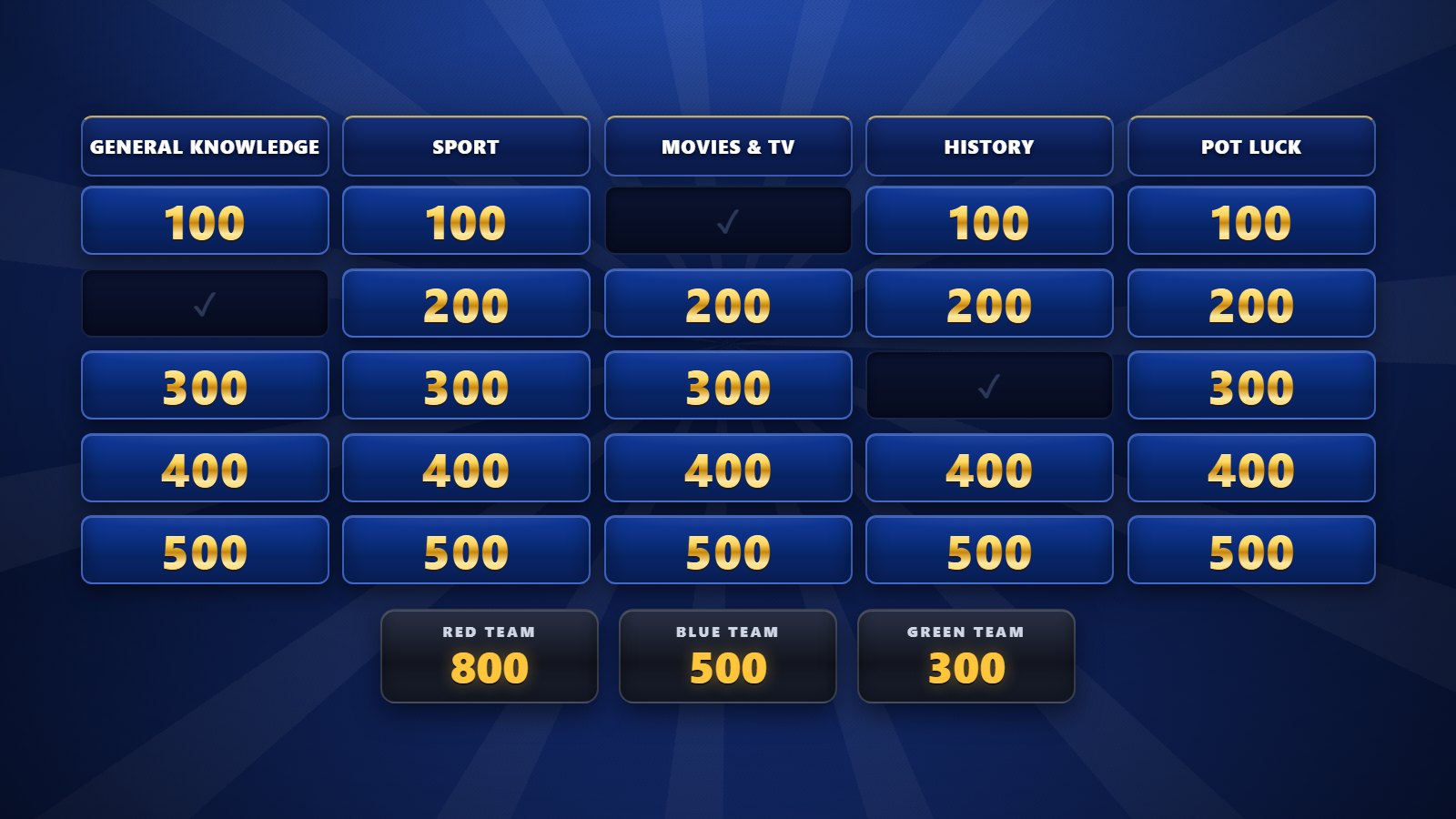
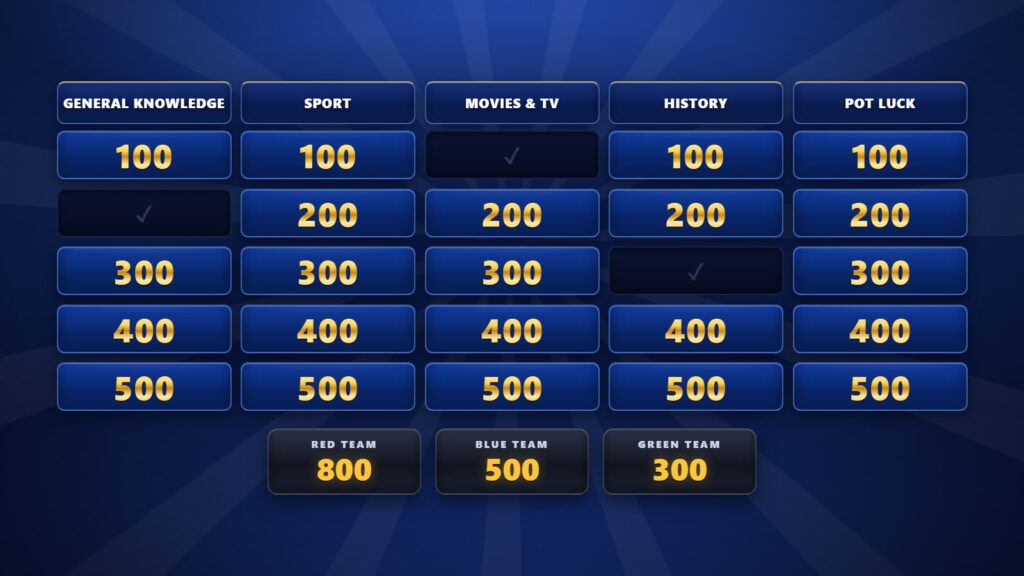
- On a Quiz Show board. History is one category, with the easiest question at 100 points and the hardest at 500. Teams pick, buzz in and steal each other’s misses.
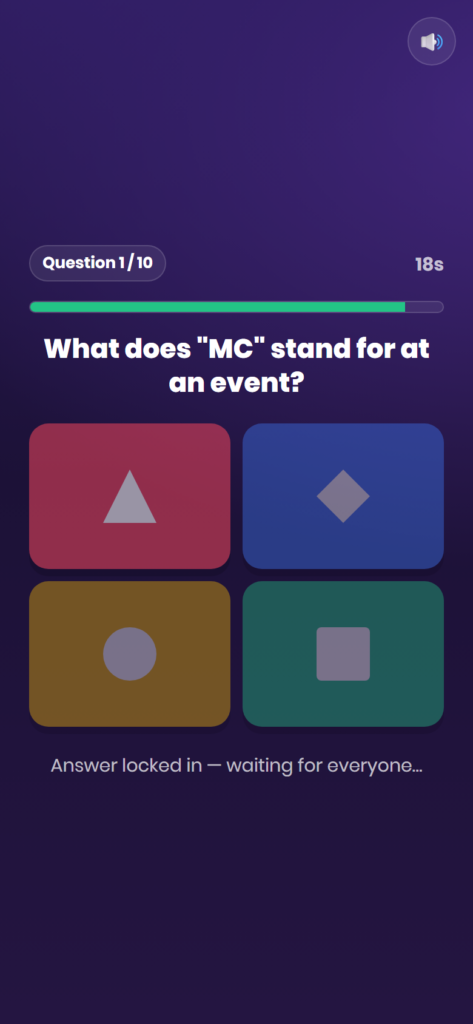
- On every phone. With Quiz Live, every guest answers on their own phone, and a leaderboard follows each question.
- As a knockout. The Cut puts the whole room in and cuts the lowest scores each round.
When is it worth hiring a quiz master for a history night?
A quiz master is worth hiring when the quiz is the main event, the room is large, or the guests include clients you want to impress. Reading questions is easy; keeping a whole room with you while you settle a dispute over Boudica’s spelling is the skill.
If it is a small team and a lunchtime, run it yourself with the list above. If you would rather hand it over, I will write the rounds, run the games and host the whole evening as your quiz master. Have ready the date, the room size, who is coming and what went wrong last time. Call me on 07596 851647, or email hello@eventhost.info, and tell me about your event.