
- Home
- Blog
- Event Host Blog
- Tie breaker questions for a quiz: 10 checked answers and the rules
Tie breaker questions for a quiz: 10 checked answers and the rules
 By Kevin Durham, event host and MC
12 November 2026 · updated 10 November 2026
7 min read

In short
- Tie breaker questions settle a quiz when two teams finish level: one question with a number for an answer, and the nearest guess wins.
- Below are 10 tie breaker questions with answers, each checked against a named source in November 2026, and none repeated from another quiz on this site.
- Decide before the question is read whether an equally close guess goes to a second question, to “without going over”, or to a count-back.
- Every team writes its guess down at the same moment. Nobody calls out in turn.
A tie breaker is the single question that splits two teams on the same score at the end of a quiz. It sounds like an afterthought, and it is the moment with the most people watching. Get the rule wrong and the winning table spends the drive home arguing about it.
I run quiz nights for companies as an event host, and I wrote this for anyone running a work, club or charity quiz with paper and pens. My own quiz night guide says to keep a tie breaker ready. This post is that tie breaker, and the rules to go with it.

What are tie breaker questions in a quiz?
Tie breaker questions in a quiz are questions held back for a draw, with an answer that is a number, so the closest guess wins even if nobody is exactly right. A normal question can be answered correctly by both tied teams, which settles nothing. Two tables rarely write down the same number.
PTA’s step-by-step quiz night guide tells organisers to prepare a tie-break question, and stops there. The question is the easy part. The rule around it is what keeps the result clean.
What makes a fair tie breaker?
A fair tie breaker has one checkable number for an answer, an answer nobody in the room is likely to know exactly, and a range wide enough that the guesses spread out. Years, distances, heights, weights and counts all work.
- Nobody should know it to the digit. If one guest can answer it from work or a hobby, you are rewarding that guest, not the team.
- The answer should not move. Records, populations and prices change, so print the date you checked it.
- The guesses should land far apart. A question with an answer in the hundreds of thousands spreads the room more than one with an answer under twenty.
Ten tie breaker questions with checked answers
Each answer below was checked on the linked page in November 2026. Write the answer on your sheet before the quiz starts.
| Question | Answer |
|---|---|
| In what year was the first text message sent? | 1992, on 3 December. It said “Merry Christmas” |
| In what year did the world’s first underground passenger railway open, in London? | 1863, on 10 January |
| In what year did Queen Victoria open the Royal Albert Hall? | 1871 |
| How many steps climb to the top of the Monument in the City of London? | 311 |
| How many stations does the London Underground serve? | 272, on the same Underground page |
| How many seats does the Royal Albert Hall have? | 5,272, on the same Hall page |
| How much does the Great Bell known as Big Ben weigh, in tonnes? | 13.7 tonnes |
| How tall is Blackpool Tower, in metres? | 158 metres (518 feet) |
| How long is the Channel Tunnel, in kilometres? | 50.46 km (31.35 miles) |
| How far is the Moon from Earth on average, in kilometres? | 384,400 km (238,855 miles), according to NASA |
Use a year for a mixed-age room, because everybody can reason towards one. Save the Moon for a room that likes an argument: the guesses will run from thousands to millions.
The station count and the seat count are the two most likely to change, so say “as at November 2026” when you read the answer.
How do you settle a tie when two guesses are equally close?
Two guesses that are equally close are settled by a rule you announced before the question, never by one you invent after the answers come in. There are two sensible choices, and either is fine as long as the room hears it first.
Here is the problem, with the Monument question. The answer is 311. Team A writes 300 and Team B writes 322. Both are 11 away: 311 minus 300 is 11, and 322 minus 311 is 11. The rule “closest wins” has just produced a second draw.
- A second question. Keep a different kind of tie breaker in reserve: if the first was a count, make the second a distance. It is the fairest option and it keeps the moment going.
- Closest without going over. On The Price Is Right the winning bid is the closest without going over, and no contestant may copy another’s bid. Under that rule Team A wins, because 300 is under and 322 is over.
What if the tie breaker is still a draw?
If the tie breaker is still a draw, go to a count-back or a sudden-death question. Both competitions below settle ties with a set order of rules, not a coin toss.
The International Quizzing Championships break ties by counting back: the team with the better best round wins, then the better second-best round, and so on. On Mastermind, a draw on points goes to the contender with the fewest passes, and only then to a five-question tiebreaker.
For a work quiz, a sensible order is:
- The closest-guess question.
- A second closest-guess question of a different type.
- Count-back on the round scores already on your sheet.
- Sudden death: one question at a time until one team is right and the other is not.
Write all four on your sheet, even if you only expect to need the first. Making up step two in front of the room is how a host loses it.
Which tie breaker rules should you read out first?
Read out three rules before the tie breaker question: guesses are written down, not called out; the nearest guess wins; and what happens if two guesses are equally close. Thirty seconds of rules saves ten minutes of appeals.
Writing matters more than people expect. If the tied teams call out in turn, the second team can simply say one more than the first and take every number above it. Hand each tied team a slip, give them the same thirty seconds, and collect both slips before you read the answer. My answer sheet template has room for the tie breaker on the master sheet.
Decide too whether a tie for second or third place needs breaking at all. If there is no prize for third, let the two teams share it and keep the room moving.
Questions that make bad tie breakers
Some numbers look perfect and are not. How many bones are in the adult human body? The usual answer is around 206, which a nurse, physio or biology teacher in the room is likely to write down to the digit. Two tables with a nurse each, and you are tied again.
Avoid questions with a yes or no answer, anything that has changed in the past year, and any figure your sources disagree on. A tie breaker has to end the argument, not start a new one.
How ties play out on my own quiz software
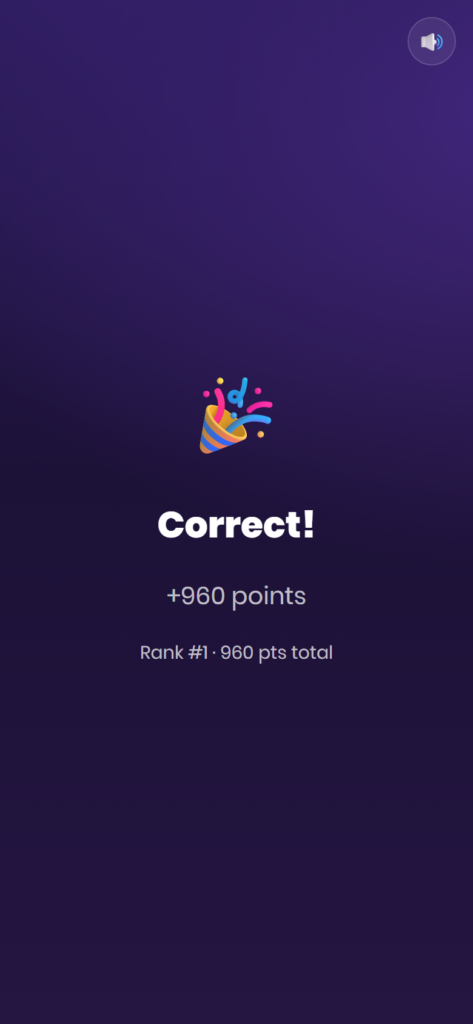
When I host a corporate quiz, guests can play on Quiz Live, the quiz software I built myself, with every guest answering on their own phone. Points are given for being right and for being quick: full marks for fast and right, fewer for slow and right.
That takes most of the sting out of a tie. Two teams with the same number of right answers will usually have different totals, because the points also count how fast each table answered. The leaderboard after every question shows who is ahead, and the top three are revealed one place at a time at the end.
Rounds played on paper or at the board still need a closest-guess question in reserve. Agree its rule before the night, not during it.
When is it worth hiring a quiz master?
It is worth hiring a quiz master when there is a real prize, a room of more than a few tables, or clients and senior guests watching the result. For a lunchtime quiz with one team in the office, run it yourself with the list above.
What clients tell me they want is someone who listens in the briefing and does not surprise them on the night. A pre-event consultation is standard for me, and tie rules are exactly the kind of detail to settle in it, so the last five minutes of the quiz are the best five, not the most awkward. One corporate client, Faerch Group, wrote on my reviews page that I “kept the evening flowing superbly”. Kind of them, and the flow comes from a client who briefed the night properly.
If you would like the quiz written for your room and hosted from start to finish, have the date, the number of guests and the prizes ready, and look at how I work as a quiz master. Then call me on 07596 851647 and tell me about the event.