

- Home
- Blog
- Event Host Blog
- 1% Club game for a party: how the live version plays and when to hire a host
1% Club game for a party: how the live version plays and when to hire a host
 By Kevin Durham, event host and MC
24 November 2026 · updated 12 November 2026
8 min read
In short
- A 1% Club game for a party is a knockout quiz in the style of the ITV programme: the questions get harder, a wrong answer puts you out, and every lost stake feeds a growing pot.
- Questions are graded by how many people get them right, from 90 per cent down to 1 per cent, and they test logic rather than general knowledge, so a mixed room plays on level terms.
- It can run on every guest’s phone, with one entry per table, or with no phones while the host runs it from the front.
- Give it 25 to 35 minutes as the main slot, not a filler between courses.
- Hire a host once the room is bigger than a couple of tables, or when the keep-or-carry-on moments need to land in front of senior people.
A 1% Club game for a party is a live knockout quiz built in the shape of the ITV programme: everyone starts with the same stake, each question is harder than the last, and a wrong answer takes you out and moves your stake into a shared pot. If you want that tension at a staff party, awards night or Christmas dinner, this guide explains how the live version plays and what hiring a host adds. I host my own version. It is not the television show.
How does a 1% Club game for a party work?
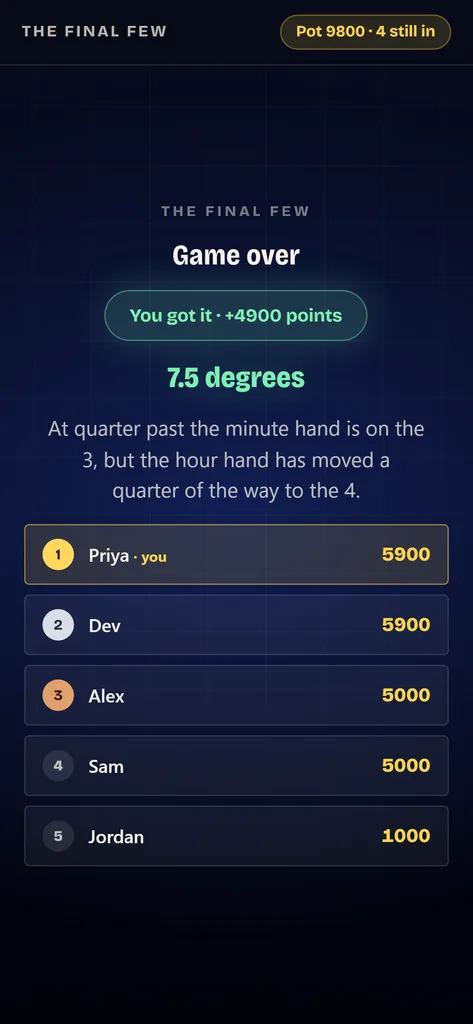
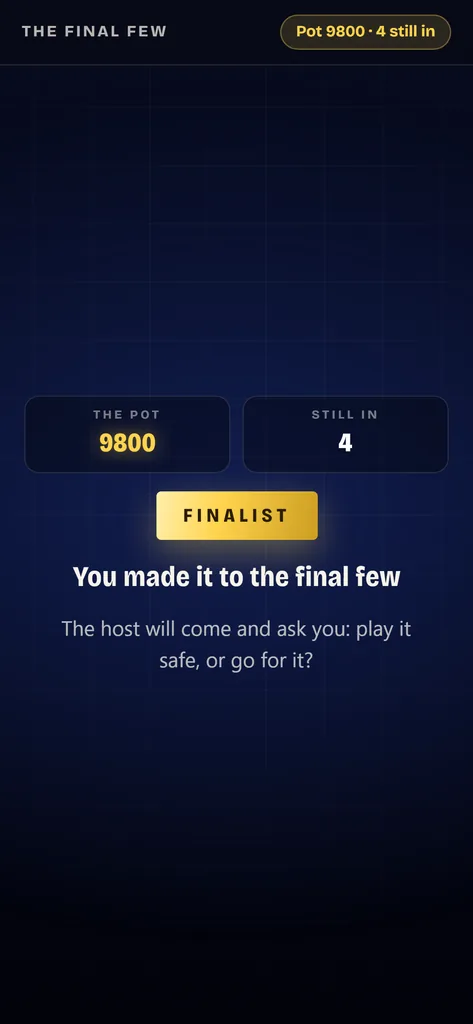
In a 1% Club game for a party every guest starts with the same stake and answers harder and harder questions. A wrong answer drops them out and their stake joins the pot. Survivors get one pass and a chance to bank, and the last few choose between a safe share and the hardest question.
The broadcast format, per Wikipedia (read 11 November 2026), has 100 contestants with £1,000 each and 15 questions from 90 per cent down to 1 per cent, 30 seconds apiece, answered secretly on phones or tablets. My version keeps that shape and plays for points, not money.
| Stage | What happens | What the room sees |
|---|---|---|
| Early questions | Wrong or late answers go out, stake into the pot | The pot climbs on the big screen |
| From question five | One pass, used once | Players deciding how sure they are |
| Question nine | Keep your 1,000 points and sit down, or carry on | The room watches who stands |
| After question fourteen | Survivors become finalists and come to the front | A handful of people, everyone watching |
| The 1 per cent question | Share a safe pot of 10,000 points, or go for the whole pot | A choice made out loud |
Why does a logic quiz suit a mixed workplace?
A logic quiz suits a mixed workplace because nobody is knocked out for not knowing something: they are knocked out for missing the trick. A new starter and a director start level, because no dates or capitals are needed.
The percentage ladder comes from testing: on the television show, questions are put to members of the public first and ranked by how many got them right.
The best questions are ones where the obvious answer is wrong. Shane Frederick’s cognitive reflection test (2005) measures the habit of resisting the first response that comes to mind. His best-known item (adapted here to pounds) says a bat and a ball cost £1.10 together and the bat costs £1.00 more than the ball: what does the ball cost? The gut says 10p. The answer is 5p.
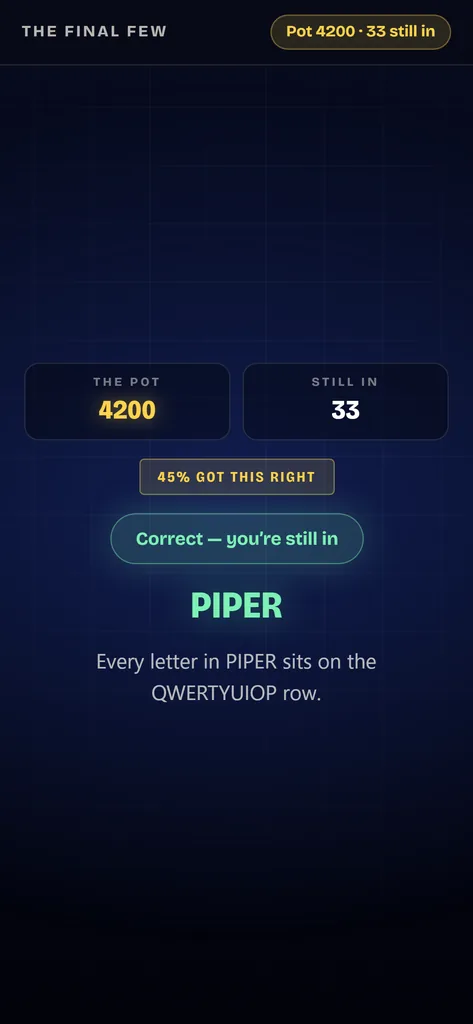
A question on my page is gentler: which word can be typed using only the top row of a keyboard? On the page, 45 per cent get it right. If you want a different use of percentages, inverted scoring rewards the obscure answer instead.
Why does the keep-or-carry-on moment hold a room?
The keep-or-carry-on moment holds a room because it asks each guest, in public, whether to protect what they hold or risk it for more. Researchers call the underlying pull loss aversion: Kahneman and Tversky’s work found losses tend to be treated as about twice as large as an equal gain.
At question nine the phone asks and the room watches who stands. A thousand points is not much, yet nobody wants to lose it in front of colleagues. For a leadership team I slow the decisions down, because a managing director saying out loud whether to play safe deserves room to breathe.
What ways can you play a 1% Club game live?
You can play a 1% Club game live with every guest on their own phone, with each table as one entry, as a show with ten players at the front, or with no phones at all. I choose the way that suits the room, the timings and the layout.
| Way to play | Who answers | Suits |
|---|---|---|
| On the app | Every guest, individually, in the phone’s browser | Christmas parties, whole-company nights |
| At the tables | One entry per table, and a wrong answer knocks the table out | Conference dinners, away days |
| As a show | Ten at the front on answer cards, the room playing along for pride | Awards nights, galas |
| No phones | The host runs it from the front | Rooms where the signal worries you |
Guests need no app store and no account, only a first name and a table. The ICO’s data minimisation principle says personal data should be adequate, relevant and limited to what is necessary, and for a party game that is about right.
Wi-Fi is one of the problems that recur at events I attend: a venue says it is fine and the client finds out on the night that it is not. Ask for a test in the room and keep a table or no-phone version ready. My page says it was tested with three hundred phones answering at once: a test result, not a promise about your venue.
Where it goes in the evening, and how long it takes
A 1% Club game needs 25 to 35 minutes for the full run, including the keep-or-carry-on decision and the finalists at the front. Put it where the room is settled and can concentrate: as the main event after dinner, or as the closing game.
It builds, so it does badly as a gap-filler between courses. Warm the room with Common Ground first, and keep phones away during speeches and awards. For December, see my Christmas party page, and games to play at work covers lighter options.
Fairness, timers and prizes
It is fair when taking part is a choice and nobody is put on show without agreeing to it. An Acas survey (March 2025) found 31 per cent of employees dislike team-building and 19 per cent dislike any social activity with colleagues. Answering privately on a phone, or sharing a table, asks less of a shy guest than being pulled up as a volunteer.
Thirty-second questions raise another point. The W3C’s WCAG timing guidance, written for websites, says people with disabilities may need more time. Ask any host what happens for a guest who needs longer, or who wants to sit a round out.
Keep it free to play: the Gambling Commission says private gaming allows no fee to take part, even a voluntary one (page updated December 2023). The points can stand for a prize, a charity donation or bragging rights.
Is it the real 1% Club from ITV?
No. My game is an original, written and built for a live room, with no connection to the ITV programme or its producers. I use the programme’s name only to describe the shape of the game, because that is what people search for.
The name belongs to someone: GOV.UK says a registered trade mark lets its owner take legal action against anyone who uses the brand without permission. Be wary of any supplier who promises the real show.
Is there an app for The 1% Club?
Yes, the TV show has a free App Store listing with live play-along, a daily question and extra games for home play. It is built for playing on your own, not for running a company evening. For a room, the guests join my game in their phone browser with nothing to download, or play with no phones at all while I run it from the front. Details of both are in the section on ways to play above.
When is it worth hiring a host for a 1% Club game?
Hire a host for a 1% Club game when the room is bigger than a couple of tables, when the game is the main event of the night, or when the finalists’ moments must land in front of senior people. A professional writes the questions, runs the pacing and fixes problems live.
Do it yourselves when it is one team in a meeting room: a colleague, a free quiz tool and a screen will do.
What a host changes is the room, not the rules. I write the questions around your company, from your year’s stories, in-jokes and departments, and I pitch the pace and teasing to the crowd that turns up, not the one on the brief. A graduate intake gets quick, slightly brutal puzzles. A board gets business-flavoured logic. If a different crowd turns up, I change style on the spot, and often the questions too.
A senior colleague running the game cannot also enjoy the party, and clients tell me it gets awkward. My entertainment packages were relaunched in 2026 around my own software, so ask any host for evidence, me included.
One corporate Christmas party client said of a night with Play Your Cards Right and Family Fortunes, not this game: “Everyone joined in and we really recommend him.” (Corporate Christmas party client, on the reviews page.)
What to have ready before you get in touch
Have the date and venue, rough numbers and how firm they are, the slot length, the running order around it and the signal. Add who is coming, whether leaders will play, and what fell flat last time.
I will say where the game fits and which way to play it. Game show hire shows the wider range, and personalised game shows explains how the content is written. To check a date for my own version, call 07596 851647 or email hello@eventhost.info. Fees are quoted individually. I am an event host who would rather start with your date and numbers.