
- Home
- Blog
- Event Host Blog
- Pointless quiz questions: how the inverted scoring works and how to build a set
Pointless quiz questions: how the inverted scoring works and how to build a set
 By Kevin Durham, event host and MC
31 October 2026 · updated 24 October 2026
7 min read
In short
- Pointless quiz questions invert the usual scoring: every answer is worth the number of people who gave it in a survey, and the lowest score wins.
- The category has to have many valid answers and a finite, checkable list, or the round collapses into an argument.
- Four checked sets below, each with the obvious answers, the middle ground and the ones that score almost nothing.
- Decide before the night what happens when a team gives a correct answer that is not on your board. One point, never zero, and never a ruling invented at the microphone.
- You need real numbers, so either survey a hundred people beforehand or use a public popularity measure. Do not make the percentages up.
Most quiz rounds reward the first thing that comes into your head. This one punishes it. Pointless quiz questions flip the scoring so the obvious answer is the expensive one, and a team that dredges up something correct but forgotten walks away with almost nothing on the board, which is the point.
It is the round to reach for when the knowledge in a room is unevenly spread. The person who never wins a general knowledge round, but happens to know every club relegated from the Premier League, suddenly matters.

How does the inverted scoring actually work?
Each valid answer carries a score equal to the number of survey respondents who gave it, and the team with the lowest total wins. That is the whole mechanic.
Put a question to a panel of a hundred people in advance, with a time limit, and count the answers. If 43 of them said Egypt, then Egypt costs a team 43 points. If nobody said Djibouti, Djibouti costs nothing. In the television version the questions go to 100 members of the public in an online survey, a zero-scoring answer is the prize, and a wrong answer takes the maximum of 100 points.
That last rule is the one people forget, and it is what stops the round becoming a guessing game. If an obscure answer is free and a wrong answer is free, everybody invents something. Price a wrong answer at the ceiling and teams have to actually know.
A format inspired by that style of round, and nothing more
This is a generic low-score-wins round written for live events. It is inspired by the style of quiz round where obscure correct answers score best, and it has no connection to, licence from, or endorsement by the BBC programme that made the format famous. None of that show’s branding, graphics or question sets appear here or in anything I run.
Worth knowing where the idea came from, because it explains the mechanic better than any rulebook. The original team described their pitch as a reverse Family Fortunes, and the comparison holds: the survey board is the same object, scored the other way up.
What makes a good category for pointless quiz questions?
A category works when it has a long list of correct answers that somebody has already published, and a steep drop from household names down to the things most people have forgotten.
Run every candidate past four tests before it goes anywhere near a running order.
- Many valid answers. Fifteen is thin. Fifty is comfortable. With too few answers the obscure end gets exhausted by the second team.
- A closed, published list. You need one page you can open on your phone when a captain leans over you. If the answer set is a matter of opinion, the round is unrunnable.
- An undisputed count. Shakespeare looks perfect until you check: the canon is approximately 39 plays and the exact number is contested. I cut it from the sets below for that reason alone.
- A real popularity gradient. Everyone can name four US states. Hardly anyone volunteers Delaware. That gap is the game.
Four sets of pointless quiz questions, with answers
Each set gives the category, the authority I would quote in a ruling, and three tiers of valid answers. The tiers are a guide to what a British room tends to produce, not survey results: replace them with your own numbers before you play.
1. Name a member state of the African Union. There are 54, South Sudan having become the 54th member in 2011.
- Expensive: Egypt, Nigeria, Kenya, South Africa.
- Middle: Ghana, Zambia, Senegal, Tunisia.
- Nearly free: Comoros, Djibouti, Guinea-Bissau, Lesotho.
2. Name a club that has played in the Premier League. Fifty-one clubs have competed in it since 1992, and only six have played in every season.
- Expensive: Manchester United, Liverpool, Arsenal, Chelsea.
- Middle: Everton, Tottenham Hotspur, Leicester City, Wigan Athletic.
- Nearly free: Barnsley, Swindon Town, Bradford City.
3. Name one of the United States. There are 50 states, which makes this the friendliest category in the set because nobody can claim they did not know the list.
- Expensive: California, Texas, New York, Florida.
- Middle: Ohio, Colorado, Oregon, Arizona.
- Nearly free: North Dakota, Delaware, Vermont, Wyoming.
4. Name a London Underground line. The network has eleven lines, and this one is deliberately small, because small lists create the best arguments.
- Expensive: Central, Northern, Piccadilly, Victoria.
- Middle: Jubilee, District, Bakerloo, Metropolitan.
- Nearly free: Circle, Hammersmith and City, Waterloo and City.
The fourth set carries a trap on purpose. Somebody will say the Elizabeth line, which appears on the standard Tube map and is integrated with the Underground without being one of the eleven lines. Rule on it before you ask the question, not after.
How do you score an answer you have not got on the board?
Give it one point, announce that rule before the first question, and never give it a zero.
A team will eventually produce something correct that your survey never threw up, because a hundred people cannot cover 54 countries. The temptation is to award a zero and let the room enjoy it. Resist that, because a zero is the jackpot in this format and you have just handed it out on a hunch rather than on data.
Four rulings worth settling in advance, in writing, on the same sheet as your answers.
- Correct but unlisted scores one. Low enough to feel like a win, honest enough that it is not the same as a surveyed zero.
- Validity is a lookup, not a debate. Name your authority when you set the question: the eleven current lines, the 51 clubs, the 54 member states. The source settles it in seconds, which is the only marking speed a room will tolerate.
- Wrong answers take the ceiling. Pick your maximum and keep it the same all night.
- Near misses get a written no. List the ones you expect (the Elizabeth line, the Docklands Light Railway, a club that only reached the old First Division) and the reason, so you are reading a decision rather than making one.
Most pub quiz marking is done by swapping sheets between tables. This round cannot work that way, because the scores live on your board and nowhere else. The host marks it, which is also why the host has to have done the homework.
How do you get the numbers without inventing them?
Survey a hundred people before the event, in writing, with the same wording and the same time limit for everyone.
At a corporate event those hundred people can be the client’s own staff, which turns the reveal into something about the room rather than about the general public. The answers come back a week before, you build the board from what they actually said, and the percentages become the punchline.
If a survey is not possible, use a public measure of how well known each answer is rather than a guess. Wikipedia’s pageviews tool will rank every US state or every Underground line by how often people look them up, which is a defensible proxy for how often a room will volunteer them.
What you must not do is invent the figures. A fabricated 46 per cent is the one thing in this round a crowd will catch, and once they stop trusting the board, there is no game left.
How I run pointless quiz questions on my own software
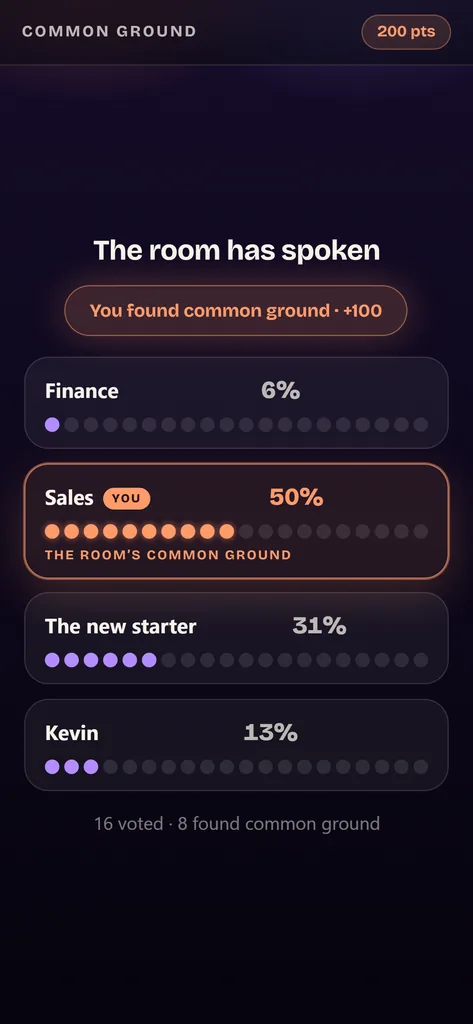
Common Ground is already this round scored the other way up: the room votes on its phones, the percentages fill the big screen, and the points go to whoever matched the majority. Turn that scoring upside down and you have the obscure-answer round, same screens, same reveal, opposite winner.
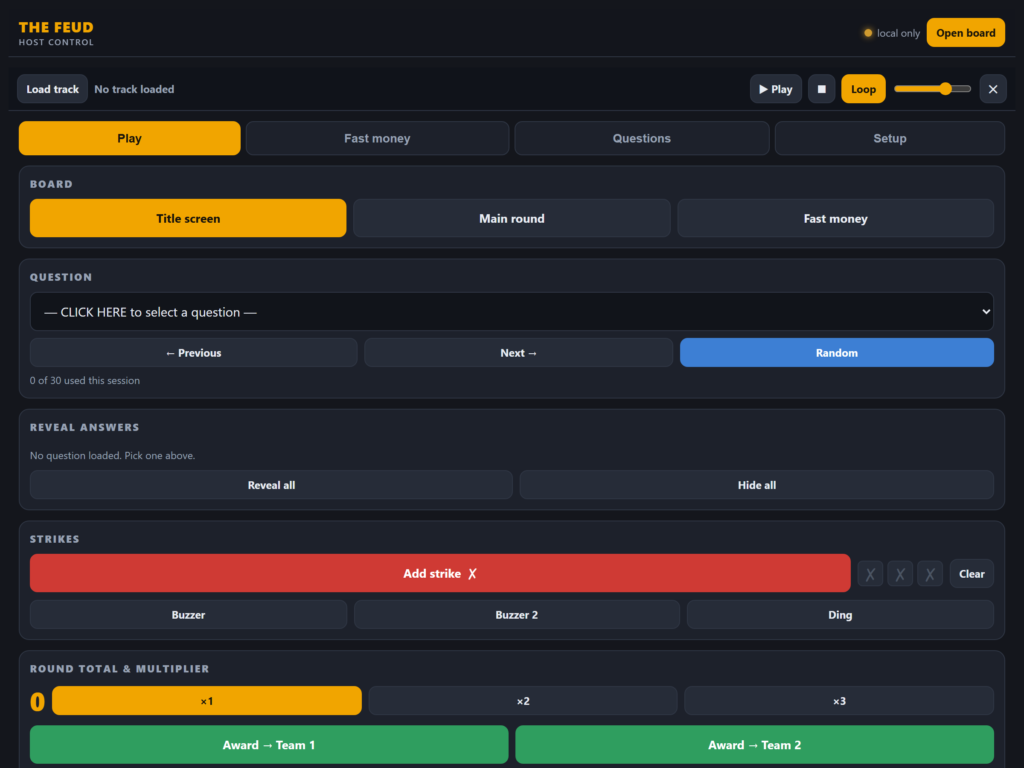
Everything runs from one control screen at the front, on my own quiz software rather than a slide deck. Questions and answers are written for the people in the room, so a graduate intake and a board of directors get different categories and a different show.
Where does the round belong in the running order?
Put it second or third, after a warm-up round and before the room has settled into a leaderboard.
It is a slow round by design. Teams confer for longer because the risk is asymmetric, and the reveal takes time because the percentages are worth reading out. Six questions is plenty. One inverted round will reorder a leaderboard built over four conventional ones, which is the jolt a flat middle section needs, and nobody remembers a normal night. More ways to break one up in my quiz round ideas.
If you want this run for you, with the survey done on your own people and the board built from their answers, that is what I do as a quiz master. Call 07596 851647 and tell me about the room.