
- Home
- Blog
- Event Host Blog
- Staff party ideas: how to choose the format and build the night
Staff party ideas: how to choose the format and build the night
 By Kevin Durham, event host and MC
30 October 2026 · updated 24 October 2026
8 min read

TL;DR
- Most lists of staff party ideas start with the idea. Start instead with two numbers: how many people are coming, and what you can spend per head.
- HMRC’s annual function exemption is worth £150 per head, including VAT and any transport you lay on. Go a pound over and the whole cost becomes taxable, not just the excess.
- A room of twenty needs a completely different shape from a room of two hundred. The format that breaks most often is the one borrowed from a much bigger or much smaller party.
- The running order matters more than the theme. Food, the moment of focus, the entertainment and the exit all want to land in a particular order.
- The things that sink a staff party are rarely the big decisions. They are the dietary note nobody passed on, the person who does not drink, the colleague who dreads being pulled on stage, and the last train home.
If you have been handed this year’s staff party, you do not need another list of twenty activities. You need the format that fits your team, then an evening built around it that does not sag in the middle. For the games themselves, I have written separately about office party games and the smaller internal staff Christmas party.

How do you choose between staff party ideas?
Choose the format from your headcount and your budget per head, then pick the theme. Doing it the other way round is how companies end up with an ambitious venue and nothing happening in it.
Three questions settle it faster than a brainstorm:
- How many people will realistically walk through the door? Not the invite list.
- What is the spend per head once VAT, drinks and getting people home are in the total?
- Is this a thank you, a celebration of something specific, or a chance for people who never meet to meet?
The third question is the one people skip, and it changes everything. A thank you can be short and generous. A celebration needs a moment where everyone looks the same way. A mixing exercise needs a reason for strangers to talk, which is where structured entertainment earns its place.
Which staff party ideas suit your team size?
Team size decides whether your party needs a stage at all. Roughly how it falls:
Up to about 20 people. No staging, no compering, nothing that smells of a show. A long table, a private room, one organised thing in the middle of the evening. At this size everyone can genuinely talk to each other, so your job is to protect that.
20 to 60. The awkward middle: too many for one conversation, too few to generate its own energy. This is the size where an unstructured evening most often dies at about 9pm. Something hosted works well, especially a format where everyone plays from their table rather than a few volunteers at the front.
60 to 150. A proper room. A seated dinner with a focal point, or a standing reception with a 45 minute centrepiece. You need someone on the microphone, because nobody self-appoints and the gaps between segments get long and loud.
150 and up. Treat it as a production. Clear running order, timed slots, a host who can cover a late start or a failed video without the room noticing. Energy management becomes the whole job: I plan conference days around deliberate peaks and recovery moments, and a large staff party is no different.
What should the budget per head actually cover?
Your per-head figure must cover the invisible costs, not just food and drink. HMRC divides the total cost by everyone who attends, and that total includes VAT plus any transport or accommodation you provide so people can get there.
Worth knowing: the £150 is not an allowance, it is a cliff edge. Exceed it and the full cost per head becomes taxable. The event also has to be annual and open to employees generally, so a one-off anniversary party does not qualify.
An OnePoll survey of 500 UK SME decision-makers, published in November 2024, found an average budget of £1,353, about £108 per employee, and that 53% of owners did not know the exemption existed. If your budget is nearer £108, spend it on the thing people will remember rather than an extra course.
How should the evening be structured?
The best running orders share a shape, whatever the budget. Arrival and a drink in hand. Food. A short moment of focus where someone says thank you properly, kept to five minutes. Then the entertainment, while people are still at their tables and before anyone has drifted. Then free time, music and the room’s own momentum. Then a clear, announced end.
Two notes from doing this a lot. Never put the speech after the entertainment: you will be asking a warm, loud room to go quiet, and it will not. And announce the finish time at the start. People relax when they know the shape of the night, and the organiser stops being asked.
The night is won in the briefing, not on the stage. Whoever is running your evening should know the names, the in-jokes that are safe, the restructure nobody mentions, and the two people who would rather be anywhere else.
Where does the entertainment belong?
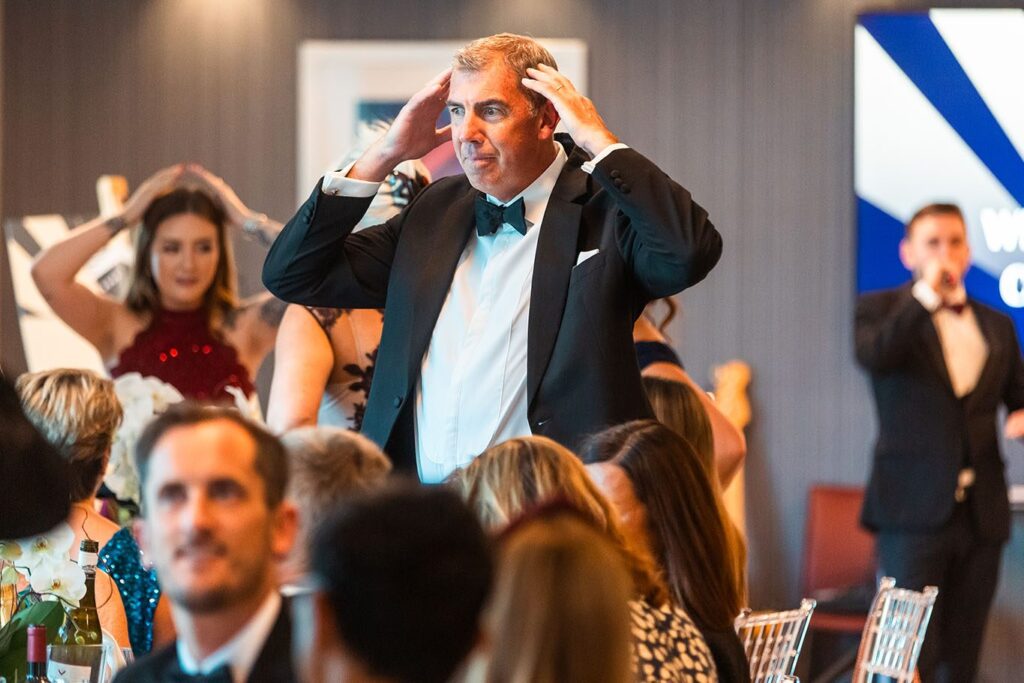
Put the entertainment where the room has eaten and is most willing, usually straight after the main course. That is also when a passive act struggles most, because people would rather be involved than talked at.
The data agrees. In an October 2025 survey of 250 professionals, 58% said they prefer sessions with some interactivity. Acas comes at it from the other side. In a January 2025 poll of 1,052 employees in Great Britain, 31% named team-building activities as the workplace social they liked least, while only 12% disliked one-off celebrations such as parties and leaving dos. People are not anti-social. They are anti forced fun.
Staff party ideas built on games I run myself
What I bring to a staff party is game-show entertainment written for the room. Thirteen games, all my own software, run from one screen as a hosted game show. Five are play-along rounds on every guest’s phone, eight are big-screen games with teams at the board. One host, the whole evening.
Every game runs three ways, which is what fits it to any team size: as a show with teams at the front, at the tables so every table is a team, or on the app so every guest plays from their seat. For Family Fortunes I write the survey questions for that specific audience and split the whole room into two teams, rotating each round so as many people as possible get to play. The questions, the answers and the presenting style all change: a graduate intake gets a different show from a board of directors, and that customisation runs on my own software rather than an off-the-shelf quiz pack.
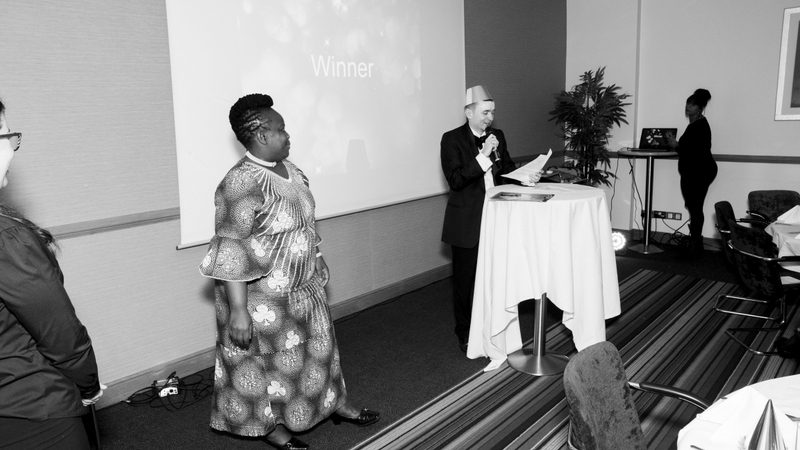
One format worth stealing if your party includes awards. Late in 2025 a client asked for an awards night that was not a standard awards night, so I interleaved the presentations with game-show rounds. Standard ceremonies drag for everyone who is not winning. Everyone stayed to the end, and the client said so afterwards.
The practical points organisers forget
The format rarely sinks a staff party. These do.
Food, and the people it excludes
Caterers serving food that is not prepacked must supply allergen information for every item containing any of the 14 allergens. Ask for it in writing and pass it on, rather than leaving it in your inbox. Roughly 14% of the UK population were meat-free at the end of 2025, so one token vegetarian option is no longer a safe plan.
People who do not drink
In the 2024 Health Survey for England, 24% of adults said they had not drunk alcohol. A quarter of your room. Decent alcohol-free options at the bar, not an afterthought jug of orange juice, and nothing in the running order that makes a toast awkward for someone on a soft drink.
People who do not want to perform
Every room has them, and they are often the people who would most like to enjoy the evening. Any hosted format should let someone play from their seat, or just watch. Nobody gets dragged to a microphone. I agree it with organisers up front: nobody gets singled out for anything that could embarrass them in front of colleagues. That matters, given how directly relationships with colleagues feed into how people feel about work.
Access, behaviour and getting home
Check the venue access information early and share it with the team. In the 2025 Euan’s Guide Access Survey of more than 4,000 people, 42% said they would avoid a venue altogether if they could not find its access details. Employers also have a duty to make reasonable adjustments so disabled workers are not substantially disadvantaged, and that covers recreation and refreshment facilities.
Acas lists work social events as a higher-risk setting for harassment and recommends setting standards of behaviour for them. A line in the invitation does that without souring the tone.
Plan the journey home before the playlist. Book taxis, publish the last train time, and remember the drink-drive limit is 80 milligrammes per 100 millilitres of blood in England, Wales and Northern Ireland, 50 in Scotland.
Quick answers: staff party ideas
What are the best staff party ideas for a small team? A private room, a proper meal and one organised activity in the middle. Under about twenty people, anything resembling a stage show feels forced.
When should the entertainment happen? After the main course, before the room drifts. Speeches go before it, never after.
Do staff parties have to involve alcohol? No. With a quarter of adults in England not drinking, the better plan is a bar and a running order that work either way.
If you want the evening built rather than hoped for, talk it through with me as your corporate event host. Call 07596 851647 and tell me about the room.