In short
- Learning how to be an MC is less about jokes and more about reading a room, keeping time, and linking segments so the night feels held together.
- The night is won in the briefing, not on the stage: preparation is where competent hosts separate from nervous ones.
- The common beginner mistakes are over-scripting, trying to be the star, hosting with no briefing, and filling every silence with waffle.
- A memorable MC serves the room and the client’s message first, which is exactly how I run corporate and awards work.
- You can teach yourself most of this. The rest is reps, and being honest about what went flat last time.
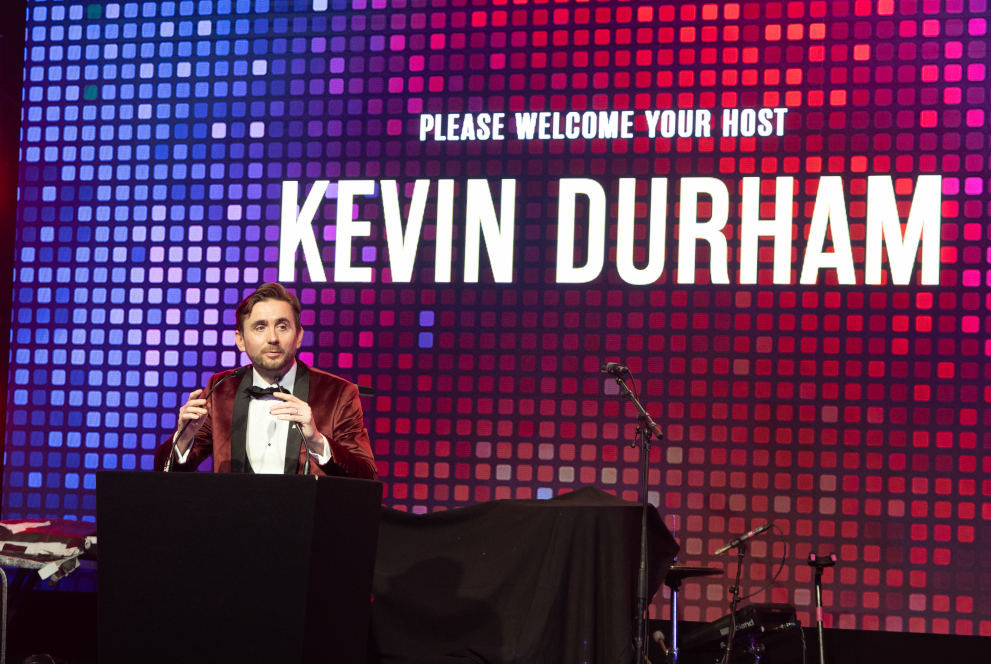
I have been hosting events for around 20 years, and the question I get asked most by people stepping up to their first gig is some version of “how to be an MC without dying up there”. The honest answer is that it is a craft, not a personality trait, and most of it is learnable. Below is how I actually think about the job, the skills that matter, the preparation nobody sees, and the mistakes I watch new hosts make in rooms every month.
What does an MC actually do?
An MC runs the room so nobody in the audience has to think about it. You are the connective tissue between segments: introducing speakers, moving from one award to the next, covering the gap when the sponsor video refuses to play, and keeping the energy at the level the moment needs.
That is the part people underestimate. A good master of ceremonies is not the loudest person in the building. They are the calmest, because everyone else in the room is quietly relying on them to know what happens next. If you want the plain-English version of the role before you go further, that link lays it out.
What are the core skills you actually need?
The core skills are reading a room, controlling time, projecting calm under pressure, and linking segments cleanly. Everything else sits on top of those four.
Reading a room means noticing when the energy dips after lunch and doing something about it before the audience drifts. Controlling time means you can lose four minutes on an over-running speaker and quietly claw it back before the finale, without anyone feeling rushed. Projecting calm is the one that surprises people: the room takes its emotional temperature from you, so if you look unbothered when the microphone cuts out, they stay relaxed too.
Linking segments is the invisible skill. A weak host announces the next item. A strong host carries a thread through the night so the evening feels like one show rather than a list of things that happened in order.
How do you prepare properly before the day?
Preparation is where the job is genuinely won. I say this often because it is the single biggest gap between hosts who look effortless and hosts who look like they are surviving: the night is decided in the briefing, not on the stage.
Get the running order early and read it like a script, not a timetable. Check the pronunciation of every name, every company, every award. Ask the organiser the questions that save you live: who is presenting what, what has changed, what is the one thing that must not go wrong. The UNC Writing Center’s guidance on speeches makes the same point from the academic side, that knowing your audience shapes everything you say. For an event, that audience knowledge comes from the client, so ask.
Here is the preparation checklist I work from:
| Before the event | Why it matters |
|---|---|
| Full running order and timings | You cannot manage time you have not mapped |
| Pronunciation check on every name | The fastest way to lose a room is the wrong name |
| A proper briefing call | Surprises on the night are almost always briefing gaps |
| Two or three lines to open | A clean start settles you and the room |
| A plan for the gap | Something always slips; know what you will do |
If you want the client side of that conversation, I wrote up how to brief a host, which doubles as a checklist for what a good MC should be asking you.
How to be an MC when you are nervous
Start by accepting that nerves are normal and mostly invisible to the audience. In my experience the fear is always louder in your head than it is in the room, and the people watching cannot see your heart rate.
The practical fix is your breathing. Slow, low breaths before you walk on genuinely settle the nervous system, and the NHS publishes a simple breathing exercise for exactly this. I still use a version of it in the wings before a big awards room.
The other fix is preparation, which is why I keep returning to it. Confidence on stage is mostly just knowing you have done the work. When you know the running order cold and you have your first two lines ready, the nerves have far less to grab onto. You are not hoping it goes well; you are executing something you already understand.
How to be an MC at a corporate event
At a corporate event, your first job is to carry the client’s message without ever sounding like a corporate script. The room can smell read-aloud copy instantly, so learn the point of the evening and deliver it in your own words.
Corporate audiences also test your energy management more than any other. A full-day conference lives or dies on whether the room is still alert after lunch, whether you can move a speaker along gently when they run over, and whether Q&A feels like a conversation instead of an awkward silence with a microphone. I build deliberate energy peaks and recovery moments into a day rather than running flat and hoping.
I have spent years working to a live camera and a timed rundown from my television days, and that is the background that helps most here: holding performance under pressure and hitting a mark on time is exactly what a streamed or hybrid corporate event asks of you. If corporate hosting is where you are headed, my conference host page shows how I structure a full day.

What are the mistakes that mark out a beginner?
The beginner mistakes are consistent, and every one of them is fixable. If you avoid these four, you are already ahead of most first-time hosts.
- Over-scripting. A word-perfect script sounds like a word-perfect script. Learn your structure and your key lines, then talk to the room. Notes are a safety net, not a teleprompter.
- Trying to be the star. The winner remembers getting on stage; the star is the client and the room, not you. A host who competes with the moment kills it.
- No briefing. Turning up cold is the single biggest cause of live mistakes. The wrong name, the wrong order, the missed cue: all briefing gaps.
- Filling silence with waffle. New hosts panic in a gap and talk. A held pause reads as confidence. Say less, and mean it.
Toastmasters International, the global body for public speaking, offers a large set of free speaking tips that reinforce the same fundamentals if you want to keep practising between events.
What separates a competent MC from a memorable one?
A competent MC gets through the running order cleanly; a memorable one makes the room feel like it was built for them. The gap is not talent, it is attention to the specific people in front of you.
The clearest example from my own work is an awards night I built in late 2025 as a hybrid, interleaving the award presentations with game-show rounds, because a standard ceremony drags for everyone who is not winning. Splitting the room into teams and rotating each round meant nearly everyone got to play, and everyone stayed to the end. That is the difference: a competent host would have announced the winners in order, and a memorable one asks what the other 90 percent of the room is doing while the winners collect their trophies.
You do not need a game show to apply the principle. Customisation is the heart of it: something written for that specific crowd, whether that is a running joke that belongs to the company or a callback to something that happened earlier in the night. If that interactive angle interests you, my game show formats show how far it can go.
Quick answers: how to be an MC
Do I need to be funny to be an MC? No. You need to be clear, warm, and in control. Humour helps, but a calm host who keeps the night on time beats a comedian who loses the room.
How much should I script? Script your open, your key transitions, and your close. Leave the middle as bullet points so you can respond to the room rather than read at it.
How do I handle something going wrong live? Stay visibly calm, name it lightly if it helps, and fill the gap with something you prepared for exactly this. The audience follows your reaction, not the fault.
Can I teach myself to be an MC? Mostly, yes. The skills are learnable and the fundamentals are well documented. The rest is reps and an honest review of what went flat last time.
If you are planning an event and would rather hand the room to someone who has done this a few thousand times, that is what I do for a living. Have a look at how I approach MC work, or call 07596 851647 and tell me what went wrong at the last one.