
In short
- When you hire a master of ceremonies you are buying continuity: one person who runs the whole evening and holds it together between segments.
- The best MC is chosen on preparation, not on a showreel. A polished edit tells you the editor is good, not who turns up to your room.
- Ask four questions before you sign: who is on the night, what prep is included, how they handle things going wrong, and whether they will listen to your brief.
- A name with no preparation is the most common flat night I hear about. The night is won in the briefing, not on the stage.
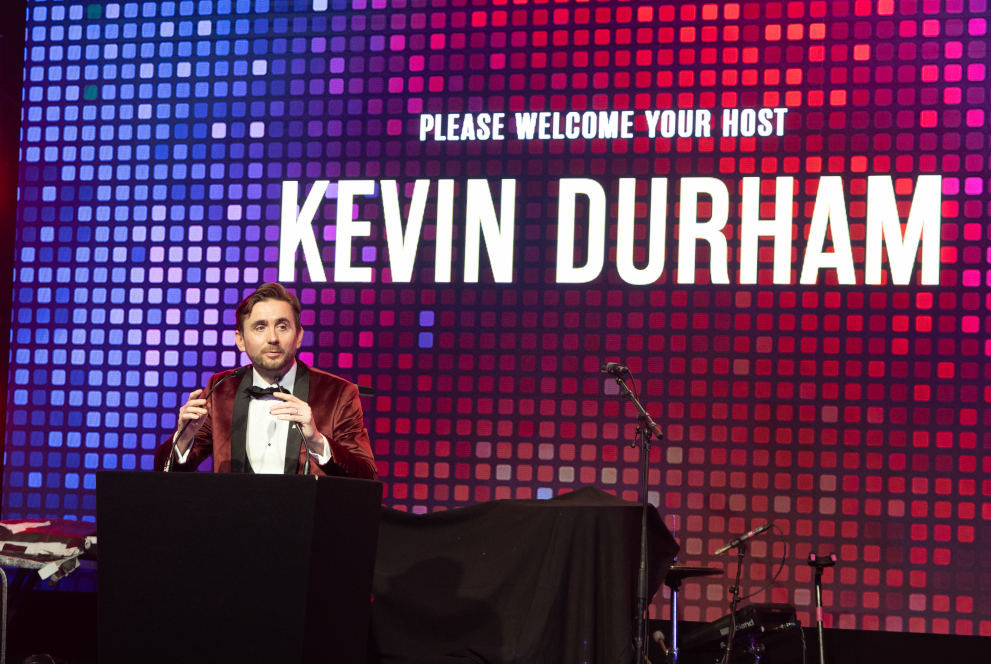
- I run the whole evening myself, with prep built in as standard.
If you have been asked to hire a master of ceremonies and you have never done it before, the job feels deceptively simple: find someone confident, book them, done. Then the evening arrives and you learn what the role actually is. A good MC is the difference between a night that flows and a night the room politely endures. Here is how to choose one, from the supplier side, written to help you book well rather than to sell you the wrong thing.
What does a master of ceremonies actually do?
A master of ceremonies runs the room so nobody in the audience has to. They open the evening, introduce speakers and award winners, manage the timing, keep the energy up between the scheduled bits, and handle the moment something slips. The visible part is the microphone work. The real product is control: the calm sense that someone experienced is holding the whole thing together.
That is why the role is easy to underestimate. Announcing the next item is not hosting. Hosting is reading the room after dinner, covering the gap when a video fails, and pulling a night that has run over back on track without the audience feeling the strain.
It also decides what people carry home. We remember an experience largely by its most intense moment and its ending, a pattern researchers call the peak-end rule, so the person managing the peaks and landing the finish is shaping the memory of the whole event, not just filling the gaps in it.
When should you hire a master of ceremonies?
You should hire a master of ceremonies whenever the evening has a running order that matters and an audience you cannot afford to lose. Award ceremonies, conferences, gala dinners, staff celebrations and product launches all live or die on pace and continuity. If the night is more than a meal and a speech, a professional host earns their place.
The clearest signal is a past event that fell flat. When event managers come to me, it is usually because the last one felt disjointed: a senior colleague pushed into hosting, a booked name who did no preparation, or a generic agency MC who announced items and little else. If that sounds familiar, the room noticed too.
It matters more because your audience arrives braced for another dull session. Executives already spend nearly 23 hours a week in meetings, so the bar for “another corporate evening” is low. A host who resets that expectation in the first few minutes changes the tone of everything that follows.
Wedding MC or corporate MC: the difference
Hiring a wedding MC and hiring a corporate MC are genuinely different jobs, even though the title is the same. A wedding MC, often called a toastmaster, coordinates a family day, coaches nervous speakers and manages a timeline where the emotion matters as much as the schedule. A corporate MC runs a business event where the brand, the message and the running order are the priority.
The overlap is the core craft: reading a room, managing time and holding the evening together. The difference is tone and preparation. If your event is a wedding, my wedding toastmaster page covers that side; the rest of this guide is written mainly for corporate and awards events.
Why is preparation the thing that separates a good MC from a risky one?
Preparation is the single biggest predictor of how the night goes, because the quality of an event is decided in the briefing, not on the stage. A pre-event consultation lets the host learn your priorities, check every name for pronunciation, understand the running order, and plan for the parts most likely to go wrong.
Award ceremonies are where the lack of it shows fastest. The mistakes are brutally visible: a name called wrong, a winner left standing at the wrong moment, a joke that lands badly in a room full of people who all know each other. My prep for an awards evening includes a full nominee briefing, pronunciation checks on every name, and a run-through with the organising team. I have covered a sponsor video that failed on cue and handled a finalist list that changed at the last minute, and both were survivable only because of what happened before the doors opened.

What questions should you ask before you hire a master of ceremonies?
Ask these four before you sign, and the right choice usually reveals itself:
- Will I get the exact person I am speaking to, on the night, in the room?
- What preparation is included: a briefing call, a nominee run-through, pronunciation checks?
- How do you handle the moment something goes wrong: a failed video, an overrunning speaker, a schedule that slips?
- Will you work to my brief rather than improvise in ways that surprise me?
A confident answer to all four is worth more than any highlight reel. If a supplier is vague about preparation, that is your answer. There is a fuller list on my guide to questions to ask before you book an MC.
Here is a short introduction so you can see the tone I bring to a room.
Does experience on camera make a difference?
Working to camera makes a real difference at any event with a broadcast, streamed or hybrid element, where the timing has to be exact and there is no second take. I came up through television, hosting for Fox, Warner and Universal, so a live rundown and a lens are second nature.
That background earns its place on a hybrid conference or a streamed awards night. It does not need waving around at a straightforward dinner, but when the format is unforgiving, a host who has performed under a countdown is a safer pair of hands.
How to hire a master of ceremonies who preps properly
Choose on substance and continuity, not on the shortlist that looks flashiest. The Meetings Industry Association, the UK’s principal body for business events, exists partly because getting these details right is a genuine discipline. Once you have your questions answered, the practical steps are simple: confirm the named person in writing, agree a briefing call, share your running order early, and give the host the nominee or speaker details in good time.
When I take a booking there is no roster and no substitute. You get me, a proper briefing conversation, and a night shaped around your people rather than a script read aloud. If you want the wider view, I have written a plain walkthrough of how to hire an event host, and you can read what clients say on my event host reviews page. For the role itself, my master of ceremonies page lays out what is included.

Quick answers: hire a master of ceremonies
What does it cost to hire a master of ceremonies? Fees are bespoke and depend on the event, the audience size and the preparation involved, so the honest answer is that you should have a conversation rather than expect a fixed price list. Be wary of a quote that looks cheap because it covers only the hours on stage: the preparation is where the night is actually won, and a fee that excludes it is a smaller job in disguise.
How far in advance should I book? As early as you can. Good dates go first, and the earlier you book, the more preparation time the host has, which is the part that actually decides the night.
What is the difference between an MC and a host? In practice, very little for most events. Master of ceremonies is the traditional term; host is the modern one. Both mean the person running your evening from start to finish.
What is the most common mistake? Booking a name and assuming preparation is included. It often is not. Confirm the briefing, the run-through and the pronunciation checks in writing before you commit.
If you are shaping an awards night, conference or gala and want one person to run the whole evening rather than coordinate several, call 07596 851647 and tell me what went flat at the last one.