
In short
- If you want to hire an event host, you are really buying one professional to run the whole evening, not just someone to read out a running order.
- A freelance host, an agency booking and a celebrity name are three different products, and the difference shows up on the night, not in the brochure.
- The best filter is the briefing: a host who wants a proper conversation before the event is usually the host who will hold the room on the day.
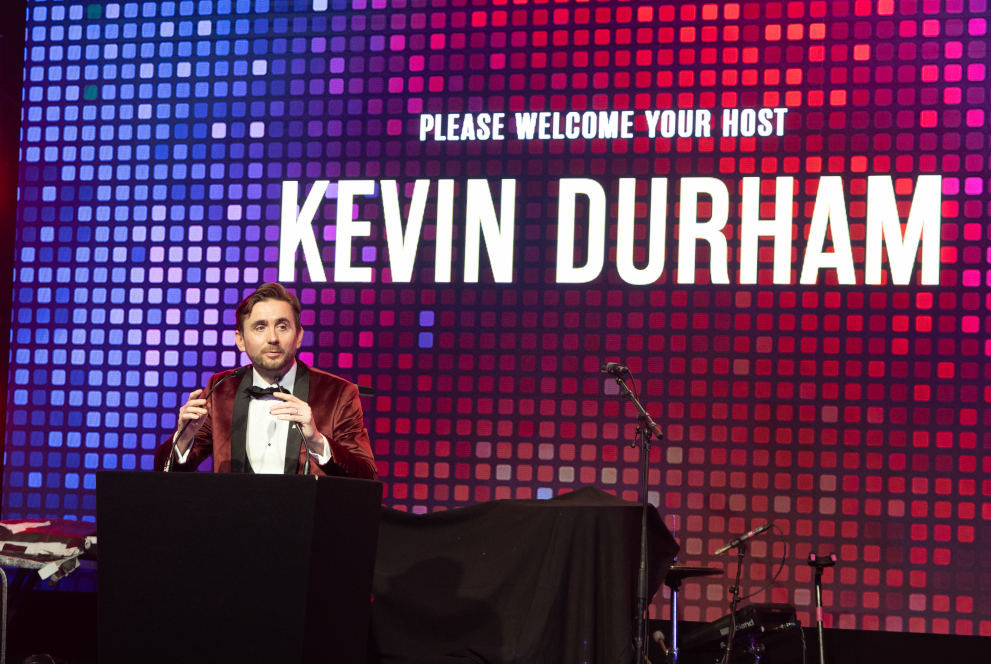
- I have spent 20 years running awards evenings, conferences, launches and festival crowds past 10,000, so this guide is written from the front of the room, not the sales page.
- The biggest red flags are a host who never asks about your audience, a senior colleague pushed into the job, and an MC and a separate act who never join up.
I find most people only decide to hire an event host after they have sat through a flat one. A generic MC announcing the next item, a room drifting between courses, nobody visibly holding the evening together. This is a buyer’s guide to getting the next one right, whether you book me or not, because a good host is easy to appreciate and surprisingly hard to specify.
What does a good event host actually do?
A good event host runs the whole evening so nobody in the audience has to wonder what happens next. That sounds simple until you watch someone do it badly. The visible part is the introductions, the links between segments and the announcements. The invisible part is timing, energy and recovery: keeping a room alert after lunch, moving a running order along without it feeling rushed, and covering the moment a sponsor video fails to play without the audience ever knowing there was a gap.
In my experience the job is closer to producing than presenting. You are reading the room second by second and deciding when to lift the energy, when to let a moment breathe and when to get out of the way. If you want the full breakdown, I have written a longer piece on what hosts do, but the short version is this: the host is the one person accountable for how the evening feels.
Why hire an event host instead of a colleague?
You hire an event host so your own people can enjoy the event as guests instead of working it. The most common regret I hear from event managers is that they asked a confident senior colleague to compere, and it went awkward. Not because that person lacked charisma, but because they ended up trying to perform rather than participate, and everyone in the room could feel the effort.
There is also the matter of the unexpected. A finalist list that changes at the last minute, a speaker who over-runs by ten minutes, a Q&A that goes quiet. An experienced host has handled all of these before and treats them as routine. A colleague hosting for the first time is improvising under pressure, in front of people they work with on Monday.
Freelance host, event host agency or a celebrity name?
These are three different purchases, and it helps to be honest about what each one gives you. A freelance host is the person who turns up: you book the individual, you brief the individual, and the individual is on the mic. An event host agency is a booking layer that supplies a host from a roster, which can be convenient but often means less direct contact with the person actually running your night. A celebrity name sells recognition and a photo opportunity, and can be exactly right for a headline moment.
The trade-off worth naming: recognition is not the same as room craft. I have heard from clients who booked a famous face and got very little preparation in return, because the appearance was the product and the hosting was an afterthought. If your priority is a name on the invitation, that can work. If your priority is an evening that runs well from the first link to the last award, you want the person who will read your audience, not just be recognised by it.
What questions should you ask before you hire an event host?
Ask the questions that reveal how they prepare, because preparation is where a good night is won. The quality of an event is decided in the briefing, not on the stage, so the answers tell you more than any showreel. Here are the ones I would ask:
- How will you brief with us before the event, and how far in advance?
- How do you handle a running order that changes on the day?
- What do you do when a video fails or a speaker over-runs?
- How do you keep the energy up in the graveyard slot after lunch?
- Can you check pronunciations for every name in advance?
- Are you hosting the whole evening, or just the opening?
A host who lights up at these questions is one who thinks about your event as a whole. If you want a structure for that conversation, my guide to briefing a host covers what to send and when.
The red flags to watch for
Some warning signs are reliable, and I would treat any of these as a reason to keep looking.
- No briefing conversation. If a host is happy to take the booking without asking about your audience, your objectives or your running order, expect a generic performance. The ones who ask the most before the event are usually the ones who need the least hand-holding on the day.
- A senior colleague pushed into hosting. This is an internal red flag rather than a supplier one, but it is the most common cause of a flat evening I see. Let your leadership enjoy the night.
- An MC and a separate act who never join up. When you book a compere for the links and a separate entertainer for the middle, the handover is where the evening sags. Two people protecting their own slots rarely produces one coherent night.
- A quote with no questions attached. A price that arrives before any curiosity about your event is a price for a template, not for your evening.

Why one host beats a patchwork
One host running the whole evening beats a patchwork of separate suppliers because there is never a seam for the night to fall through. When the same person handles the welcome, the links, the entertainment and the close, the energy carries across the whole event instead of resetting every time a new face takes the mic. Nothing gets dropped in the handover, because there is no handover.
My clearest example is an awards evening in late 2025. Standard ceremonies drag for everyone who is not winning, so instead of a run of announcements I interleaved the award presentations with game-show rounds written for that specific room. One person held both jobs, the presentations and the entertainment, so they reinforced each other rather than competing. Everyone stayed to the final award. If that idea is useful for your night, the full awards hybrid case study explains how it worked, and the same single-host logic applies whether or not you add corporate entertainment to the evening.
How much does a corporate event host really matter?
A corporate event host matters most on the evenings you have invested the most in, because the host is what turns a schedule into an experience. The economics back this up. UK business events, including conferences and meetings, are worth billions each year according to VisitBritain’s business events research, and organisations do not spend that to watch a room go flat.
The reason in-person events earn that spend is the human contact, and that is precisely what the host protects. Accor’s research on in-person meetings found professionals rated one face-to-face meeting as worth three virtual ones, while the Events Industry Council reports that building relationships through face-to-face contact is the single thing people find hardest to replace. A host who keeps the room engaged is defending the exact value you booked the venue for in the first place.
Quick answers: hiring an event host
What does it cost to hire an event host? Good hosts price bespoke, because a two-hour awards evening and a full conference day are different jobs. Expect a conversation about your event before any figure, not a fixed package off a menu.
How far in advance should you book? As early as you can, and certainly once your date and venue are confirmed. Popular dates go first, and an early booking gives the host time to brief properly rather than turning up cold.
Do you need an MC and an entertainer, or just one host? For most evenings, one host who can do both is the stronger choice, because it removes the seam where a patchwork night sags. Book two only when a specific act genuinely needs its own slot.
What is the single best way to judge a host? The briefing conversation. A host who asks sharp questions about your audience and your running order before the event is telling you exactly how the night will feel.
If you are weighing up who to book, the most useful next step is a short conversation about what your evening actually needs. Tell me what went wrong at the last one, and I will tell you honestly whether I am the right host for it. You can get in touch or call 07596 851647.
I host corporate events across the UK, including Manchester, London and Birmingham.