
- Home
- Blog
- Event Host Blog
- Pub quiz company or do it yourself: what you are actually buying
Pub quiz company or do it yourself: what you are actually buying
 By Kevin Durham, event host and MC
1 November 2026 · updated 26 October 2026
8 min read
In short
- A pub quiz company sells four separate things: the questions, the kit, the person on the microphone and the scoring. If a quote does not say which of the four you get, ask.
- Doing it yourself is free in cash and expensive in hours. Whoever hosts is working all night.
- For a small, informal room with a confident volunteer, running it yourself is the right answer. The commercial case starts when the room is big, the night matters, or the obvious host should be a guest.
- Before booking, ask who actually turns up, whose software it runs on, what happens if the venue Wi-Fi dies, and who is handling the music licence.
- Your venue may want paperwork from whoever you hire: public liability cover, a risk assessment, sometimes electrical test certificates.
A quiz looks like the cheapest entertainment in the world. Forty questions, a few sheets of paper, someone with a loud voice. That is why people try it in-house, and why it is also the format that most often ends up with half the room on their phones by round three.
Both routes work, just in different rooms. The useful question is which room you have.

What does a pub quiz company actually provide?
A pub quiz company provides some combination of four things: written questions, the equipment to run them, a host to present the night, and a scoring system. The gap between quotes almost always comes down to how many of those four are included.
The cheapest version is a question pack: rounds, answer sheets and an answer key, read out by your own volunteer. That is a content subscription, not an event.
Add a host who turns up and reads them, and the night has a person in charge. That alone fixes the two most common failures: dead air between rounds, and a quiz that overruns by forty minutes.
A hosted show is a different thing again. Questions written around your audience, a presenter who can read a room and change gear, screens and sound, live scoring, and someone who owns the running time.
So comparing two quotes on headline cost tells you almost nothing. Ask for the package in writing, line by line, including travel, set-up, and what happens if the food comes out late.
What does running the quiz yourself really cost in time?
The real cost of a DIY quiz is the question writing, and almost everyone underestimates it. A schools quiz publisher that writes for a living reckons on two hours to produce a single ten-question quiz with plausible wrong answers and a comment on each answer, and notes that it surprises people how long it takes.
Scale that honestly. Six rounds of ten, written so the answers are checkable and the difficulty actually rises, is most of a working day. A picture round means sourcing images. A music round means editing clips.
Then there is the night. Someone has to read, adjudicate, collect sheets, mark them, add up and announce. Marking forty questions across fifteen tables by hand is the moment most quizzes lose the room, because the room has nothing to do while it happens.
The part that never shows up on a budget line is who that someone is. The clearest pattern I hear from event managers is that the obvious in-house host turned out to be a senior figure who should have been a guest, and who spent the evening presenting instead of enjoying it with their team. They were not badly briefed or badly chosen. They were working.
When is a DIY quiz genuinely the right call?
Run it yourself when the room is small, the mood is informal, and somebody would genuinely enjoy standing up. Twenty people in a meeting room with pizza do not need a supplier, and hiring one would look like overkill.
The conditions are specific: under about forty people so marking by hand is quick, one room so nobody strains to hear, a volunteer who is confident rather than merely willing, and no stake beyond bragging rights.
The case for hiring starts where those stop. A room over about eighty. Clients or award winners in it. A mixed-age crowd where general knowledge leaves half the room out. A quiz that has to finish on time because something follows it. At that point you are not buying questions, you are buying someone to take the risk off your team. There is more on the mechanics in my guide to hosting a quiz, whichever way you go.
What should you ask a pub quiz company before booking?
Ask these before you commit. The answers separate suppliers far more reliably than a price list does.
- Who turns up on the night? Some agencies sell a brand and send whoever is free. Get the name in writing.
- Is it their own material or a licensed pack? If it is a pack, ask when it was last fact-checked, and whether another company in your town is reading the same questions this month.
- Can the questions be written around our audience? A round built on your industry and your year plays completely differently from a generic forty.
- Whose software does the scoring? Paper and a calculator is fine for small rooms and painful above about ten tables. If there is an app, ask whose it is and who fixes it at 8pm.
- What happens if the venue Wi-Fi dies? Ofcom’s coverage figures published in May 2026 report mobile coverage outside premises, not inside a basement function room, so a phone-based quiz needs a fallback.
- How long will it run? A quiz with a hard stop needs a host who can cut a round live without the room noticing.
- Who provides the sound? A host nobody can hear is not a host.
- What is the cancellation and substitution position? Ask once, in writing, then forget it.
The paperwork and licences nobody mentions
Venues ask suppliers for documents, and it is your problem if they arrive late. Bassetlaw District Council’s town hall terms are typical: hirers must declare outside providers including entertainers, and those providers must produce, on request, documentary evidence of public liability insurance of not less than £5,000,000.
Electrical test certificates come up too. Testing portable equipment is not legally required, as the Health and Safety Executive makes clear, but the Electricity at Work Regulations 1989 require equipment to be maintained in a safe condition, and a certificate is the easy evidence of that. HSE event guidance also tells organisers to consider their suitability and competence for providing a safe and reliable service, which is a fair standard to hold a supplier to.
Licensing is the other blind spot. You need a licence to play live or recorded music in public, now one licence from PPL PRS called TheMusicLicence. Most licensed venues hold one, a village hall or an office may not. A quiz itself is not regulated entertainment under the Licensing Act 2003, while music is, exempt between 8am and 11pm for audiences of 500 or fewer at qualifying premises. And a picture round built from search results is a copyright question nobody raises until it is on a screen: government guidance on copyright exceptions describes no general exception for showing a work to an audience.
Two more. A prize draw alongside the quiz is probably an incidental lottery, needing no licence from the Gambling Commission if it raises money for charity rather than private gain, within limits: £100 of proceeds on expenses, £500 on prizes, tickets sold only at the event. And if guests type names or email addresses into a supplier’s app, that is personal data processed on your behalf, so the Information Commissioner’s Office says a written contract needs to be in place.
How I run a quiz night, and what changes in the room
I host quiz nights as a show, on software I wrote myself, and the difference it makes is in the room rather than on the table. Nobody sits in silence while scores are added up. Questions go up on the big screen, every guest answers on their own phone from a code on the table, and the leaderboard moves after every question.
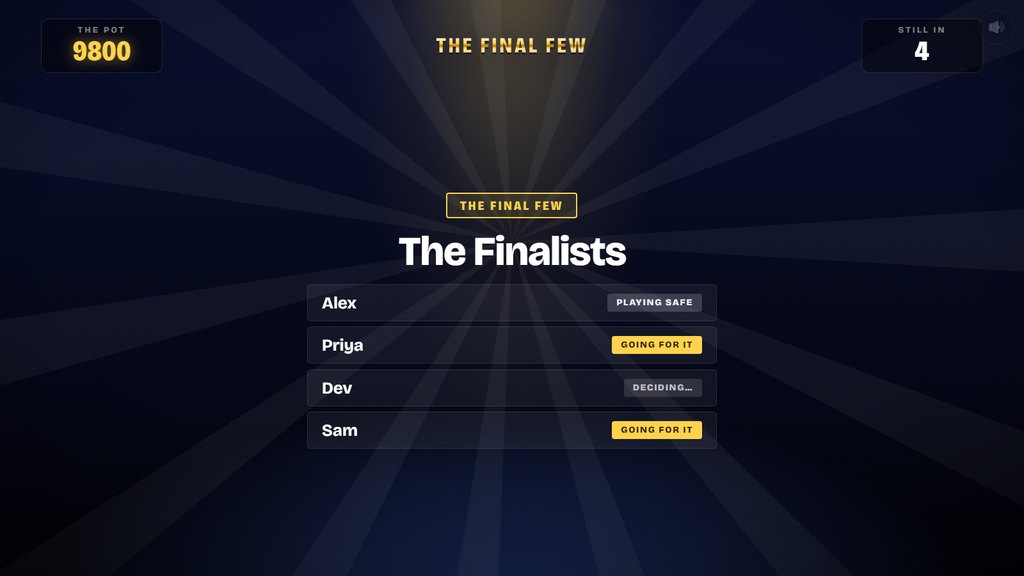
I write the content for the audience in front of me. A graduate intake and a board of chief executives get different questions and a different style, because the same forty would land in very different places.
The night is won in the briefing, not on the stage, which is why a pre-event consultation is standard for me. There is more on the quiz software itself, on quiz master bookings, and on the big-screen live quiz show format.
Pub quiz company or in-house: how do you decide?
It comes down to three things: room size, what the night is for, and who would otherwise hold the microphone.
| Signal | Run it yourself | Hire a pub quiz company |
|---|---|---|
| Room size | Up to about 40, one space | 80 plus, or several tables deep |
| What is at stake | Internal, informal | Clients, winners, a message to land |
| Who hosts | A confident volunteer who wants to | Someone who should be a guest |
| Running time | Flexible, nobody minds | Fixed, something follows it |
| Scoring | Paper between rounds is fine | Live, visible, no waiting |
| Questions | General knowledge is enough | Written around this audience |
If most of your answers land in the left column, write the quiz and enjoy it. If they land in the right, those question-writing hours are better spent on everything else the night needs.
The same thinking carries over to a bigger format, set out in my guide to a corporate quiz night. If you would like a quote, tell me the room, the date and the occasion, and I will come back with what I would do with it.