
- Home
- Blog
- Event Host Blog
- Film and television quiz questions, graded easy to hard
Film and television quiz questions, graded easy to hard
 By Kevin Durham, event host and MC
1 November 2026 · updated 26 October 2026
7 min read
In short
- Thirty-nine film and television quiz questions, graded easy, medium and hard, with the answers checked against a source I opened.
- The easy round takes one question per decade from the 1960s to the 2020s, so no age group is locked out.
- Four sub-formats that lift a film round off the page: taglines, theme tunes, stills described in words, and television catchphrases.
- Describing a frame out loud costs nothing. Showing the clip means the venue needs a screening licence.
- Finish on a tie-breaker with a number for an answer so nobody shares first place.
Film and television quiz questions are the round nobody opts out of. Someone at every table has seen the film, and the one who hasn’t has at least heard the line. The trouble is that most question lists are flat: forty questions at roughly the same level, which either humiliates half the room or bores the other half.
What makes film and television quiz questions work in a live room?
Film and television quiz questions work when the answer is a fact rather than an opinion, and when the question tells the room which era it is in. Give the year or the channel and the arguments about remakes stop before they start.
Three more rules I stick to:
- Ask about the thing people watched, not the trivia behind it. The casting that nearly happened is a story, not a question.
- Leave out anything still argued over. A question two sources disagree on is a fight waiting to happen.
- Say every title out loud before the night. If you stumble on it, so will the room.
How do you grade film and television quiz questions easy to hard?
You grade film and television quiz questions by how many people in the room could plausibly know the answer, not by how obscure the title is. An easy question is one most of the room will get. A hard one is for the two tables who take this seriously.
Run the three rounds in order and the room warms up instead of switching off. I also spread the easy round across seven decades, because a question set that lives entirely in the last ten years quietly tells half your guests the quiz is not for them.
Round one: easy film and television quiz questions
One per decade, from the 1960s to the 2020s.
- Which BBC science-fiction series began in November 1963 with a serial called An Unearthly Child? Answer: Doctor Who.
- Who played Danny Zuko in Grease (1978)? Answer: John Travolta.
- Which American sitcom, set in a Boston bar, ran on NBC from 1982 to 1993? Answer: Cheers.
- In Toy Story (1995), what does Buzz Lightyear believe he is? Answer: a real space ranger, not a toy.
- Which ITV talent show was first broadcast on 9 June 2007? Answer: Britain’s Got Talent.
- Which HBO series, first shown in April 2011, is based on George R. R. Martin’s A Song of Ice and Fire? Answer: Game of Thrones.
- Which Netflix drama about a chess prodigy arrived in October 2020? Answer: The Queen’s Gambit.
Round two: the medium questions
Harder, but still gettable by a table that watches a reasonable amount.
- In the British version of The Office, what is the name of the paper company? Answer: Wernham Hogg, with the branch in Slough.
- Which 1994 film is set almost entirely in Shawshank State Penitentiary in Maine? Answer: The Shawshank Redemption.
- In Breaking Bad, what is the name of Gus Fring’s fried chicken chain? Answer: Los Pollos Hermanos.
- Which film won the Palme d’Or at the 1994 Cannes Film Festival? Answer: Pulp Fiction.
- Which BBC comedy, filmed around Holmfirth in West Yorkshire, is the longest-running sitcom in the world? Answer: Last of the Summer Wine.
- Which English seaside town is Fawlty Towers set in? Answer: Torquay, in Devon.
Round three: the hard questions
I save these for late in the night, when the leaderboard needs separating.
- On what date did Coronation Street first air? Answer: 9 December 1960.
- Which programme was the first broadcast on Channel 4 when it launched on 2 November 1982? Answer: Countdown.
- Who created the original Twilight Zone, which began in 1959? Answer: Rod Serling.
- Which actor played the Eighth Doctor in the 1996 television film of Doctor Who? Answer: Paul McGann.
- In Dad’s Army, what is the name of the fictional town on the south coast? Answer: Walmington-on-Sea.
- Who directed the 1927 German silent film Metropolis? Answer: Fritz Lang.
What are good film tagline quiz questions?
Good film tagline quiz questions use lines that were genuinely printed on the poster, not lines of dialogue people half remember. Read the tagline out, then ask for the title. Every one below is documented as that production’s tagline.
- “Just when you thought it was safe to go back in the water…” Answer: Jaws 2 (1978).
- “Be afraid. Be very afraid.” Answer: The Fly (1986).
- “In space no one can hear you scream.” Answer: Alien (1979).
- “Earth. Take a good look. It could be your last.” Answer: Independence Day (1996).
- One for television: which series ended its opening titles with the words “The Truth Is Out There”? Answer: The X-Files.
How do you run a theme tune round without playing a note?
You run a theme tune round without playing a note by asking about the music instead of playing it. A UK venue showing films or television on its premises needs the right licence, and recorded music has its own licensing on top. Questions about the composer and the song sidestep all of it.
- Who wrote the Doctor Who theme in 1963, and who realised it at the Radiophonic Workshop? Answer: Ron Grainer wrote it, Delia Derbyshire realised it.
- “Thank You for Being a Friend”, written by Andrew Gold, became the theme to which American sitcom? Answer: The Golden Girls.
- “Woke Up This Morning” by Alabama 3 opens which HBO drama? Answer: The Sopranos.
- Lalo Schifrin’s Mission: Impossible theme is famously written in which unusual time signature? Answer: 5/4.
- Jan Hammer composed the theme to which 1980s series set in Florida? Answer: Miami Vice.
Can you run a picture round with no pictures?
Yes, and I think it plays better. Describe a single famous frame out loud, in plain words, and let the room build the image themselves. No projector, no licence, and the slow dawn of recognition around a table beats a slide.
- A coach teetering over a cliff edge, gold bars sliding towards the back, the crew bunched at the front as a counterweight. Answer: The Italian Job (1969).
- A woman’s white pleated dress blown upwards as she stands over a subway grate. Answer: The Seven Year Itch (1955).
- A man in round glasses hanging from the hands of a giant clock face high above the traffic. Answer: Safety Last! (1923).
- A giant ape at the top of the Empire State Building, swiping at circling biplanes. Answer: King Kong (1933).
- A column of mods on scooters riding down to Brighton. Answer: Quadrophenia (1979).
Which television catchphrases work as quiz questions?
Television catchphrases work as quiz questions because people remember the line perfectly and the programme vaguely. Say the words, ask for the show.
- “You are the weakest link, goodbye.” Answer: The Weakest Link.
- Finish it: “Nice to see you, to see you…” Answer: “nice”, from The Generation Game.
- Which animated sitcom gave the Oxford English Dictionary the word “d’oh”? Answer: The Simpsons.
- “I’m free.” Which sitcom, set in the Grace Brothers department store? Answer: Are You Being Served?
- “Lovely jubbly.” Which BBC sitcom? Answer: Only Fools and Horses.
What is a good tie-breaker for a film and television round?
A good tie-breaker has a number for an answer, so the nearest guess wins outright and nobody shares the trophy. Try this one: how many episodes of Game of Thrones were broadcast in total across its eight seasons? The answer is 73.
How I run a film and television round on my own software
A list read off a sheet works in a pub. At a work night it leaks people, because the moment one person per table picks up the pen, everyone else gets their phone out. I run quizzes as a show instead, on software I wrote, and every game plays three ways: at the front with teams on stage, at the tables, or on every guest’s phone.

- The graded rounds go on a Quiz Show board. Five categories, five values each, easy at the bottom and hard at the top, with teams buzzing in and stealing the misses.
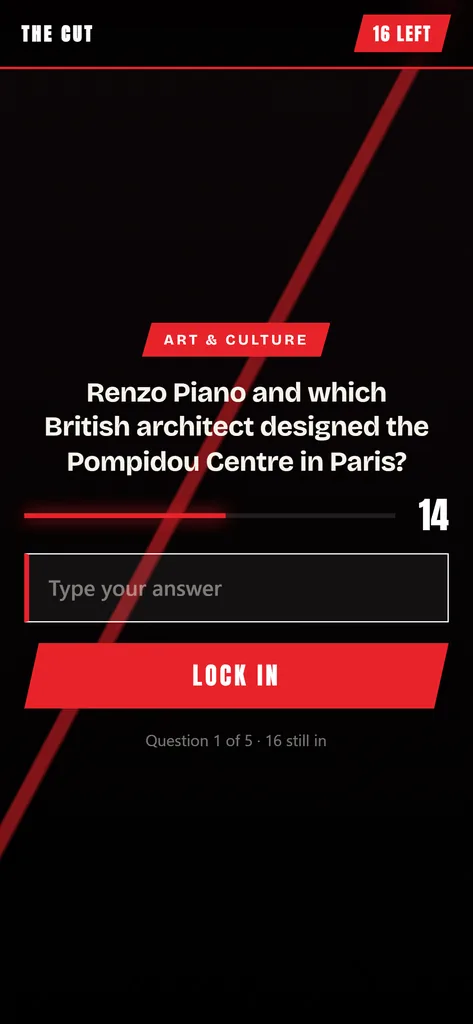
- The taglines and described stills are a knockout. The Cut takes typed answers, not multiple choice, so there is nothing to guess from and the lowest scores drop out until one person is left.
- The catchphrases play on every phone through Quiz Live. Four tiles, a countdown, points for being right and for being quick.
The part that matters is the writing. I build every round for the people in the room, which means a graduate intake and a board of directors get different questions under the same format. A company film round, with your own team’s favourite films in it, lands harder than any list I could publish.
Nobody remembers a normal night.
If you would rather hand the whole evening over, I will write the rounds, pick the games and host it as your quiz master. One host, the whole evening. Call me on 07596 851647 and tell me about the room.