
- Home
- Blog
- Event Host Blog
- Christmas party awards: how to run the segment without losing the room
Christmas party awards: how to run the segment without losing the room
 By Kevin Durham, event host and MC
2 November 2026 · updated 27 October 2026
7 min read
In short
- Christmas party awards are a segment, not a ceremony. Six awards, fifteen minutes, then the room is theirs again.
- The joke has to be about something the winner chose to do. Appearance, drinking, relationships, competence and lateness are the five that always go wrong.
- Write the citation before the category. The warmth lives in the detail, the laugh in the exaggeration.
- Tell every winner in advance, and let anyone who hates a stage collect at their table.
- Acas names work social events and alcohol as higher-risk settings, and from 30 October 2026 employers must take all reasonable steps to prevent sexual harassment.
Christmas party awards are the lighter cousin of a formal awards evening, and they are harder to host. At a proper ceremony the script protects you. Here you stand in front of people who know each other, holding a joke about one of them, and the gap between a cheer and a wince is four words wide.
I host both versions. The silly one is where I take more care, not less.
Why do Christmas party awards work at all?
Christmas party awards work because they recognise what no formal category covers: the tea rounds, the calm voice when a system went down, the colleague who answers at 7am.
Gallup’s data points the same way: the most memorable recognition comes from someone’s own manager (28%) or a senior leader (24%), and it lands when it is individual rather than standardised.
A joke trophy is not a reward strategy. It is the one moment in the year when a business says out loud that it noticed something small.
Categories that land, and categories that always go wrong
The test I use is whether the winner chose to do the thing. Somebody chose to learn where every file from 2019 is buried. Nobody chooses their face or their commute. Five to strike off:
| Never award | Why it goes wrong |
|---|---|
| Appearance: best dressed, best hair | Lands on sex, race, religion or disability |
| Drinking: party animal, most hungover | A dig dressed as a compliment, and some people do not drink |
| Relationships: office romance, most likely to marry | Sex, sexual orientation, marriage and civil partnership |
| Competence: most disorganised, worst at emails | A performance review read to a room, with no right of reply |
| Lateness: always last in, always on the school run | Caring responsibilities, disability, or a bus route |
Most sit near the nine protected characteristics in the Equality Act 2010. The longer leave-it-out list, with a safe swap beside each one, is in my funny office awards post, and the sincere categories to mix in are in employee award categories.
Three jokes and three sincere awards beats six jokes. A room that laughs six times running stops believing any of it.
Where is the line between a joke and harassment?
The line is not where the speaker thinks it is. Acas says unwanted behaviour can include jokes and pranks, and that whether it counts depends on how the person receiving it views it, provided a typical person would see it the same way. “It was banter” is not a defence you get to pick for yourself.
The setting makes it worse. Acas lists work social events and environments where people are drinking among the higher-risk factors employers should assess.
From 30 October 2026, under the Employment Rights Act 2025, employers must take all reasonable steps to prevent sexual harassment rather than some of them. The same date makes them liable for harassment by third parties unless they have taken them. The compere you hire is a third party. So is the DJ.
This is general information, not legal advice. Run anything borderline past HR, and brief whoever is holding the microphone.
How do you source nominations without a popularity contest?
Nominate, never vote. A vote measures how many friends somebody has. A nomination with a one-line reason measures what they did.
- Ask for the reason, not the name alone. “Sam, because he rebuilt the stock sheet over a weekend and never mentioned it” is half a citation already.
- Say on the form that nominations are suggestions and the final list is curated. That one sentence prevents a pile-on and lets you quietly bin the category somebody invented to needle a colleague.
- Spread the winners. If the same name is in four categories, pick one.
- Watch for a department with nobody in it. Teams forgotten on the form get forgotten all year.
How do you write a citation that is warm as well as funny?
Write it in three beats: one true detail, one exaggeration, one thank you. The detail does the warmth, the exaggeration does the laugh, and the thank you is what the winner repeats at home. Here is the shape:
“This next one goes to the person who has lent out the same phone charger forty-one times this year. Forty-one. She keeps a tally in a notebook, which is the part that worries me. Half of you would have gone home flat without her. Keeper of the Spare Charger: [name].”
The number is specific, because specific is funnier than general. The line before the name is sincere, so the applause starts warm. Twenty seconds each, no more.
If you cannot find a true detail for a category, you do not have an award. You have a punchline looking for a victim.
Should you tell the winners in advance?
Tell every winner of a funny award in advance. Keep the sincere ones a surprise if you want to.
A quiet word three days before catches almost every problem there is. Most say yes, some say “could you not mention the thing with the fire alarm”, and occasionally somebody says they would rather not, which has just saved your evening. That conversation, not the stage, is where the segment is won.
How I deliver it, and what I do when a joke dies
I prepare a silly award exactly as I prepare a serious one: a nominee briefing, a pronunciation check on every name, a run-through with the organiser. A plastic trophy lowers the budget, not the standard.
On the night I read the citation as agreed, and I never improvise a dig. The unscripted line is the one they are still discussing in January.
Jokes die. It is a Tuesday in December and the room has just eaten. When a line lands flat I take it myself and move on: “That was for me, that one.” Then straight into the name, with real energy, because applause fixes almost everything.
The harder moment is when a joke lands too hard and you feel the room tip. The rescue is never a second joke. It is a straight sentence about the person, said to them rather than the room: “And seriously, you have had a year of it, and you have been the calmest person in that building.” Then the trophy, the handshake, and briskly on. Do not apologise at length. A long apology tells the whole room something bad just happened.
The only person I am happy to be rude about is me. The senior team are fair game if they have signed the line off in writing beforehand.
Where do Christmas party awards sit in the running order?
Put them after the main course and before the music, in one block of fifteen minutes at most.
- Arrivals and a drinks reception
- Seated, welcome, two short minutes from your most senior person
- Starter and main
- The awards block: six awards, three funny and three sincere, headline last
- Dessert and coffee
- Music, and the rest of the night is theirs
Two mistakes. Holding them until half past ten, when a third of the room is at the bar and your winners collect a trophy in front of empty chairs. And running them before the food.
If the whole evening still needs building, start with the work Christmas party plan, and the walk-up itself is covered in how to present an award.
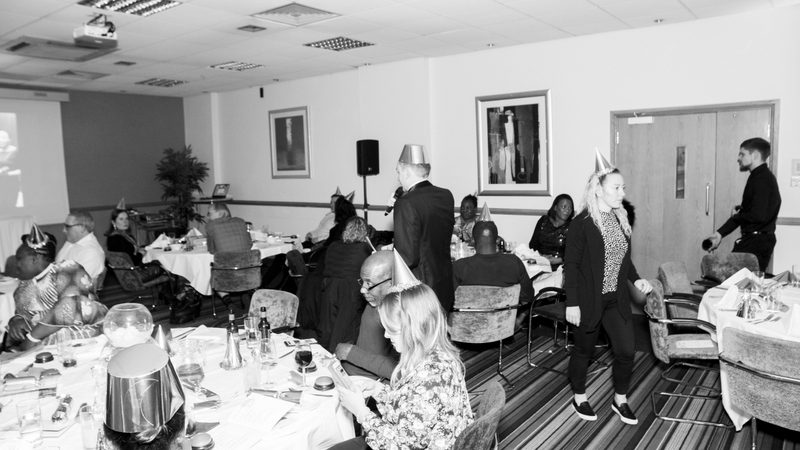
The prize question
Give a trophy, not cash. A cheap engraved cup that lives on a desk all year beats a voucher forgotten by February.
Two HMRC points before you order. The annual function exemption covers a Christmas party at up to £150 per head, the figure as at October 2026, including VAT, transport and accommodation, as long as the event is annual and open to staff generally. The trivial benefits exemption needs four conditions met, one being that the benefit is not given in recognition of particular services performed. An award is exactly that, so do not assume a £40 hamper slips through.
What about the person who hates being singled out?
Give them a way to collect without a stage, and ask first. In a January 2025 YouGov poll for Acas, 19% of employees said they dislike any social activity with colleagues, and Acas’s advice was to ask rather than assume.
Offer three options during the quiet word:
- Up to the front, as normal.
- Named and applauded, with the trophy carried over to their table.
- Named in the programme only, and handed the trophy quietly afterwards.
Some of this is inclusion rather than preference. Acas notes that neurodivergence will often amount to a disability under the Equality Act 2010, which brings a right to reasonable adjustments. A spotlight and sudden applause is a real problem for some people, and option two costs nothing.
One host, the whole evening
Christmas party awards go wrong in the delivery far more often than in the planning. The list is usually fine. What breaks is a senior colleague reading someone else’s jokes off a phone, two glasses in, with no idea how to rescue a flat line.
That is the job an award ceremony host does: checks the list, writes the citations with you, keeps the block to fifteen minutes and holds the room when something lands oddly. One host, the whole evening.
Call me on 07596 851647 and tell me what happened at the last one.